MDOT MTA
MDOT MTA on July 2 released its CNI and Prioritization Report (download below), which examines the investments needed in the transit agency over the next 10 years “to reach and maintain a state of good repair for existing service, complete priority enhancements to the customer experience and fulfill contractual obligations.”
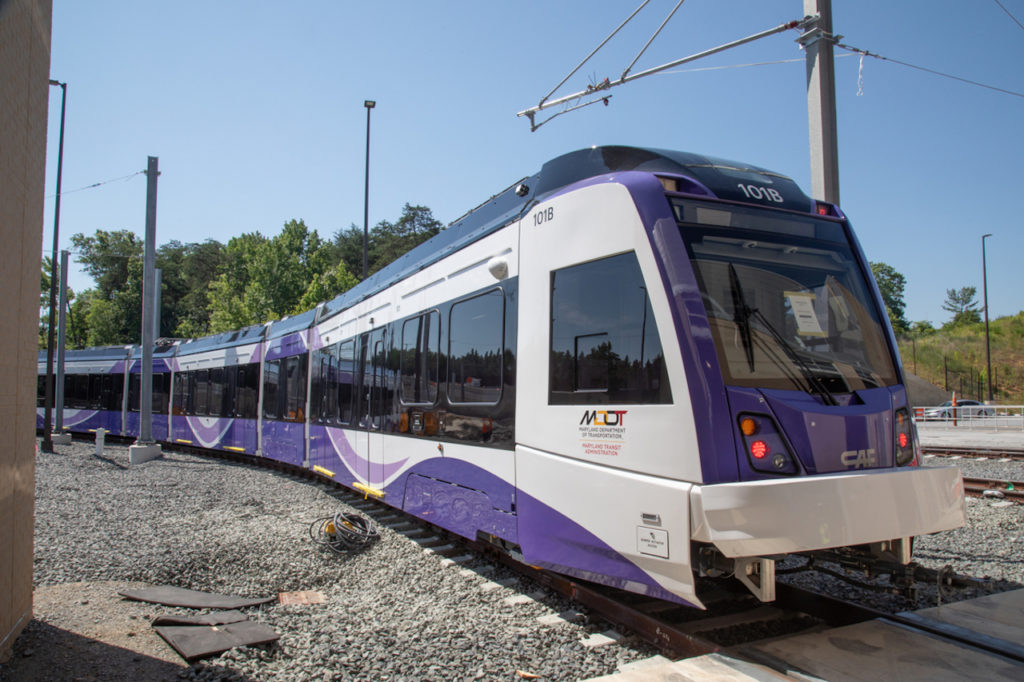
These investments will support major construction projects such as the Frederick Douglass Tunnel, the Purple Line, major MARC projects, and achieving a state of good repair across bus and rail. Due to ongoing efforts, the amount of MTA assets outside of a state of good repair is already projected to drop in the next year, and continued funding at CNI-recommended levels could nearly eliminate MTA’s state of good repair needs backlog over the next ten years, according to the agency.
“These state of good repair investments are critical to preserving the core functions of the transit system and supporting its future growth,” said Maryland Transit Administrator Holly Arnold. “Thanks to additional funding in Governor Moore’s budget, MTA will continue to prioritize safety-critical investments that improve reliability for our riders.”
As a result of the Moore-Miller Administration’s investment in transit, the six-year Consolidated Transportation Program (CTP) for Fiscal Years 2025 – 2030 provides funding to advance MTA’s key priorities, as well as for more than 90% of MTA’s state of good repair needs. It also includes a more than $1 billion investment in the Light Rail Modernization Program to replace Baltimore’s light rail vehicle fleet with modern, low-floor cars, as well as making the necessary station, power and maintenance facility upgrades for the new vehicles. Successful completion of the Light Rail Modernization Program will double the frequency of light rail service as compared to today, the agency noted.
The MTA operates and maintains $14 billion in assets to provide transportation services throughout Maryland. If not addressed, the agency says, a backlog of state of good repair preservation efforts can impact transit performance, affecting reliability and service quality, although it does not indicate assets that are unsafe to operate. The agency’s transit asset management program monitors the condition of its assets and applies lifecycle management strategies to support full performance.
According to the MTA, total needs have increased “due to supply chain inflation, Purple Line entering revenue service, the agency’s commitment to supporting Amtrak major Northeast Corridor projects, the cost of light rail vehicle replacements and aging rail systems.” Transit agencies across the country are facing similar challenges, with aging infrastructure, rising supply chain costs and limited funding streams—all contributing to a growing backlog of state of good repair needs. The MTA says it will continue to pursue discretionary funding to further close the funding gap and address additional enhancement and expansion needs.
Recent agency projects have included the delivery of new Metro Subway railcars and train control system, bus replacements, rehabilitation of Light Rail track, and interlockings and the completion of a heavy maintenance building for MARC Train locomotives at the Riverside Yard. In addition, items planned for funding in the CTP between 2025 and 2030 include:
- Light Rail Systems Traction Power Substations.
- Light Rail and Metro Track Maintenance.
- Metro Elevator and Escalator Rehabilitation.
- Metro Interlocking Improvements.
- Metro Facility Power Upgrades.
- MARC Safety Control Systems.
- MARC Vehicle Overhauls.
- Bus Replacements.
- Mobility Vehicle Replacements.
LA Metro
The LA Metro Board has approved a collective bargaining agreement with the Teamsters to represent Transit Ambassador personnel, effective July 1. The Board also approved 85 additional Ambassador program positions to manage the program in house and expand Ambassadors coverage on more bus lines and new stations that will be opening before the end of the calendar year.
With these actions, LA Metro says it can begin the process of building an in-house LA Metro Ambassador department, which the LA Metro Board approved in October 2023. The agency will begin the process of hiring those Ambassadors who are currently deployed on the system through two contractors.
A 2023 survey of LA Metro customers found that the visible presence of LA Metro Ambassadors contributes to the perceptions of safety. Sixty-three percent of survey respondents who reported having seen Ambassadors stated that seeing made them feel safer. That number increases to 66% among women and among people earning less than $25K a year, 68% among people Hispanic/Latinos and people under the age of 18 and 70% among Asian/Pacific Islanders.
As part of the Board’s approval, LA Metro’s FY26 Budget was amended to include $11.8 million for the implementation of the new wages and benefits for the approval of the final collective bargaining agreement. This collective bargaining agreement will result in the addition of 388 contract positions (Teamsters) comprised of 309 Transit Ambassador program staff who are currently in the field, and 79 new Transit Ambassadors to continue and expand the visible presence and in-person support across the Metro bus system, as well as the new Metro/LAX Transit Center, A Line extension to Pomona and D Line extension to West L.A.. In addition, LA Metro will add 49 positions for Supervisors to oversee Ambassador staff in the field and two non-contract positions to oversee expanded day-to-day operations, staff training, reporting and customer experience improvements related to the Ambassador program.
“Metro Ambassadors have been an incredible addition to our system, helping us make it friendlier and safer, while keeping a watchful eye out for issues that need to be addressed,” said LA Metro CEO Stephanie Wiggins. “They’re a key part of our customer experience and safety strategies, as we work to deliver the type of world-class transit service necessary for us to become the first choice for transportation among LA County residents and visitors.”
WMATA
WMATA on July 2 announced a new progress report highlighting three years of success for the agency’s joint development real estate program. The program has delivered eight projects in three years totaling 1,490 residential units (813 affordable), and one million square feet of office space, resulting in $15 million new annual tax revenue for local jurisdictions, according to the new progress report on WMATA’s 10-Year Strategic Plan.
WMATA’s joint development program collaborates with developers to build housing, offices, and other amenities on the agency’s property. It is a form of transit-oriented development (TOD) that generates new WMATA ridership and revenue and adds new housing, jobs, and tax revenue to the region.
Five new developments, either under construction or expected to break ground in 2025, will add another 1,270 residential units and 422,000 square feet of office, generating $22 million in new annual tax revenue, according to the agency.

“Metro has completed more joint development projects than any other transit system in the nation, and we’re not slowing down,” said WMATA General Manager and CEO Randy Clarke. “Over the last three years, the Metro team has developed and implemented strategies to accelerate joint development because we know the value that it brings to the region’s economy, residents, and the Metro system.”
WMATA says it is nearly halfway towards achieving its goal of 20 additional joint development agreements by 2032. Since 2022, WMATA’s Board has approved five new joint development agreements, and staff are in negotiations on four additional agreements. To achieve this milestone, the agency says it has “updated transaction templates, streamlined processes, and retained external real estate advisors and counsel, with a goal to complete future negotiations in six to nine months.”

WMATA recently executed an amended Joint Development Agreement for Takoma with EYA for a 434-unit residential building with 17,000 square feet of retail and a 1.8-acre park, and a Joint Development Agreement for Twinbrook with Hines will be executed this month. The Twinbrook joint development includes a 437-unit residential building with 5,000 square feet of retail. Both projects are expected to break ground in 2027.
In 2024, WMATA released four solicitations, much higher than the previous 10 years, the agency noted. From these solicitations, WMATA selected developers for two stations, and a third is expected this fall.
WMATA’s site planning and solicitation process, the agency says, “reduces risk and increases site marketability through right-sizing transit facilities, controlling the cost of replacement assets, and utilizing updated solicitation templates.” WMATA also works with jurisdictional partners to address financial feasibility challenges, with $187 million state, local and federal investment allocated to WMATA sites in the past three years.
WMATA’s 2025 Progress Report (download below) identifies 29 million square feet of remaining development potential across 41 stations, with the potential to generate an additional $300 million in new annual tax revenue. WMATA’s station prioritization groupings, the agency says, help WMATA staff manage internal resources, and local jurisdictions understand and proactively address challenges to development.
Since 1975, WMATA’s 59 projects have created 10,800 residential units, 5.7 million square feet of office development, and 1.3 million square feet of retail development across 32 stations, generating $220 million in annual tax revenue.
To give WMATA’s stakeholders and the public increased visibility into the joint development program, the agency is launching a new Joint Development Tracker that shows all completed projects, their fiscal impact, and future development sites.