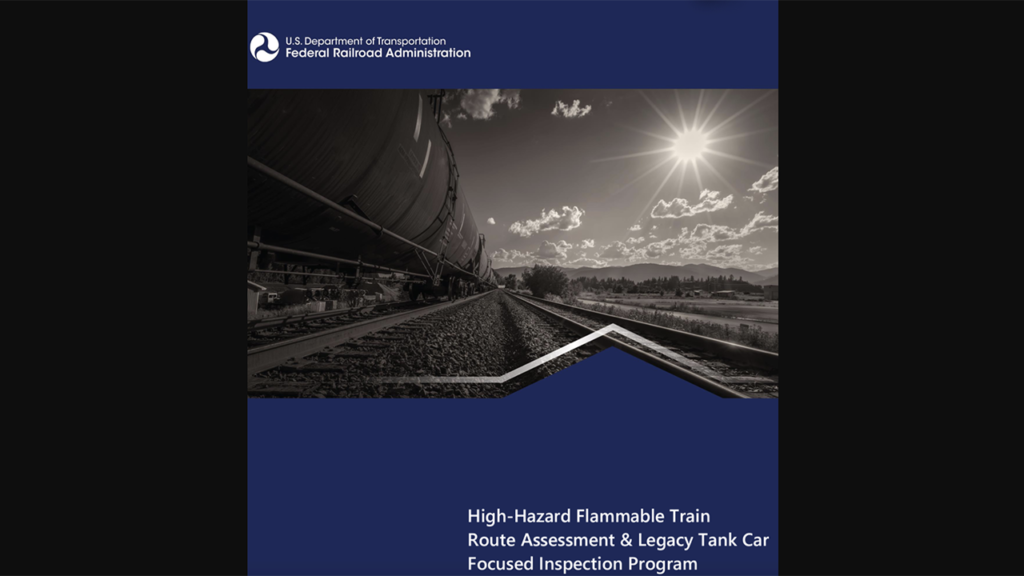
In response to directives from U.S. Department of Transportation Secretary Pete Buttigieg, the Federal Railroad Administration (FRA) has produced and recently released online a summary report of its High-Hazard Flammable Train Route (HHFT) Assessment and Legacy Tank Car Focused Inspection Program (scroll down to download).
Following the Feb. 3, 2023, Norfolk Southern train derailment in East Palestine, Ohio, Buttigieg committed the Department to two directives, according to the FRA report:
- “[C]onducting a focused inspection program on routes over which HHFTs and other trains carrying large volumes of hazardous material travel.”
- “[I]nitiating a focused inspection program of legacy DOT-111 tank cars and the shippers and car owners that have not upgraded to the more robust, DOT-117 specification tank cars.”
FRA conducted these reviews between March 1, 2023, and Aug. 31, 2023.
As part of the first directive, FRA said in the report that its assessment “covered a broad range of rail infrastructure and operations, including hazardous materials transportation, motive power and equipment, track, signal and train control, and operating practices.” FRA said it also reviewed industry practices, processes, and procedures related to wayside detector technology, which FRA currently does not regulate.
Although the agency said it “identified some conditions not in compliance with federal regulations … generally, FRA found that the railroads’ infrastructure, equipment, and processes were in compliance with applicable federal regulations.” FRA’s assessment did “point to areas where improvements are needed in railroads’ practices, processes, and procedures related to the use of wayside detector technology to ensure effective use of that technology.” For example, the report said that “inconsistencies identified in railroads’ processes and procedures for handling wayside detector data and alerts would benefit from the development of shared best practices related to the inspection and maintenance policies and procedures related to wayside detectors.” Similarly, it noted that “the current lack of detector data information sharing among railroads is preventing individual railroads from identifying trends in equipment condition as equipment is interchanged between railroads.” According to the report, this lack of information sharing “may lead to defective equipment continuing in transportation until catastrophic failure.” FRA’s assessment also “highlighted the need for railroads to ensure sufficient resources and infrastructure are in place to effectively process and communicate detector data and alerts to all those involved in the movement of trains (including operating employees as well as dispatch center employees),” the report noted. “This assessment confirms many of the concerns FRA has previously expressed related to industry’s use of wayside detector technologies. FRA recognizes the value of wayside detections systems if they are appropriately installed, maintained, and used and if appropriately trained resources and data communication infrastructure are in place to effectively manage and respond to the data the systems produce.”
Regarding the second directive, FRA said that its “focused inspection of tank car phase out (Legacy Tank Car Focused Inspection Program) reviewed the largest tank car owners (those that collectively own and control almost 85% of the North American tank car fleet), finding they are on target to meet the May 2029 FAST Act-mandated DOT-111 phase out requirements, and that economic and practical challenges remain that prevent the full-scale, immediate phase out of the cars.”
Next Steps
FRA will use the results of its assessment “to further inform the ongoing Railroad Safety Advisory Committee (RSAC) task related to wayside detectors (RSAC Task No. 2023-01),” according to the report. The RSAC working group charged with this task “will consider not only current railroad processes and procedures, but also current industry standards and historical safety data.” The report said that this “ongoing RSAC task is intended to lead to the development of best practices in the use of wayside detectors that may include recommendations to update existing regulations and guidance, and/or develop new regulations and guidance regarding wayside detector equipment and operations.”
The report concluded that FRA “expects the RSAC task to comprehensively address the installation, maintenance, and calibration of wayside detector technologies, the methods and practices to respond to a wayside detector alert or trend data, and the necessary processes and procedures associated with sharing real time alert or trend data across the railroad network.” It added that “PHMSA will use the results of this assessment to further inform the ongoing rulemaking efforts to implement regulatory requirements and operational controls on a larger set of newly designated High Hazard Trains.”