Approximately three weeks after its June 25 public meeting in East Palestine, Ohio, site of the Feb. 3, 2023 derailment of a Norfolk Southern freight train that resulted in a hazmat release and fires, the National Transportation Safety Board (NTSB) on July 16, 2024 published its final report, Railroad Investigation Report RIR-24-05, Norfolk Southern Railway Derailment and Hazardous Materials Release (download below).
The report, which closely follows NTSB’s synopsis of the investigation, Norfolk Southern Railway Train Derailment with Subsequent Hazardous Material Release and Fires, released June 25 at the meeting, contains 34 new recommendations, reiteration of 1 previously issued recommendation, and 4 “classified” previously issued recommendations.
WHAT HAPPENED
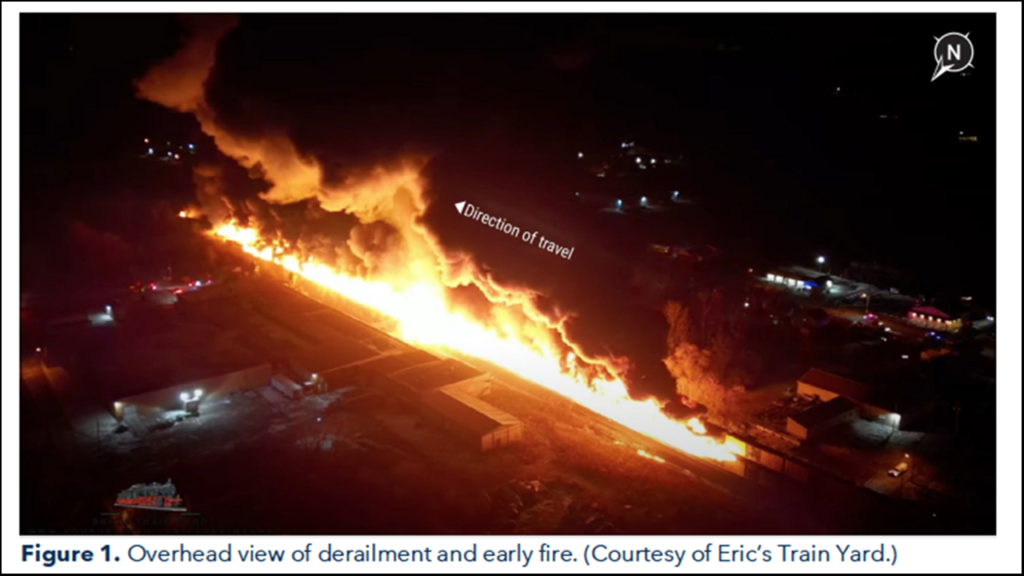
“On February 3, 2023, about 8:54 p.m., eastbound Norfolk Southern Railway (NS) train 32N derailed 38 mixed freight railcars at milepost 49.5 on the NS Fort Wayne Line of the Keystone Division in East Palestine, Ohio,” NTSB said in the report’s Executive Summary. “Three tank cars carrying flammable and combustible hazardous materials were mechanically breached during the derailment. A fire ignited during the derailment and grew to involve lading released from these three mechanically breached tank cars, additional derailed tank cars carrying both hazardous and non-hazardous materials, and freight cars. Emergency responders established a 1-mile evacuation zone that affected about 2,000 residents. The derailed equipment included five hazardous materials tank cars carrying vinyl chloride monomer (VCM), a compressed liquified flammable gas offered for shipment as ‘UN1086 vinyl chloride, stabilized, 2.1.’ The five VCM tank cars were not mechanically breached during the derailment, but over the next day, four of these tank cars were exposed to fires and released material from pressure relief devices. These releases ceased on the afternoon of Feb. 4. Acting on information provided by NS and its contractors that a dangerous chemical reaction was occurring within a VCM tank car, the incident commander managing the response chose to expand the evacuation zone and perform a vent and burn (a deliberate breach of a tank car) on all five derailed VCM tank cars. The incident commander was not aware of dissenting opinions the VCM shipper had provided to NS and its contractors. A contractor hired by NS breached the VCM tank cars at 4:37 p.m. on Feb. 6, releasing and igniting their lading. No injuries were reported during the derailment or emergency response.”
PROBABLE CAUSE
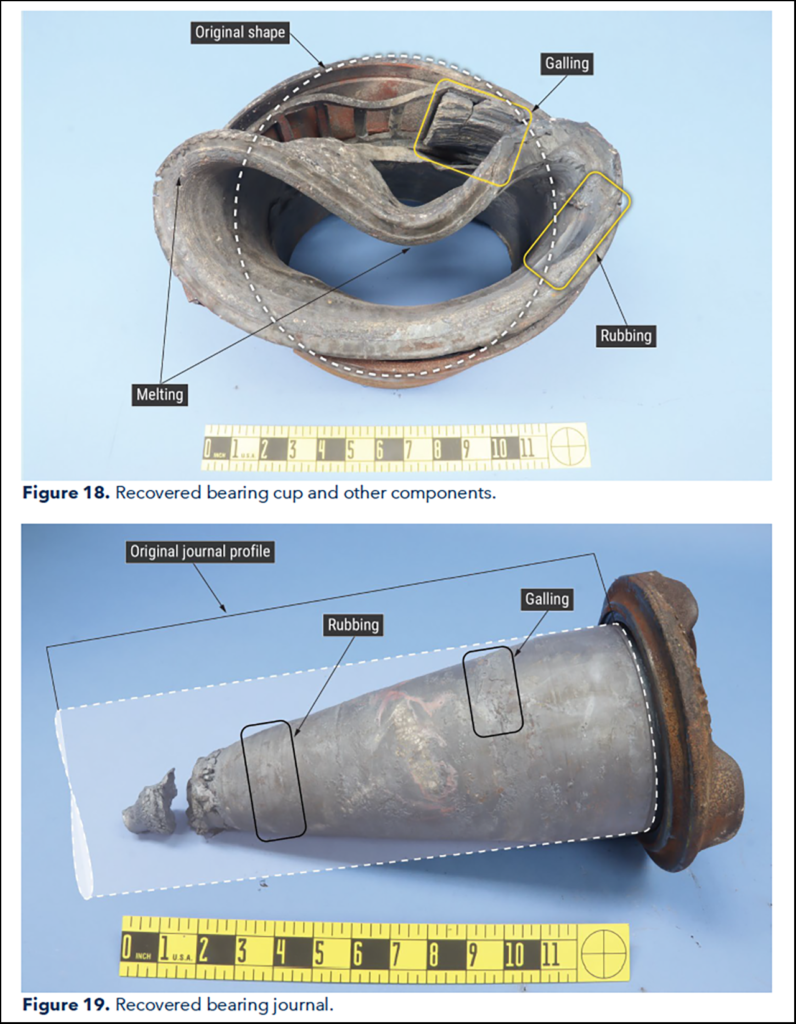
“The NTSB determines that the probable cause of the derailment involving Norfolk Southern Railway train 32N was the failure of the L1 bearing on the 23rd railcar in the consist that overheated and caused the axle to separate, derailing the train and leading to a post-derailment fire that likely began with the release of a Class 3 flammable liquid from a DOT-111 tank car that was punctured during the derailment,” NTSB said in the Executive Summary. “Contributing to the post-derailment fire and the severity of the hazardous materials release was the continued use of DOT-111 tank cars in hazardous materials service. Also contributing to the severity of the hazardous materials release were (1) the failure of NS and its contractors to communicate relevant expertise and dissenting opinions to the incident commander and (2) the inaccurate representation by NS and its contractors that the tank cars were at risk of catastrophic failure from a polymerization reaction, which created unwarranted urgency and led to the unnecessary decision to vent and burn five derailed vinyl chloride monomer tank cars to prevent a polymerization-induced tank car rupture. Contributing to the exposure of emergency responders and the public to post-derailment hazards were (1) NS’s delay in transmitting the train consist information to emergency responders and (2) the state of Ohio’s insufficient training requirements for volunteer firefighters.”
RECOMMENDATION HIGHLIGHTS
“We asked the Federal Railroad Administration (FRA) to conduct research on bearing defect detection systems,” NTSB said in the Executive Summary, “and recommended that the FRA use the results to establish regulations on related subjects:
- “Railroads’ use of bearing defect detection systems, including thresholds for alerts and alarms and distances between wayside detectors.
- “Railroads’ operational responses to bearing alerts and alarms.
- “Installation, inspection, and maintenance of wayside bearing defect detection systems.
“We recommended that the Association of American Railroads develop a database of bearing failure and replacement data to help railroads, regulators, and investigators identify and address bearing failure risk factors.
“We issued a recommendation to the state of Ohio to amend its statute limiting volunteer firefighter training and bring its training requirements in line with a widely accepted standard. To expand the reach of lessons learned at East Palestine, we recommended that the International Association of Fire Chiefs, the International Association of Fire Fighters, and National Volunteer Fire Council inform their members of the derailment and fire and encourage them to adopt training that meets a widely accepted standard. We also recommended that the National Volunteer Fire Council identify barriers to volunteer firefighter training and actions to address them.
“To improve local preparedness, we recommended that the Columbiana County Emergency Management Agency develop a policy to immediately provide train consists to emergency responders and update its emergency plans to incorporate lessons learned from the East Palestine derailment.
“We classified Closed—Acceptable Action a recommendation to the Pipeline and Hazardous Materials Administration (PHMSA) that it require railroads to immediately provide emergency responders with train consist information (R-07-4, Open—Unacceptable Response). We also recommended that NS review and revise its practices to ensure immediate communication of the consist to first responders. We made a new recommendation that PHMSA require that placards used to identify hazardous materials be able to survive accidents and fires.
“We issued additional new recommendations to PHMSA expanding and accelerating the current phase out of DOT-111 tank cars from hazardous materials service and expanding the definition of high-hazard flammable trains to include a wider variety of hazardous materials and account for variations in how well different tank car specifications survive derailments. We made a related recommendation to the AAR to account for the risk posed by certain tank cars in its definition of key train. We also recommended that the Association of American Railroads take steps to require manufacturers of tank car service equipment to demonstrate that their products are compatible with a tank car’s intended lading and that the FRA monitor AAR progress to ensure they address weaknesses in their approval process.
“Regarding the vent and burn decision, we recommended that The Chlorine Institute review and revise its pamphlet on VCM to ensure that it is accurate and suited to supporting emergency responses, and that it change its Chlorine Emergency Plan program to make sure specialized emergency response contractors can appropriately respond to chemical hazards during a VCM incident; that Oxy Vinyls update its safety data sheet for VCM to ensure that it is accurate and develop a policy to ensure that its expertise is communicated to the full incident command; that the American Chemistry Council and The Chlorine Institute make their members aware of the events at East Palestine and emphasize the importance of shippers communicating their expertise to the full incident command; that NS establish a policy of communicating all expert opinions to the full incident command, share information collected by its emergency response contractors with entities that provide hazardous materials guidance, and update its submissions the PHMSA incident database; that the FRA disseminate current and updated versions of its existing study on the vent and burn method to help guide incident commands in the future; and that PHMSA spread awareness of the FRA’s most current guidance by referencing it in the next edition of the Emergency Response Guidebook. We made an additional recommendation to the International Association of Fire Chiefs, the International Association of Fire Fighters, and National Volunteer Fire Council to encourage the distribution of federal guidance about the vent and burn method.
“We also classified Closed—Superseded recommendations to the Secretary of Transportation and the FRA regarding the installation and use of inward- and outward-facing audio and image recorders on locomotives (R-10-1, and R-10-2 to the FRA were Open—Unacceptable Response; R-19-7 to the Secretary of Transportation was Open—Await Response). We recommended that the FRA and Secretary of Transportation take the actions described in the closed recommendations, obtaining legislative authority to act if necessary.
“We reiterated one recommendation to the Class I railroads regarding installation and use of audio and image recorders (R-13-26, Open—Acceptable Response).”
Classified Previously Issued Recommendations
NTSB classified the following safety recommendations:
- “To the Secretary of Transportation: Require the Federal Railroad Administration to issue regulations for inward-facing recorders that include image and audio recordings as recommended by the National Transportation Safety Board in R-10-1 and R-10-2. (R-19-7). Safety Recommendation R-19-7 is classified Closed—Superseded in section 2.6 of this report.
- “To the Federal Railroad Administration: Require the installation, in all controlling locomotive cabs and cab car operating compartments, of crash- and fire-protected inward- and outward-facing audio and image recorders capable of providing recordings to verify that train crew actions are in accordance with rules and procedures that are essential to safety as well as train conditions. The devices should have a minimum 12-hour continuous recording capability with recordings that are easily accessible for review, with appropriate limitations on public release, for the investigation of accidents or for use by management in carrying out efficiency testing and systemwide performance monitoring programs. (R-10-1). Safety Recommendation R-10-1 is classified Closed—Superseded in section 2.6 of this report.
- “To the FRA: Require that railroads regularly review and use in-cab audio and image recordings (with appropriate limitations on public release), in conjunction with other performance data, to verify that train crew actions are in accordance with rules and procedures that are essential to safety. (R-10-2). Safety Recommendation R-10-2 is classified Closed—Superseded in section 2.6 of this report.
- “To the Pipeline and Hazardous Materials Safety Administration: With the assistance of the Federal Railroad Administration, require that railroads immediately provide to emergency responders accurate, real-time information regarding the identity and location of all hazardous materials on a train. (R-07-4). Safety Recommendation R-07-4 is classified Closed—Acceptable Action in section 2.3.2 of this report.
“A DIFFICULT LINE TO DRAW”
NTSB Member J. Todd Inman filed a concurring statement. It includes his “Commentary on the Purpose of NTSB Investigations”:
“While the original purpose of reserving the opportunity to submit a Board Member Statement was to further highlight the importance of the recommendations of the report, I would be remiss if the opportunity was not also taken to remind the agency and future parties as a whole that we are entrusted by the public to investigate accidents, determine a probable cause, and issue recommendations that will improve transportation for the general public. As our regulations state, ‘NTSB investigations are fact-finding proceedings with no adverse parties… and are not conducted for the purpose of determining the rights, liabilities, or blame of any person or entity, as they are not adjudicatory proceedings.’ It is a difficult line to draw, but one that we need to be careful of never blurring as we deal with entities and individuals that may not elevate safety improvement in the manner we do, that hinder or hamper the work of our investigators, and that do not abide by the expectations of the NTSB.
“My fear is that some of the comments made in connection to the Board Meeting and underlying investigation were not in response to information documented in our report or the accident itself and may have overshadowed the important content of the report, the work of the NTSB’s investigators, and the attention our recommendations deserve. While some discussion may have been warranted regarding alleged breaches of the party agreement and the impact it may have had on our staff and the investigation, the party system has proven to be effective over the 57-year history of the NTSB. The party system must be preserved to ensure we continue to receive the engagement necessary from industry and regulators that allows us to effectuate change in the transportation system. It is our responsibility to protect the party system to keep the public safe and it is the responsibility of the parties to embrace it. This requires respect and good faith by all participants and avoiding the placement of blame by parties or the NTSB at any point.”