
MBTA
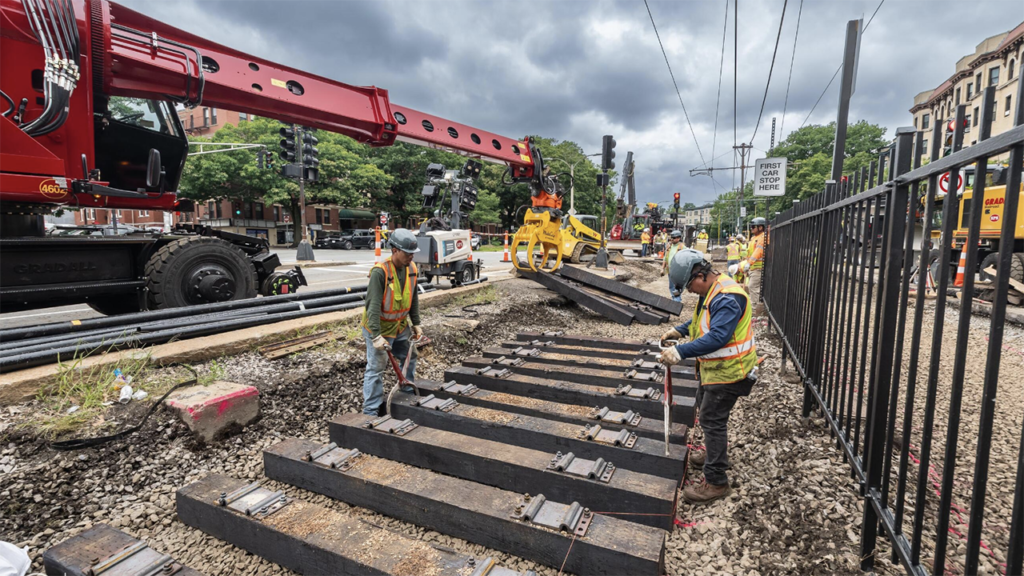
MBTA on Aug. 2-11 completed track work on the Green Line B Branch while service was suspended between Boston College and Babcock Street. As a result, the agency said it has lifted eight speed restrictions, and the entirety of the B Branch is now restriction-free.
Part of MBTA’s Track Improvement Program, work included:
- Replacing more than 4,200 feet of restraining rail.
- Resurfacing and tamping more than 5,400 feet of track.
- Accomplishing greater than 4,100 feet of full depth track reconstruction, including the replacement of rail, ties, and ballast.
- Replacing 250 restraining rail bolts.
- Performing more than 40 thermite welds.
- Replacing 60 plates, 50 ties, and running rail within the Boston College yard.
- Installing nearly 800 tons of pavement at the Griggs Street pedestrian crossing and platforms; the Allston Street intersection, curb ramps, and platforms; and the Warren Street grade crossing, curb ramps, and platforms.
- Installing two cast-in-place concrete duct banks to support the MBTA Integrated Transit Programs Duct Bank project.
- Reconstructing the curb ramps at Sutherland Road and Chiswick Road to improve accessibility, including relocating critical drainage areas.
- Replacing more than 13,000 feet of Green Line B Branch catenary throughout the service suspension area.
- Replacing four sets of power crossarms that support the Green Line’s catenary.
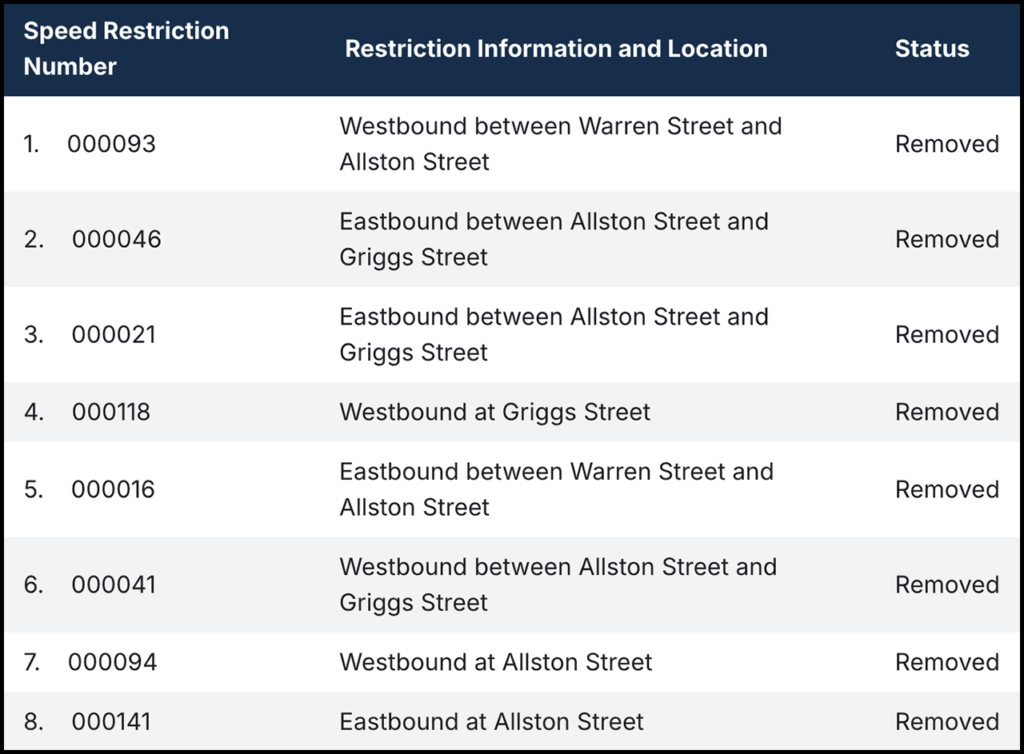
With the work complete, the following safety-related speed restrictions are no longer in place:
According to MBTA, the following work also took place along the Green Line:
- Security enhancements within the Boston College yard.
- Tree trimming and vegetation removal.
- Power washing stations and cleaning platform areas throughout the service suspension area.
- Pressure washing buildings within the Boston College yard.
- Fencing improvements.
- Inspections.
- Painting.
- Signage replacement.
- Platform repairs.
“The critical infrastructure work our contractors and MBTA crews accomplished, including intersection enhancements and accessibility upgrades, allows us to make meaningful travel improvements for Green Line riders and countless members of the public who traverse Comm. Ave. in these areas,” MBTA General Manager and CEO Phillip Eng said during the Aug. 13 track work announcement. “Giving riders a quicker, smoother trip is a result of careful and thoughtful planning and coordination by many MBTA teams and contractor crews. I thank them for their dedicated work and the City of Boston whose support was instrumental as we managed local vehicular traffic adjacent and through the work zone. I’m proud that, as a result of this work, the B Branch is now completely restriction-free as we reverse years of underinvestment and deliver the safe, reliable, and more frequent trip that our riders deserve.”
In July, MBTA completed Red Line track work, removing nine speed restrictions.
In other MBTA news, the search is on for a partner to redevelop the Alewife Station complex, which includes a Red Line station, a 2,733-space parking garage, and additional MBTA Commuter Rail facilities; and dispatching responsibilities for the transit agency’s South Coast Rail territory will now be performed by Keolis Commuter Services.
PATH
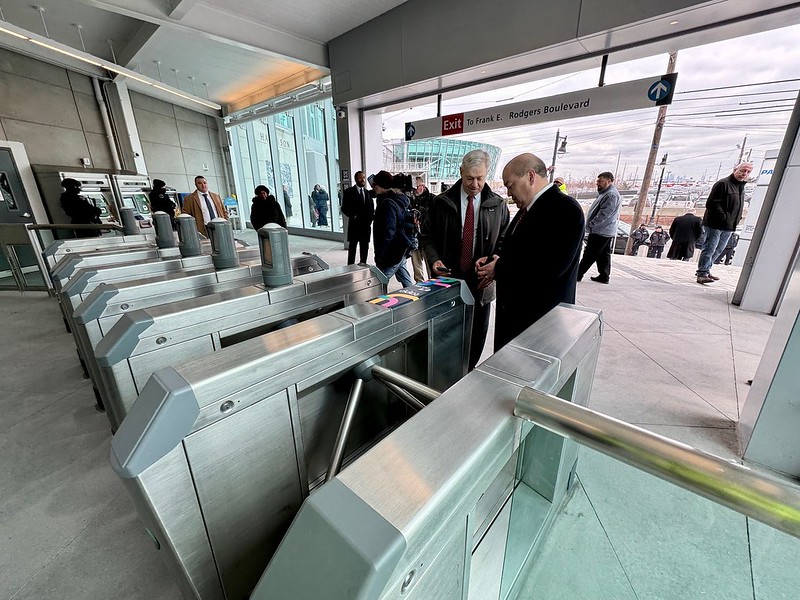
The PANY/NJ on Aug. 13 reported that PATH’s new TAPP fare payment system has been used more than 10 million times since its launch as a pilot program in December 2023.
The latest usage milestone comes as TAPP adoption rates have risen to more than half of all fare entries into the PATH rapid transit system since the first readers were installed at the end of 2023, according to the Port Authority. TAPP has been available at all New York and New Jersey PATH stations since May 2024.
TAPP, short for Total Access PATH Payment, allows riders to pay fares at select turnstiles with the tap of a contactless debit/credit card, smartphone, or wearable device, instead of using the PATH-issued SmartLink cards or pay-per-ride MetroCards that have been in use since 2008.
During the month of July, riders entering the Christopher Street Station in New York “were the most eager TAPPers,” according to the Port Authority, with 59% of riders there using TAPP to pay, and 57% of riders entering the 33 Street Terminal Station choosing to use the new fare payment system.
“PATH’s December 2023 launch of TAPP began a transformation of the fare system that will lead eventually to the full replacement of PATH’s legacy SmartLink and MetroCard options,” the Port Authority said. “During this transition period, fare equipment supporting SmartLink and MetroCard cards will remain operational as more customers become familiar with the new payment option. Current PATH discounts for SmartLink users remain in effect and will be available when PATH issues a TAPP fare card.”
“Ten million served is a big achievement for PATH and reflects how quickly and readily our riders have responded to TAPP,” said Clarelle DeGraffe, PATH General Manager and Director and a 2020 honoree of Railway Age’s Women in Rail awards program. “We continue to look for meaningful ways to enhance the customer experience, whether it’s a new fare payment system, building more modern facilities, or improving our infrastructure.”
Separately, May 2024 marked the first month that PATH surpassed 5 million riders since the onset of the pandemic.
TriMet
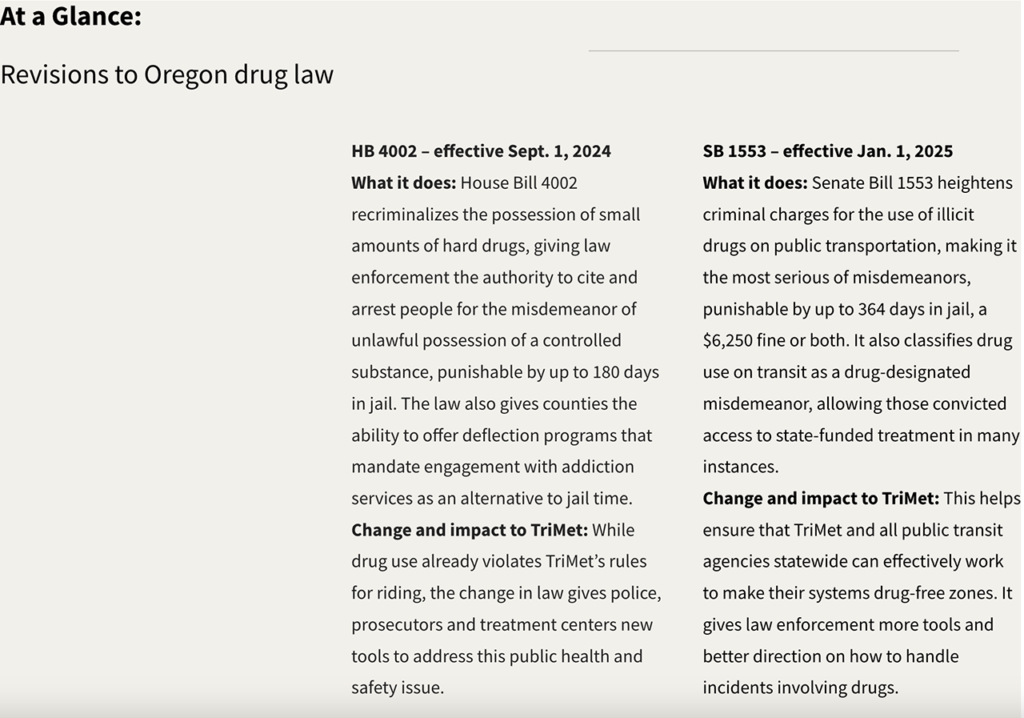
“As TriMet continues our efforts to provide safe, welcoming and reliable transit service, we look forward to the Sept. 1 revision to Oregon law making possession of small amounts of illicit drugs like fentanyl and methamphetamine a crime again,” the transit agency reported Aug. 13. This change, TriMet said, will make possession and use of hard drugs in public—including on TriMet trains and buses, as well as at its stations, stops, and transit centers—a misdemeanor offense.
“Despite our continued focus on safety and security efforts, rampant open drug use in the communities TriMet serves extends onto our transit system at times,” the agency reported. “That creates an unpredictable and potentially dangerous situation for TriMet riders and employees. We believe public spaces and public services should feel safe and comfortable for everyone to use, without worry of being exposed to illegal drug use. TriMet is a lifeline for many who rely on transit to get work, school and other opportunities due to age, disability or income. They deserve to ride with dignity.”
While TriMet’s Code of Conduct already prohibits drug use, starting in September, law enforcement, including officers assigned to TriMet’s Transit Police Division, can cite individuals for drug possession, punishable by up to 180 days in jail. The new law also gives counties the ability to offer “deflection programs that mandate engagement with addiction services as an alternative to jail time,” according to TriMet.
This is the first of two new drug laws to take effect. The second—starting Jan. 1, 2025—”explicitly focuses on public transportation,” TriMet reported. “It will classify the use of drugs on public transit buses and trains in Oregon as a Class A misdemeanor, the most serious of misdemeanors, punishable by up to 364 days in jail.”
Public drug use has increased significantly in Oregon since 2020, according to TriMet. In 2021, the Centers for Disease Control and Prevention found that overdose deaths increased by 43% statewide, and “they’ve kept rising in the following years,” TriMet reported. “No other state saw a higher rate of overdose deaths than Oregon did in 2023. Both of the new Oregon laws will open up new avenues for those facing addiction to get help.”
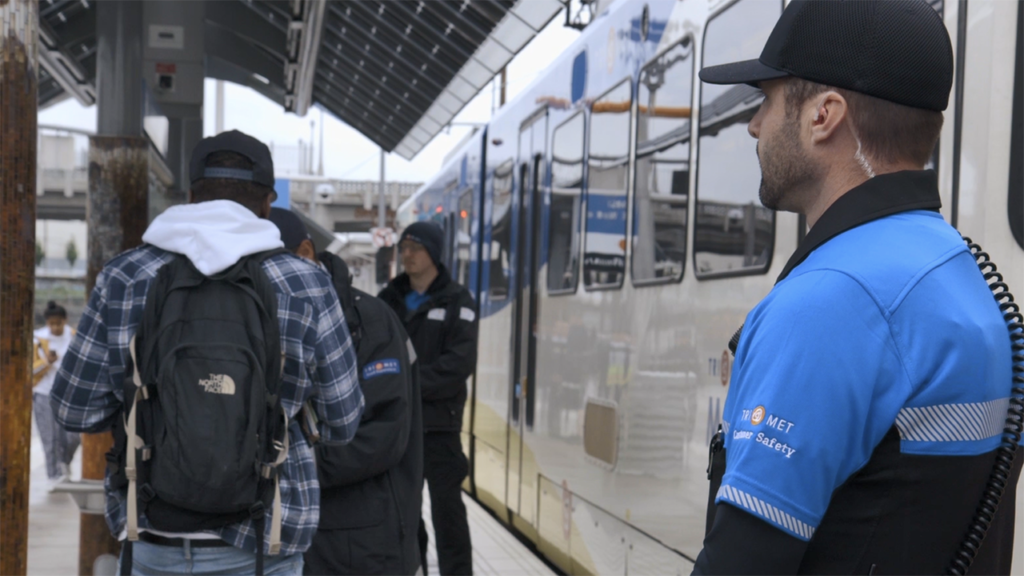
The new laws, TriMet noted, are “important steps in our ongoing work to make transit safer.” Since the start of 2022, the agency said it has more than doubled the number of safety, security, and customer service staff on the transit system and taken other steps to address TriMet code violations and inappropriate behavior on board.
Earlier this summer, safety and security staff began increasing enforcement of TriMet’s Code of Conduct —the agency’s rules for riding—to improve cleanliness and accessibility on board while addressing inappropriate activity. “These rules focus on behavior that is prohibited on TriMet and cover everything from paying fare to not bringing items on board that leak and block aisles and prohibit smoking of any kind,” the agency said. “As part of this focus, riders will see Customer Safety Supervisors checking fares and, along with our Customer Safety Officers and Transit Security Officers, they’ll let riders know they need to follow the rules.”
In other TriMet news, the agency’s recruitment efforts have driven a record-setting flood of MAX operator applicants.
WMATA
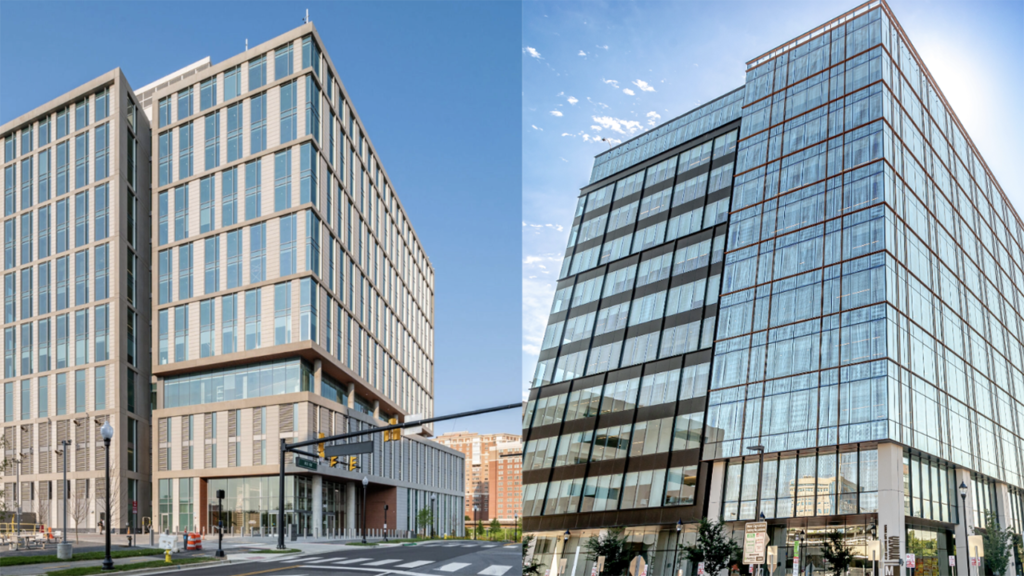
The WMATA Buildings at Eisenhower and New Carrollton have been certified as LEED® (Leadership in Energy and Environmental Design) Gold by the U.S. Green Building Council, the transit agency reported Aug. 13. Both buildings have access to public transportation—through the Eisenhower Avenue and New Carrollton WMATA stations, bus depots, MARC commuter rail, and Amtrak—and onsite secure bicycle storage.
Using guidelines from LEED®, a green building rating system, WMATA said it improves building efficiency, reduces carbon emissions, creates healthier workspaces for employees, and promotes community stewardship. The agency now has 14 green-certified facilities with the addition of Eisenhower and New Carrollton.
Among the key features of the Eisenhower and New Carrollton buildings:
- Energy-saving LED lighting and controls and automatic daylight sensors, which WMATA said maximize energy efficiency and lower costs. The Eisenhower building achieved a 99 out of 100 on the Energy Star scale, it reported.
- “Plenty of access to natural daylight, improving employee productivity, comfort, and well-being,” according to the transit agency. In both buildings, 75% of the occupied floor area has a direct line of sight to the outdoors.
- “State-of-the-art air filtration and fresh air circulation systems, supporting a healthy work environment,” according to WMATA.
- Water bottle filling stations on every floor, providing filtered water for employees and encouraging the use of reusable water bottles to reduce waste.
- The construction waste diversion rate at both buildings exceeded 80%, according to WMATA.
- Incorporating green roofs and open green space helps reduce the heat island effect in the community, WMATA said. New Carrollton has a 4,600 square-foot green roof.
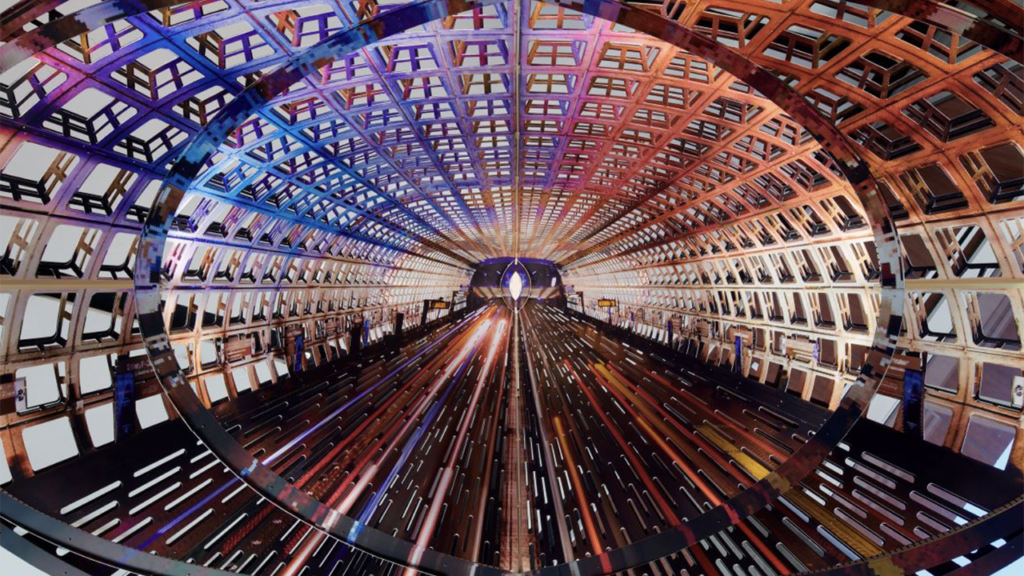
According to WMATA, the building at Eisenhower’s featured public artwork “Tunnel Vision” (see above) by the artist team FreelandBuck (David Freeland and Brennan Buck) has won an internationally acclaimed 2024 CODAaward in the Institutional category. “This award honors projects that successfully integrate commissioned art into interior, architectural, or public spaces,” the transit agency said. “Inspired by Metro’s [WMATA’s] iconic underground stations, this artwork uses LED lights and printed aluminum to create converging lines and light that capture the look of a moving train through the system.”
The building also received the 2024 Best Office Award for Excellence in Office Development from the Urban Land Institute (ULI) Washington, “for making outstanding contributions to development within the region, inspiring vibrant communities, and activated downtowns,” according to WMATA.
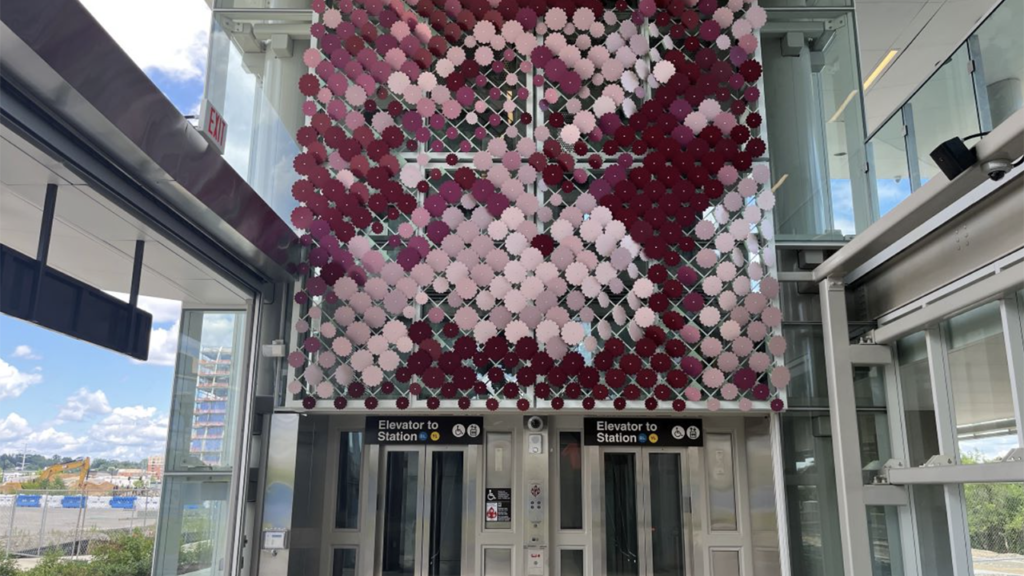
Meanwhile, another LEED-designed project, the Potomac Yard-VT Station (see above), received a 2024 Beautification Architectural Award from the City of Alexandria, Va., “for the station’s exceptional contribution to the City’s beauty through distinguished design and environmentally sustainable practices,” according to WMATA. The station features artworks by artist Rob Ley.
With the Potomac-Yard VT station project, WMATA said it is “on track to become one of the first transit agencies in the U.S. to certify a station project under the LEED® Building Design and Construction: Transit Stations pilot rating system with the artworks fulfilling the biophilic requirement.”
In other WMATA news, the transit agency will respond to 13 findings following a safety audit of its Metrorail Roadway Worker Protection Program.




