LACMTA
Los Angeles is one step closer to a direct rail connection that will make travel faster and easier through the Sepulveda Pass, one of the most congested corridors in the country, LACMTA reported Jan. 22. The transit agency’s Board has selected a fully underground “heavy rail” subway option as the Locally Preferred Alternative (LPA) for the Sepulveda Transit Corridor Project, which will run between the Van Nuys Metrolink Station in the Valley and the Metro E Line’s Expo/Sepulveda Station on the Westside (see map, top). At the Van Nuys end, the project would also connect riders to the Metro G Line and the future East San Fernando Valley Light Rail Project that will operate between Van Nuys, Panorama City, Arleta and Pacoima; on the Westside, riders would have a station on UCLA’s campus and transfers to the D and E lines.
According to LACMTA, the Sepulveda Corridor is “a vital link” for the communities of greater Los Angeles, connecting residents in the San Fernando Valley to the Westside’s employment and educational hubs and cultural landmarks. The natural barrier created by the Santa Monica Mountains, it noted, makes traveling between the San Fernando Valley and the Westside “difficult, unpredictable and slow.” This new project would provide a 20-minute trip from end-to-end; the same trip by car often takes 40 to 80 minutes and is unpredictable because of traffic, the transit agency noted.
The agency last summer released a Draft Environmental Impact Report (DEIR) evaluating five different build alternatives. The Board selected Modified Alternative 5 as the LPA based on technical evaluation and community and stakeholder input. This is a modified version of one of three heavy rail alternatives in the DEIR; also under consideration were two monorail alternatives. (Download project Fact Sheet below.)
Modified Alternative 5 is underground between the Van Nuys Metrolink Station and E Line Expo/Sepulveda Station and modified to connect to the Van Nuys G Line Station and future East San Fernando Valley Light Rail station at the G Line at Van Nuys Boulevard. (Download LACMTA Board report below.) According to LACMTA, it “incorporates key elements of Alternative 5, including automated vehicles in a single-bore tunnel, a terminus at the E Line Expo/Sepulveda Station and 2.5-minute frequencies during peak travel times.” Additionally, it “leverages the strengths of Alternative 5—high ridership, high frequencies, and shorter station construction sites—while avoiding construction of a ventilation shaft in the Santa Monica Mountains.” It also offers “the connectivity benefits of Alternative 6 along Van Nuys Boulevard instead of Sepulveda Boulevard, which reduces the project’s overall length and is anticipated to reduce cost.”
The “monorail alternatives didn’t meet the DEIR goals as well as Modified Alternative 5, particularly with regards to mobility benefits, including ridership and travel times, and cost-effectiveness,” according to LACMTA.
In 2021, LACMTA entered into Pre-Development Agreements with two private-sector teams to design the alternatives: LA SkyRail Express (LASRE) developed Alternatives 1 and 3 (monorail), while Sepulveda Transit Corridor Partners (STCP) designed Alternatives 4 and 5 (heavy rail). Alternative 6 (heavy rail) was prepared by LACMTA’s environmental consultant, HTA Partners.
According to LACMTA, staff recommended phasing construction of the Sepulveda Transit Corridor Project so that segments can be built as funding becomes available. Staff propose focusing first on an Initial Operating Segment between the G Line in Van Nuys and the D Line on the Westside; this would allow riders to make direct transfers from multiple rail and bus lines, which the transit agency said would improve transit travel times.
The preliminary capital cost estimate for Alternative 5 ($24.2 billion in 2023 dollars) will be “updated to reflect Modified Alternative 5 as design refinement progresses,” LACMTA reported. Initial funding for the Sepulveda project, it said, was in the 2008 and 2016 sales tax measures—Measure R and Measure M, respectively—both of which were approved by more than two-thirds of L.A. County voters. (This amounts to approximately $3.5 billion, according to the LA Times.) Additional funding to build the project will be required; LACMTA anticipates pursuing a combination of federal, state, and local funding, along with potential private financing through a public-private partnership (P3).
With the LPA now approved, LACMTA said staff can begin refining the project’s design, including evaluating project phasing strategies; defining an updated maintenance and storage facility approach; identifying value-engineering opportunities; further assessing a P3 delivery approach; and refining design elements to improve connectivity, including the G Line interface in Van Nuys. The environmental review process will continue, along with ongoing community outreach and additional opportunities for public input.
“A direct rail connection through the Sepulveda Pass will connect people to jobs, schools, airports and entertainment faster than ever,” LACMTA Board Chair and Whittier City Councilmember Fernando Dutra said. “This project will cut travel time, reduce air pollution and is the kind of bold, forward-looking investment that moves Los Angeles County into the future.”
“This is a historic moment for transportation in Los Angeles,” LACMTA CEO Stephanie Wiggins said. “The Sepulveda Corridor Project is one of the most ambitious transportation investments in our region’s history and will redefine how millions of people travel across Los Angeles.”
Further Reading:
DART

DART and Trammell Crow Company earlier this month celebrated the groundbreaking of a new 500-space subsurface parking garage for DART riders and a 394-unit apartment community that will be integrated into the existing shopping center and DART’s SMU/Mockingbird Station.
The transit agency on Jan. 22 reported that the apartments and underground garage are the first phase of redevelopment of 16 acres of DART-owned land adjacent to the light rail station at the intersection of Twin Sixties Drive and Worcola Street. Built on the site of a former DART parking lot, the seven-story apartment building will feature a mix of studios and one- and two-bedroom units, as well as a swimming pool, outdoor areas with fire pits and grilling stations, a fitness center, club room, co-working spaces, electric vehicle (EV) chargers, a dog park, and a sky deck overlooking the Downtown Dallas skyline.
“The expanded development around SMU/Mockingbird Station is a true partnership between DART and Trammell Crow, with both parties actively working to reconfigure the site through the Covid-19 pandemic and inconsistent economic conditions to ensure a viable TOD [transit-oriented development] opportunity remained near downtown Dallas,” DART reported. “The transformation of the existing land will afford residents and visitors convenient access to DART’s 93-mile light rail system, multiple bus routes, walkable retail, and Dallas’ extensive urban hike-and-bike trail network. Trammell Crow’s future development plans include an office tower, retail, and hotel, adding to the existing retail, dining and living experience available at the SMU/Mockingbird Station area.”
The buildout of the entire site will be completed in phases, DART said, with the second phase focusing on the office tower and hotel. Construction of the SMU/Mockingbird Station TOD is supported by the City of Dallas TOD Tax Increment Financing (TIF) District and funds programmed by the Regional Transportation Council.
“Developments like these promote the economic and social activity that underpins vibrant and prosperous communities, all centered on a critical regional mobility hub,” DART President and CEO Nadine Lee said.
In December, DART and Integral Group hosted the grand opening of the EVIVA Trinity Mills Station apartments and Esplanade Park, the first phase of redevelopment of a 25-acre site that once housed a big box home improvement store and the former DART Carrollton Transit Center.
TOD within a quarter mile of DART light rail stations has generated $18.1 billion in direct economic impact to North Texas over the past 25 years, according to the University of North Texas (UNT) Economic Research Group, DART reported in November. This includes a $1.0 billion direct impact from 2022 to 2024 based on 37 development projects.
Denver RTD

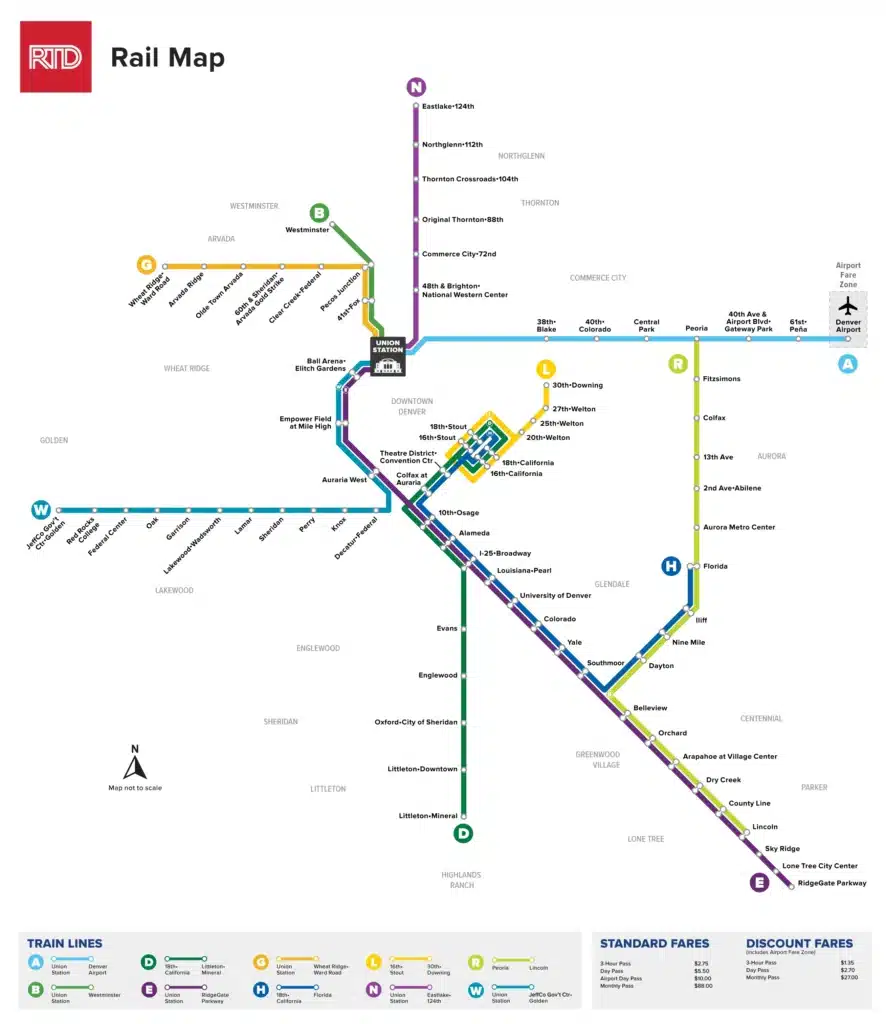
RTD on Jan. 22 reported that Transit Police and contracted security officers conducted nearly 5 million fare checks on its rail system (commuter and light rail) in 2025.
Officers scanned 252,677 mobile passes and checked almost 591,000 total transit passes (mobile, paper, or other) for light rail services. According to RTD, 7.28% of individuals did not pay the fare before boarding. Similarly, officers scanned 1,849,856 mobile passes and checked more than 4.2 million total transit passes (mobile, paper, or other) for commuter rail services; 4% of individuals boarded without paying the fare in advance.
“For rail services systemwide, officers scanned more than 2 million mobile passes and checked more than 4.8 million total transit passes (mobile, paper, or other),” RTD reported. “Of these, officers were able to recover fare from 208,722 customers and issued more than 14,664 warnings and 712 citations systemwide for those who did not pay fare.”
RTD reported that fare checks in August 2025 had increased by more than 500% from May 2024. In 2026, with directed RTD Transit Police Department officer patrols across the system’s rail services, fare checks are expected to increase, according to RTD Chief of Police and Emergency Management Steve Martingano.
“Fare checks are an essential safeguard to ensure public transportation remains fair, sustainable, and accessible for everyone who relies on it,” Martingano said. “An increased presence of police and security not only supports this effort, it also helps reinforce a safe and welcoming transit environment, consistent with RTD’s commitment to its customers.”
According to the transit agency, fare payments became more accessible and convenient in 2025 with the launch of Tap-n-Ride , which allows customers to pay the fare at any validator with a tap of their Visa or Mastercard bank or credit card. (Customers who prefer to pay via cash can now load cash value onto a MyRide card or MyRide account for payments at validators.)
The RTD Transit Police Department has 105 sworn officers as of January 2026. Fare checks are just one part of the department’s four-step security plan. Implemented in 2024, the plan focuses on “improving officer presence supported by 24/7 patrolling, educating customers to treat one another with respect, using enhanced technology, such as real-time video feeds for safety observations, and ramping up fare enforcement to support customers and RTD employees,” according to the transit agency.