
Transit Briefs: Denver RTD, Sound Transit, MBTA, NJ Transit, Brightline, TransLink

Denver RTD
A new study (download below) by Denver RTD has reaffirmed that even a “bare-bones” version of its long-delayed passenger rail line between Denver, Boulder and Longmont would be “expensive to build, would carry relatively few passengers, and likely wouldn’t open until the 2040s,” according to a CPR News report.
According to the report, the study concludes that the $650 million estimated cost—down from the most recent estimate of $1.5 billion for the full buildout—“could be lowered and timelines could be accelerated” through its partnership with the state and the Front Range Passenger Rail District, which are trying to plan and build a rail line between Pueblo and Fort Collins.
The two lines could share track and infrastructure between Denver and Longmont, “lowering costs, and increasing opportunities for more federal funding for both projects,” according to the CPR News report.
According to the report, RTD declined to make its Northwest Rail project leaders available for an interview, citing its board’s planned discussion of the matter Wednesday night. But the new study and a coming plan for Front Range Passenger Rail service will “form the foundation for a potential joint path forward,” the study’s authors wrote.
RTD and Front Range rail officials have been working together for years. Front Range Passenger Rail District spokesperson Nancy Burke said that would continue, as the state legislature recently required in a bill that also compels RTD to “prioritize the unfinished Boulder train.”
Sound Transit
“Runaway construction inflation, more engineering study and the tremendous size of a Duwamish River train bridge have driven the price tag for West Seattle light rail to somewhere between $6.7 billion and $7.1 billion, far beyond what is affordable in Sound Transit’s current financial plan,” according to a report by The Seattle Times.
According to the report, the soaring estimates, which were revealed by Terri Mestas, deputy CEO in charge of megaproject delivery, during an interview on Sept. 17, come after last week’s Environmental Impact Statement (EIS) that predicted $5.1 billion to $5.6 billion, in 2024 dollars, to build the river bridge, a short tunnel atop the West Seattle peninsula, a larger Sodo Station and new train stops at Delridge, Avalon and Alaska Junction. This line and another to Ballard are among a dozen or so rail corridors voters approved in the ST3 tax measure of 2016, across three counties.
Following that public vote, West Seattle estimates previously “mushroomed” from $2.3 billion in 2016 dollars to $4 billion by 2023; an outside reviewer blamed that surprise partly on “lousy coordination between decision-makers and real estate experts, to pinpoint rising land costs.”
According to The Seattle Times report, Mestas said that “while past construction figures were based on the unit costs to build a certain distance of trackways or stations, the new estimates reflect ‘bottom up’ cost calculations that literally go deeper, such as how much concrete or steel it takes to anchor a 150-foot-high train bridge over the river.” Design is about 30% completed, she said.
The figures, The Seattle Times reports, are so “dire” that authors of the EIS repeatedly bring up a “minimum operable segment”—a starter line only from Sodo to Delridge to reduce initial cost by half.
Sound Transit says it isn’t seriously considering such a cutback and that drastic reductions are “premature.” A minimum segment is something the Federal Transit Administration (FTA) has to mention in such studies, CEO Goran Sparrman said, to conceivably approve and fund later, according to The Seattle Times report.
According to the report, the 18-member governing board will be briefed about West Seattle issues in a public session on Sept. 26, but Mestas said, “a specific menu of decisions will be a long way off.” Board members have individually been notified of the new near-$7 billion estimates, a spokesperson said, but such numbers haven’t been shared publicly yet.
Sound Transit’s “strong revenue stream, and FTA’s history of support that’s already been roughly $9 billion over the years,” are two reasons Sparrman says the current funding gap should be solvable, insisting that the problem is “less severe” than in 2000, when high bids and bad soils forced the agency to cancel a tunnel under Portage Bay, leading to years of delays building initial lines.
MBTA
MBTA recently shared South Coast Rail project updates at the Taunton City Hall, following two previous meetings, which took place in June 2024 in Fall River and New Bedford.
The project includes six stations: Middleborough, East Taunton, Freetown, Fall River Depot, Church Street, and New Bedford.

Train Schedule
Initially, 26 trips were expected to be part of revenue service daily for the Fall River and New Bedford lines. The team has since increased total weekday trips between South Station and East Taunton to 32. This includes 15 trips on the Fall River line (increased from 13) and 17 trips on the New Bedford Line (increased from 13). There will be a total of 26 trips between South Station and East Taunton on the weekends. The project team expects 70 minutes between trains on weekdays and 120 minutes between trains on the weekends.
Late night service will be offered to South Coast Rail stations with the last train leaving Boston just before midnight.
In addition to direct service, there will also be shuttles operating between each terminus point and East Taunton Station. This allows for even more frequent service, which is consistent with the All-Day Service model across the rest of the Commuter Rail network.
The MBTA has determined that the fare structure for all South Coast Rail stations will be priced in Zone 8, meaning that passengers will pay a full fare of $12.25 and a reduced fare of $6.
PTC System Testing is Under Way
Automatic Train Control (ATC) testing completed in July 2024 and dispatch responsibilities have been transferred to Keolis. Positive Train Control (PTC) system testing, which is federally mandated and under way for two trains on the South Coast Rail, is expected to run through January 2025.
The trains are testing more than 800 PTC functions, and residents will see increased train movements and crossing signal usage as Keolis begins dispatching trains. To date, more than 400 PTC functions have been tested.
Keolis will operate the rail system and will commence maintenance duties on February 1, 2025.
Construction
Construction and inspections have been completed on all stations with the exception of East Taunton Station—the most complex station in the project because it relies on a center island platform and requires components like elevators, ramps, and stairs for safe and accessible access and egress. Work is concentrated on the elevators at this time. Middleborough, Freetown, Fall River Depot, Church Street, and New Bedford stations rely on side platforms for passenger loading and unloading.
The only remaining outstanding certificate of occupancy is for the Wamsutta Layover Facility in New Bedford.
“The MBTA remains steadfast in advancing the South Coast Rail project as quickly as possible and with the highest standards of quality and safety,” said MBTA General Manager and CEO Phillip Eng. “We understand the significant impact this project has on the local communities, as well as the surrounding region. Our ongoing testing and quality control measures are aimed at ensuring a reliable and dependable rail service that the community can trust.”
“The South Coast Rail project is crucial for our southeastern Massachusetts communities, and we are dedicated to its success,” said MBTA South Coast Rail Program Executive Karen Antion. “We’re currently testing PTC systems, a key safety measure, through January 2025. As Keolis continues train dispatch, please be aware of increased train activity and follow all safety warnings at crossings. With construction nearly complete and testing underway, we’re on track to deliver a safe and reliable rail service.”
NJ Transit
NJ Transit continues to advance a resiliency project that will create a “safe haven” for railcars and locomotives during extreme weather events and allow the agency to “more quickly resume service following a weather event.”
The NJ Transit Board of Directors approved a contract to initiate the construction phase of the Delco Lead Storage and Inspection Facility Project, which is part of the agency’s Resilience Program and calls for the creation of an additional storage location for railcars and locomotives that will provide greater protection against future flooding.
The centrally located Delco Lead along the Northeast Corridor in New Brunswick will allow railcars and locomotives to be safely stored and protected from flooding during extreme weather events, NJ Transit noted. The approved contract also allocates funding for the construction of a new Service and Inspection facility on the adjacent grounds to “quickly inspect and return the equipment to service once a weather event has passed.”
With this action, the Board authorized NJ Transit to enter into a contract with George Harms Construction Company, Inc., of Howell, N.J., in the amount of $497,977,585.35, plus 10% for contingencies, for the reconstruction of four miles of the existing Delco Lead track, and the construction of an adjacent track—approximately one mile long—from County Yard to North Brunswick. County Yard and Delco Lead, due to their location above the floodplain, provide an ideal storage location for railcars during extreme weather events, according to the agency.
Additionally, the contract includes the construction of a 1,250-foot-long Service and Inspection Facility. The new facility will be used for inspection and light maintenance of trains, spare parts storage, two 12-car inspection tracks, and five 12-car storage tracks. The new facility will allow for the rapid inspection of rail equipment and its timely return to revenue service following an extreme weather event.
In the aftermath of Superstorm Sandy, the County Yard and associated four-mile-long Delco Lead were identified as safe-haven storage locations for railcars and locomotives as the land and yard are above the flood plain with a minimal number of adjacent trees. Strategically located along the Northeast Corridor, the Delco Lead Project will provide resilient storage for NJ Transit’s rail equipment in the event the Meadows Maintenance Complex in Kearny, N.J., and Morrisville, Pa., yard are evacuated.
A crew quarters and employee parking lot at County Yard will also be constructed as part of the project.
“With the Delco Lead Storage and Inspection Facility Project, NJ Transit is taking proactive steps to protect our rail assets from the growing threat of severe weather,” said NJ Transit President & CEO Kevin S. Corbett. “This project will ensure that our rail equipment remains safe, while allowing us to more quickly resume critical rail service following an extreme weather event.”
Brightline
Brightline on Sept. 18 celebrated the first anniversary of its Orlando Station in partnership with Orlando Health, establishing a critical link between Central and South Florida.
The Orlando Station, Brightline says, “redefines passenger rail in America, marking a level of service and connectivity that hasn’t existed in Florida in [more than] 100 years.” Brightline says it is committed to “revolutionizing intercity travel with a seamless, car-free and carefree journey and will continue to set new standards unmatched by any other passenger rail service in the U.S.”
Since opening the Orlando Station in September 2023, Brightline has traveled 5.4 million miles with 2.6 million rides taken, totaling 1.9 million cars off the road. This demand, the company says, “is consistent with the ramp-up seen with similar systems around the globe.”
Over the past year, Brightline has been recognized by TIME as one of the 100 Most Influential Companies in the World and named one of the 50 Most Innovative Companies by Fast Company, with a special acknowledgment as the No.1 Company in Social Good. The company also hosted key U.S. leaders, including USDOT Secretary Pete Buttigieg, “underscoring its national significance.” Additionally, Brightline received recognition as a Webby Award Honoree in 2024 for its new app and website, designed to offer a seamless booking experience for guests. With features like real-time train status notifications and a user-friendly interface, Brightline’s app has earned more than 6,000 five-star ratings, making it a favorite among mobile app users.
“This has been a historic year for Brightline and high-speed rail in America, and the support we have received from the communities in Florida has been incredible,” said Brightline President Patrick Goddard. “The connections we’ve built between Central and South Florida are transforming lives—businesses are expanding, families are spending more time together, and tourists are exploring more of what our state has to offer. As we look to the future, Brightline will continue to innovate, connect communities, and offer an experience that is not only convenient but truly transformative. My deepest thanks to all our teammates who make these innovations possible.”
Looking Ahead: What’s Next for Brightline Guests
- “A New Fleet of Coaches: Brightline is on track to expand its fleet of eight trainsets with 30 new coaches over the next year, including 20 SMART and 10 PREMIUM. The first of these coaches will be delivered within a few weeks, traveling over 3,000 miles from Sacramento, CA to Orlando, FL. Expect the first five new coaches in service this fall.
- “A Brightline Events Guide: Created by Brightline and sourced by the community, this online resource is the soon-to-be hub for top events, attractions, and things to do in Florida’s top destinations—from concerts and festivals to sports, state parks, rooftop bars and brunches. Discover event details, directions, special offers, and the best part: arrive in style with Brightline. Set to launch this year.
- “Loyalty Program: Get ready to earn rewards with every trip. Brightline’s new loyalty program is launching in the first half of 2025, offering exclusive perks and benefits for travelers.
- “TikTok Channel Launch: Join Brightline on TikTok for travel tips and behind-the-scenes content. Follow Brightline on TikTok at @brightlinetrains to be part of the journey and see how we’re making every trip extraordinary.
- “ADA Services: Accessibility is fundamental for Brightline. As the preferred transportation provider for Special Olympics athletes in 2024, Brightline continues to explore modern and seamless accessibility travel options for all guests with the first on-demand ADA transportation service for first-and-last-mile. For more information on Brightline’s ADA-accessible travel options, check out the new Accessible Travel page.
- “Order-to-Seat: Brightline continues to bring innovative amenities to its guests with the launch of order-to-seat onboard its fleet. This new feature will allow guests to order food, beverages, and sundry items directly to their seats via a mobile webpage, seamlessly integrated with Square’s Point of Sale (POS) software.
- “Everglades Foundation Partnership: Sustainability is central to Brightline, with the first green partnership launched to celebrate a joint commitment to restore and protect one of Florida’s most vital natural resources. The Everglades plays a crucial role in supplying clean freshwater for millions of Floridians, including those near four South Florida Brightline stations.
- “Notch 8 Graduates of 2024 and a New Class for 2025: The Notch 8 program continues to foster the next generation of conductors in transportation. We celebrate the 2024 graduates and look forward to continuing this program and investing in the talent that will drive the future of Brightline.
- “RAISE Grant Construction to Begin: Ensuring the safety of guests and communities remains a top priority. Looking ahead to the new year, construction will begin on safety improvements funded by the RAISE Grant, further enhancing the safety and efficiency of the service. In collaboration with communities and state and federal governments, additional improvements such as fencing, signage, delineators and exit gates are planned.
- “Expansion: In Florida, Brighltine is continuing to plan expansion stations in Cocoa and the Treasure Coast.”
TransLink
TransLink announced Sept. 18 that it is one step closer to achieving its net-zero emissions goals by converting the West Coast Express fleet to renewable diesel.
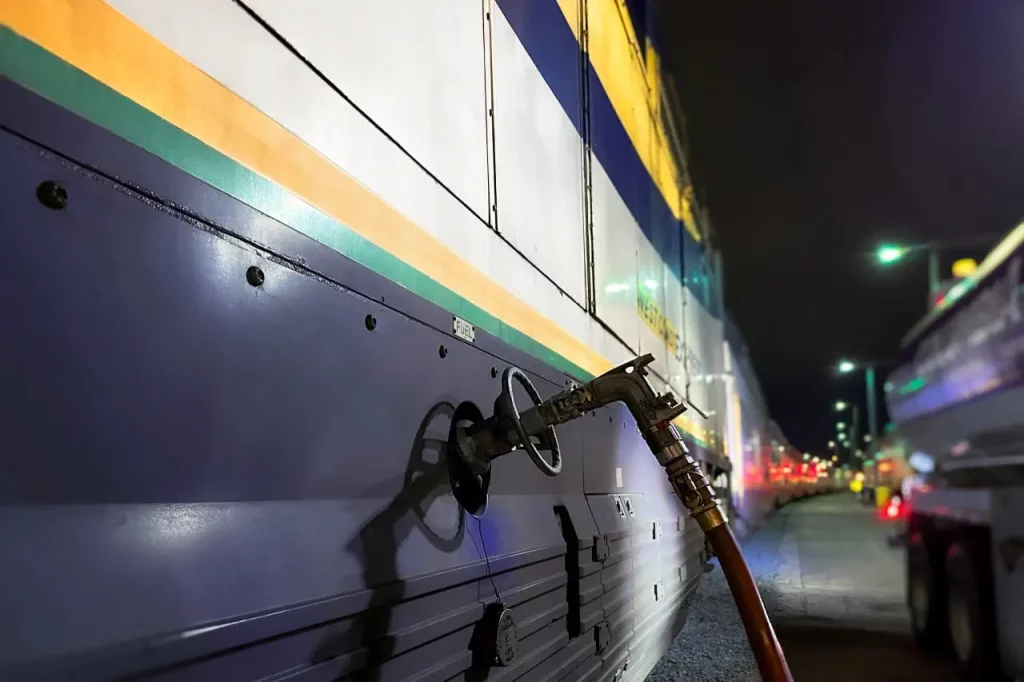
The conversion, TransLink says, delivers a 97% greenhouse gas (GHG) reduction across the fuel life cycle, compared to fossil fuel diesel. In total, this means a 3,200-tonne annual GHG reduction, or the equivalent of taking 940 cars off the road per year, the agency noted.
“Converting the West Coast Express to renewable diesel is an important step towards achieving a zero-emission future,” said TransLink CEO Kevin Quinn. “Customers can feel good knowing that each trip to and from the Fraser Valley is helping to reduce the region’s carbon footprint.”




