The Amtrak Board of Directors held its year-end 2025 meeting earlier this month in New Orleans, the site of a celebration held three-and-a-half months ago for the inauguration of Mardi Gras Service along the Mississippi Gulf Coast. Unlike other “public” Board meetings that show only the presentations to non-members, this meeting occurred both in person and on line, and included questions and answers. (Watch here and at bottom; download overview presentation below.)

This fourth Board meeting exhibited to the public included some 30 people in the room and about 125 on line, according to Amtrak Board Chair Anthony Coscia, who opened the meeting. He noted that more than 180,000 riders travel into or out of New Orleans per year, and that the “exciting news” is Mardi Gras Service. While Amtrak had expected 71,000 riders per year, Amtrak is “well on pace to double that,” he said. He also reported that “demand for Amtrak service is incredibly high,” and “America needs a strong passenger rail provider.” Passenger rail is an “essential mode of transportation” for millions of Americans, he noted, “many of whom live in places where bus service is nonexistent and where the nearest airport may be three hours away or more. People really like traveling on Amtrak. We’re just getting better, year after year.”
Among the other Board members, Vice-Chair Joel Szabat encouraged attendees to ask questions. Rob Gleason of Johnstown, Pa., told them that in addition to the two trains across his state (one in each direction), there will be two more starting next October. Ronald L. Batory—a longtime railroader with 50-plus years of service and a former FRA Administrator—praised Amtrak’s management team, and said Board service is his “opportunity to give back.” Elaine Clegg, the former City Council President of Boise, Idaho (who stepped down to run the local transit agency), told the group that she advocates not only for a return of trains to her region, but also for the entire national network. The last time her city hosted a passenger train was in 1997, when the Pioneer was discontinued. She said that people are “starved for more rail service” and that she wants to help provide it; she mentioned the people in her region who are 100 to 150 miles away from the nearest bus or plane. Chris Koos, the Mayor of Normal, Ill., mentioned the potential for trains to serve rural areas. Kyle Fields, FRA Chief Counsel, was in attendance, representing the U.S. Department of Transportation. David Capozzi, from Gaithersburg, Md., noted that he was the former Executive Director of the U.S. Access Board and the first person with a disability on the Amtrak Board.

Amtrak President Roger Harris reported that Amtrak has set “many, many” records in the past year. He showed a slide that said ridership, ticket revenue, customer miles traveled and capital investment have all increased to record levels, and noted that ridership set records last year and this year with no new fleet. He set a target for train operations to be at a break-even level by 2028. He ended his presentation with this short video:
Amtrak Executive Vice President and Chief Financial Officer Costin Corneanu gave the financial recap. He said net operating loss was down to $598.4 million; an improvement of 15.1% over last year and a 10.3% improvement over plan. He said Amtrak’s revenue across all service lines increased by 9.1% and that October preliminary operating results are coming in $11 million, favorable to the 2026 plan. He also said the increased ridership is driving increased revenue. Capital investment was $5.5 billion, which is 23.8% higher than 2024 and 19.8% lower than the 2026 plan. The largest amount of spending was $1.57 billion on bridges and tunnels, with all projects mentioned located on the NEC. Other spending included State of Good Repair, new equipment, and ADA compliance. Adjusted passenger operating loss was $312.8 million; 35.4% less than last year and 22.2% better than plan. Revenue grew by 8.8%. The infrastructure side had an adjusted operating loss of $289.6 million; 29.6% higher than last year and 7.8% unfavorable to plan.

Corneanu also said the Northeast Corridor (NEC) service line remains “operationally profitable” and is the “primary driver” of year-over-year improvement. Adjusted operating losses on state-supported trains decreased slightly; an 8.4% improvement compared with last year and a $52.3 million revenue increase. Adjusted operating loss for long-distance trains was $621.8 million, which was 2.1% better than the prior year. He said that Amtrak added 8.4% capacity on those trains, which increased revenue by 9.5%. He noted: “While long-distance remains the largest contributor to our operating loss, it continues to fulfill a vital national mission and receives strong Congressional support.”
Szabat pointed out that Amtrak’s capacity limitations could hamper future growth. Batory asked about near-term challenges and risks. Corneanu responded by saying deployment of new equipment would improve reliability. Clegg stressed the importance of Long Distance (LD) trains and asked how Amtrak could start a path toward expansion. Corneanu noted that LD trains will never be profitable, but Amtrak is looking toward efficiency and minimizing losses, so higher-performing parts of system will carry the load.

Amtrak Chief Commercial Officer Eliot Hamlisch was up next, with the Commercial & Operations Report. He praised quick turns on Northeast Regional trains and higher service levels on New York State routes because construction outages were postponed. He also mentioned “headwinds”: a four-month delay in the Next Gen Acela launch and the “grounding” of the Horizon fleet. He said that November ridership numbers should beat plan by about 2.1%, “due primarily to a very strong Thanksgiving holiday demand, which was driven in part by flight cancellations stemming from the government shutdown.” Hamlisch reported that ridership increased across service lines: 8.0% increase on the NEC (0.9% over plan), 2.6% increase on state-supported trains (0.9% under plan), and 4.2% increase on long-distance trains (2.7% over plan). Acela ridership declined by 2.6%, however.

According to Hamlisch, weekday ridership has grown due to increasing return-to-office demand. He touted the new Borealis train between Chicago and St. Paul for delivering a 140% increase (one-third of the total increase along state routes), although the only train on that route previously was the long-distance Empire Builder. He concluded by discussing the relationship between on-time performance (OTP) and customer satisfaction. He noted that variables like food and beverages, comfort, and cleanliness are far more important to riders when a train runs on or close to schedule. Delays remain the biggest problem.

Gary Williams, Executive Vice President of Service Delivery and Operations, reported that OTP was 1.4 points unfavorable year over year and 2.5 points unfavorable to goal. The problems were an aging fleet (59% in car and locomotive delays, mostly on legacy Acela cars) and major project work on the NEC (22% increase in scheduled work delays). Crescent and Lakeshore were the highest-performing LD trains for OTP. The Floridian and Southwest Chief were the lowest-performing. The Sunset Limited improved by 22 points.
Canadian Pacific Kansas City and Norfolk Southern were best-performing host railroads for least delay minutes per train mile, according to Williams. Union Pacific was the worst-performing. He said that Amtrak has “an incredible group of employees,” noting that many customer complaints included the phrase: “But we love your people.” Hamlisch added that capacity is constrained in the Northeast, but new Acela equipment should help, and so should other new NEC equipment.

Next came Laura Mason, Amtrak Executive Vice President for Capital Delivery, with a project update. “We have a fantastic amount of work going on at Amtrak,” she told attendees, and there is a FY26 capital plan of $5.2 billion. This includes transitioning to running only Next Gen Acela trains and retiring legacy Acela equipment by the end of the fiscal year. Amtrak is spending $440 million on new Airo fleet cars, including dual-mode for use on the NEC, which are being tested, and Amtrak plans to launch on the Cascades route. The FY26 plan also calls for $3.1 billion to be spent on Level 1 maintenance facilities. There will be 16 Level 2 facilities. While Mason did not elaborate on new LD equipment because it is “still in procurement,” she said Amtrak is “working collaboratively with the FRA to determine how to best move that program forward in light of current funding constraints, some cost realities, as well as feedback and risk considerations raised by the car builders during the RFP process. We hope to have more for you on that in the spring.”
Mason mentioned construction at Philadelphia’s 30th Street Station, Baltimore Penn Station, and Chicago Union Station, in cooperation with Metra, including the first high-level platform there. She also listed state-of-good-repair projects. A key goal, she said, is getting the most useful life out of assets. Asset condition will drive planning. Additionally, she described such Northeast projects as the East River Tunnels, Hudson Tunnel Project, Connecticut River Bridge, Portal North Bridge (with a new span opening next spring), Dock Bridge (Newark, N.J.) to be decommissioned and fixed in place, and the B&P Tunnel in Baltimore, Md.

Roger Harris returned with summary comments. He pointed out “a remarkable turnaround in the business, both in OTP and Customer Satisfaction Index (CSI) in the second half of the fiscal year.” He called the number of capital projects “overwhelming” and mentioned “the breadth of projects that we’re investing in” and “that some of these assets are actually beginning to come to life.” He also noted “the importance of partnerships and relationships.” He praised the work with partners, such as New Jersey Transit on the Portal North Bridge and New York MTA on the East River Tunnels. He also said that he was impressed with safety at Amtrak, and noted that this was the third year of no National Transportation Safety Board-reportable incidents. He summarized the strategic focus for 2026 as “Run a Great Railroad, Build for the Future, and Deliver Business Results.” As he concluded his remarks, he showed a graph of this year’s ridership exceeding pre-COVID levels, and he expressed the hope that recent momentum will result in another record next year.
David Capozzi told attendees that visual and audible signage provides more information on train arrivals and departures than either visual or audible signs alone for riders who are deaf or blind. He asked about making on-board information fully accessible in that way. Harris responded by expressing thanks for the support Amtrak has received from the disability community and agreed that it “would be a huge improvement,” and that Amtrak is working with Alstom on that product. Harris reported that Amtrak is on track to meet its Station Accessibility goal by 2029, and that Amtrak had invested almost $200 million in station accessibility improvements; he expects to invest $320 million in station accessibility improvements, on 70 active projects.
Capacity, Equipment Issues, and a Different NEC Operation?

John Shea, Amtrak Senior Director, Internal Communications, moderated the public Q&A session that followed. The first topic was capacity, with Amtrak having enough cars operate and fulfill present and future demand. Jim Mathews, President and CEO of the Rail Passengers’ Association, expressed concern, especially now that the Horizon cars have been taken out of service. He asked what provisions should be included in the next Surface Transportation Reauthorization bill that would improve Amtrak’s capacity. Harris reported that this is a “good problem to have” and that Amtrak is restoring capacity as best it can. He said fares are high because of high demand, so additional capacity is “very necessary.” He noted that Amtrak needs to look toward a “very broad” approach, including working with car builders.
Elaine Clegg also expressed concern about capacity, saying that Amtrak should work with government agencies and request enough grant money from Congress to keep Amtrak going for the next five to ten years, including funds to purchase enough equipment. Ron Batory commented: “There’s nothing more valuable than standardization. Standardization brings a scale that will be both efficient in the way of ability, maintenance, and cost, and that is something that I think is an opportunity for Amtrak to seize.”

Scott Spencer, Chief Operating Officer for AmeriStarRail (ASR), was next, offering “the opportunity for the largest private-sector investment ever in Amtrak.” It would be done, he said, “by driving innovation in five key areas: service, marketing, technology, the organization, and safety.” He proposed that ASR operate trains on the NEC according to a Service Plan that he had furnished to the Amtrak Board and senior managers. He suggested that Acela trains be rebranded as Libertyliner 250 trains to honor the 250th birthday of the United States, as well as the speed of 250 kilometers per hour (155 mph) that the trains can maintain. Spencer also proposed a “Freedom Pass” that would be valid for seven days of unlimited travel on the NEC for a flat fee of $250.00 per person. Coscia reported being open to these ideas: “We have a very strong interest in seeing whether there’s private capital and private innovation that can be brought into the mix in order to allow us to do our job and do it better.” (This is only a summary of what Spencer proposed; Railway Age will have a report with more details soon.)
The next question concerned where Amtrak trains will terminate in Miami, Fla., in the future. The response was that the trains will continue to terminate at Hialeah but could move to Miami Central Station (used by Brightline and Tri-Rail) someday, in connection with state-supported service.
A Topic of Regional Interest
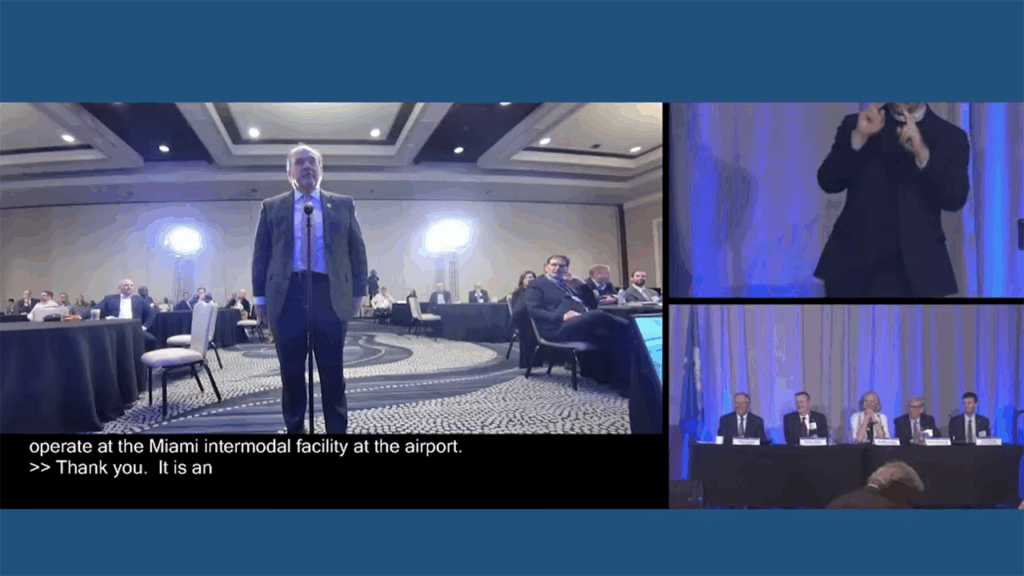
Southern Rail Commission (SRC) Chair Knox Ross thanked Amtrak officials for their efforts to get Mardi Gras Service trains running, and said that “CSX, NS, and the Port [of Mobile] have done a tremendous job of making the service work.” He added: “We’re very excited about the ridership, the revenue.” He complimented Amtrak employees, including mechanical and on-board service workers, saying “Amtrak is putting a white glove on this” and “this is how Amtrak ought to run.” Coscia agreed, also thanking the Amtrak employees and the community. He recalled the thousands of people who came to see the train on its inaugural run, and said “it’s continued every day” and that ridership has exceeded initial expectations. He added: “it also speaks volumes for potential expansion of service in other parts of the country.” Coscia and Amtrak Executive Vice President for Planning and Strategy Jennifer Mitchell said that permanent platforms and other station improvements are coming, but did not provide details.
John Spain, a Louisiana resident and SRC Vice Chair, was up next. He thanked Amtrak for the Gulf Coast trains, too. He noted the 20th anniversary of Hurricane Katrina, and said that trains would have helped get people out of harm’s way if they had been used in 2005. He called for a route between New Orleans and Baton Rouge, the state capital. He also called for state funding, including for the proposed I-20 route, which would run between Fort Worth, Tex., and Meridian, Miss., across northern Louisiana.

More questions came from on line participants. One asked when the first and second tracks of the Portal North Bridge on the NEC in northern New Jersey would be in service. Laura Mason reported that Amtrak expects to have the first track in operation this spring and the second track in fall 2026. Another online questioner asked about plans for running the now tri-weekly Sunset Limited (between New Orleans and Los Angeles) every day, but Harris suggested consulting the FRA Long-distance study, without giving a specific answer. The next questioner asked what Amtrak is doing about the disruptions caused by problems with the Siemens Charger fleet. Gary Williams said that Amtrak is working with Siemens and its own mechanical crews to improve the situation; that it is improving; and that Amtrak is working to shorten response time when events occur that are beyond Amtrak’s control, like a vehicle accident. The next question was about the problems that Amtrak has had with shunt antennas on the Siemens Charger units pulling trains on host freight railroad CN in Illinois (the historic Illinois Central, where Amtrak is running long trains of Superliner cars while single-level cars would otherwise be used). Williams said that new antennas are being built for the Charger locomotives.

The next question concerned the new span of the Long Bridge over the Potomac River that the Virginia Passenger Rail Authority is building. Will long-distance trains running south of Washington, D.C., be able to operate during bridge closure hours due to the construction? Williams said that the Floridian will run there but did not mention the schedule. Harris said that schedules for long-distance trains will be “modified” but did not release details. The next question concerned restoring dining car service to trains that do not currently offer it. Harris said that many people care about food and beverage service on board but offered no specifics; he did offer to provide more specific information to the individual questioner. Another on line participant asked about the status of the Horizon cars that are at the manufacturer for repair. The answer: the fleet has been evaluated, and some can be repaired. A “small number” are being repaired to return to service.
After Jennifer Mitchell gave an update on Amtrak projects in the region and funding for them, on line questioning resumed with an inquiry about New York Penn Station, including the area to its south. Anthony Coscia said that the Penn Station Transformation Plan is about redevelopment at the station and enhancing capacity there, rather than development on private property south of the station. He added that the project is “on time, on budget, and on schedule,” and concentrates on the building’s footprint. FRA Chief Counsel Kyle Fields elaborated on the agency’s role in the development, including “what expansion might be necessary before going there.” A related question was whether the Feds are still financially supporting the Gateway Program. Coscia answered in the affirmative. Another questioner noted the high sleeping car fares on the long-distance trains, due to lack of capacity, and asked what is being done to expand the fleet. Harris said that the wreck-damaged cars that can be saved are being repaired. The next question was about publishing timetables, and Hamlisch defended Amtrak’s practice of not issuing printed timetables by saying that they change often. Concerning service expansion in Ohio, Mitchell mentioned projects led at the state level for corridor development.
Coscia concluded the meeting by saying it was “very, very important to hear from you,” noting that there will be another similar meeting next year. He expressed his hope that there will be more to celebrate then.
This was the annual (since 2022) Amtrak Board meeting where members of the public can ask questions. However useful (or not) the responses were to the questioners, this publicly available meeting helps provide transparency for Amtrak. That, along with the records, is something to celebrate.