
Amtrak’s Board of Directors met on May 22. The event included several presentations about Amtrak’s performance and plans, presentations that were made available to the public through a Zoom link. The presenters (or most of them, anyway), were senior managers, generally at the VP or EVP level. The information they conveyed was mostly technical and financial, although several concerned advocates sent e-mail messages to fellow advocates on the blogging groups to convey their impressions. One such advocate is James M. Tilley, President of the Florida Coalition of Rail Passengers and Vice Chair of the AuroraGroup. His comments appear together with this article.
The technical side of the event left something to be desired. The sound quality varied, so it was not always easy to identify the presenters. The slides that were packed with the sort of information that those “in the know” always want were not always on the screen long enough to absorb all the material they contained. Sometimes the presenters gave different information to supplement the material on the slides, a set of circumstances that did not lend itself to leaving the event feeling totally well-informed.
When I had trouble identifying some of the presenters, I sent a message to Amtrak Media Relations, requesting their names and titles, and inquiring when and how I could view and listen to the presentations later. The “automatic reply” that I received did not contain a single word of content, or even a single character. It was totally blank.
Nonetheless, Amtrak’s willingness to allow members of the public to pre-register and then “listen in” on Zoom is a positive step toward transparency, an attribute that some advocates have claimed for a long time that Amtrak lacks. The railroad’s in-person Board meeting in Seattle last December was also available on line, so Amtrak deserves credit for taking these early steps to augment its outreach and improve transparency. Still, there were no opportunities for anyone who is not a Board member to make a statement or ask a question. I hope that Amtrak can improve the technical aspects of the presentations, while opening these meetings and other events to an increasing degree of public participation. With that said, it’s time to recount some highlights from the presentations.
Although Board Chair Anthony Coscia attended the meeting, he did not participate in the part available to the public, except to introduce the first presentation, by Costin Corneanu, Senior VP for Finance. Corneanu compared actual performance numbers to “planned” or “expected” numbers, in the style of a budget review. Among the numbers he reported was 1% more capacity than planned, ticket revenue up 10% due to increased capacity and demand, and an adjusted operating loss 25% better than expected. He called for operational break-even in FY28. He also said that operating loss was decreasing, infrastructure was improving year-by-year, and L-D (Long-Distance) trains performed favorably by 10% while state-supported trains performed unfavorably by 17%. He also said that Northeast Corridor (NEC) is “profitable,” a claim advocates and other observers dispute. (See Editor’s Commentary, below.)

Eliot Hamlisch, EVP, General Counsel and Chief Commercial Officer, was next. He reported that NEC ridership was up by 11%, although it was down by 2% on Acela Express. State-supported trains did well, with the new Borealis train between Chicago and St. Paul running 27% ahead of plan. He added the L-D trains increased ridership, mostly in the 20%-30% range, due to additional capacity in some of the consists.
Gary Williams, EVP and Chief Operating Officer, reported on-time performance (OTP) below planned levels, but not on the L-D trains. He reported a 78.4% Customer Satisfaction Index. He also said that consist fulfillment was best on the NEC, mixed on state trains, and constrained in the West.

EVP for Strategy & Planning Jennifer Mitchell reported that delays caused by host railroads were down on state-supported trains, but up on lL-D trains, especially the combined Chicago-Florida Floridian. CSX is doing worse, do to heat-caused slow orders, but the Sunset Limited’s OTP has improved significantly.

Nicole Bucich, VP for Network Development, gave an overview of the FRA’s Corridor ID Program. She mentioned three Amtrak projects, two of which involve running the tri-weekly Sunset Limited (rerouted to restore the former stop at Phoenix) and Cardinal every day. She said service frequency affects ridership, that the daily Capitol Limited between Washington, D.C. and Chicago carried three times as many riders as the tri-weekly Cardinal.

The third project is bringing some Amtrak Washington, D.C.-New York trains further east onto the Long Island Rail Road, with stops on the LIRR main line at Jamaica, Hicksville and Ronkonkoma. (See Editor’s Commentary, below.) There would only be three round trips per day with that routing. While Amtrak and AmeriStarRail, a private-sector company that wants to run trains on the NEC, have both called for the Ronkonkoma routing, some advocates in the region believe that it would be a waste of money. The LIRR already runs trains on the line at least hourly throughout the service day. Where would the LIRR and Amtrak find the capacity, especially the four East River tunnels are in dire need of overhaul, and Amtrak’s plan is to take them out of service, one by one? But that’s another story.
Bucich also mentioned the upcoming Mardi Gras Service between Mobile, Ala. and New Orleans, which is expected to launch this summer. Other expansions planned for further in the future are extension of the Roanoke, Va. trains 35 miles to Christiansburg, a second Pennsylvanian train to Pittsburgh, and a fifth daily frequency for the Piedmont corridor in North Carolina. In Colorado, Amtrak is planning for Mountain Rail between Denver and Craig (discontinued by the Denver & Rio Grande in 1968) and a new route north of Denver to Fort Collins. Other plans include extending two daily trains to and from New Haven past Springfield to Boston on the Inland Route and adding service in Wisconsin to Madison and Eau Claire, on the way to Minnesota’s Twin Cities.
Jim Short, Acting AVP for Project Delivery, was next. He reported that Amtrak’s annual operating grant is unchanged this year at $2.4 billion, while funding under the COVID-era IIJA (Infrastructure Investment & Jobs Act) was $17.3 billion for facilities and accessibility, with another $7.4 billion in discretionary infrastructure grants from the FRA. The other projects he mentioned were Portal North Bridge, reported 83% complete ($2.2 billion), Hudson Tunnel Project ($16 billion, scheduled for completion in 2038), Connecticut River Bridge at Old Saybrook ($1.3 billion), East River Tunnel Project ($1.6 billion, a project that includes a long-term shutdown of one tube, which a number of elected officials and advocates oppose), and platform improvements at Boston, Seattle, Philadelphia and Washington, D.C. (somewhat less than $2 billion total).
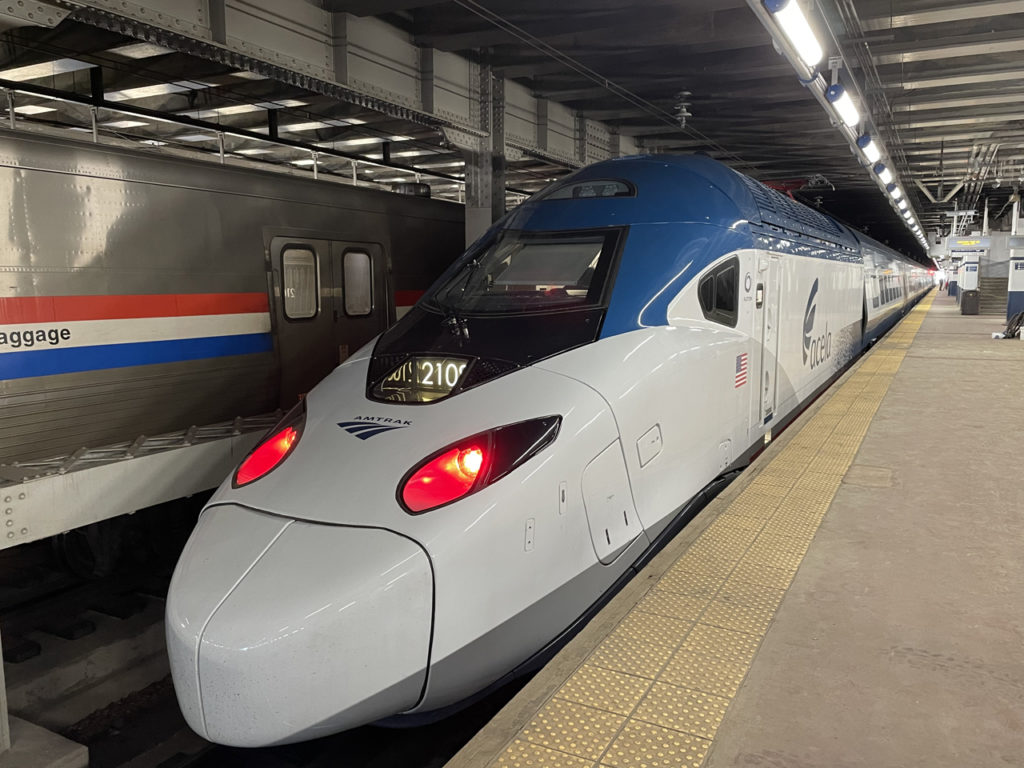
Regarding fleet expansion, Short said that he was “very excited” that the Alstom-built Acela II equipment is “coming soon” (introduction has been delayed for at least a year beyond the initial schedule). He added that more Siemens Airo equipment is coming for state-supported routes. He noted that Amtrak is using “value engineering” to save money on projects and said that the next challenge will be the FIFA soccer World Cup, June 11-July 19, 2026. That events will take place in New York (actually, in New Jersey at MetLife Stadium, Meadowlands Sports Complex, which is served by NJ Transit), Philadelphia and Boston, and anticipates 1.5 million fans will attend, 60% to 85% not using automobiles. (

The final topic was the combined efforts of Amtrak and New Jersey Transit (NJT) to improve the infrastructure on the NEC that NJT uses, with endpoints at New York and Trenton. Last summer was fraught with annulments, cancellations and delays, some of which were attributable to problems with Amtrak’s infrastructure. (See Editor’s Commentary, below.) Regarding the riders, Gary Williams said that Amtrak “did not deliver the service they deserved.” Liam McQuat, Amtrak VP for Engineering Services, blamed power failures and pantographs on NJT’s equipment for some of the adverse events and reported that there is now a Technical Committee with members from Amtrak, NJT, and the FRA. (See Editor’s Commentary, below.) He and other presenters reported that electrical components are being replaced, along with 3.5 miles of overhead wire. Aerial inspections are being performed using a helicopter and drones. There is a Renewal and Maintenance Prioritization (RaMP) program to identify critical maintenance and repair needs as part of preparation for summer.
There were only two questions from Board members after the presentations. James M. Tilley, whose comments follow mine, told Railway Age: “Vice Chair [Joel] Szabat asked if there was sufficient demand for all the new Acela capacity coming on line shortly and the answer was that the demand is there. Available data referenced below suggests that possibly the demand may be, there but not for a premium priced product. If you have 15 trainsets now, what is the impact on pricing when the total increases to 28 even-longer trainsets?” The other question came from Elaine Clegg, a new Board member from Boise, Idaho, who is advocating for the return of the Pioneer on Union Pacific’s route to Portland, which served her city from 1981 until 1997. She asked about expanding the L-D network. The answer she received was that there will be no new railcars to expand the fleet for at least five years, and that Amtrak is attempting to drive increased demand while cutting costs.
As part of the registration process to get the feel of the event on Zoom, there was a place where registrants could submit questions. However, Tilley noted: “Amtrak solicited questions for the Board meeting. But as the meeting started there was a message that there was no time for questions. The meeting proceeded to end early.” He’s correct. It was scheduled for 90 minutes but ended after 77. I timed it.
Although Amtrak is facing political and financial challenges now, none of the presenters had much to say about what Amtrak is facing, whether connected to the L-D trains, state-supported trains and corridors, or the NEC. Of course, I don’t know what management told the Board members when no outsiders were listening, but the entire presentation appeared positive in all respects, perhaps unduly so.
“Fundamentally Unrealistic,” by Jim Tilley

Amtrak’s Board-approved Strategic Blueprint (download below) outlines a goal of eliminating the company’s “adjusted operating loss”—with a particular emphasis on achieving break-even results from its train operations business. Yet recent financial and operational metrics raise serious questions as to how management intends to realistically attain this objective. Given that Amtrak essentially bankrupted itself in the late 1990s when then-CEO Warrington targeted putting Amtrak on a “glide path to self-sufficiency,” why would this Board target a metric that may very well be unattainable and self-destructive?
In FY2019, Amtrak came close to this goal, due in large part to a reported $568 million in “adjusted operating income” from the Northeast Corridor (NEC). However, despite a full ridership recovery on the NEC post-pandemic, adjusted operating income declined by 53% to $268 million in FY2024. Through the first half of FY2025, NEC operating margins remain essentially flat year-over-year—a stark indication of stalled financial momentum.
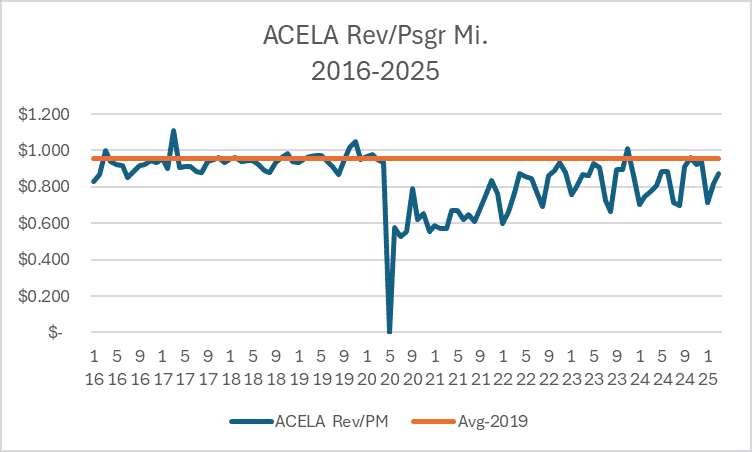
A primary factor behind this decline is price erosion. While passenger growth has concentrated in the lower priced NEC’s Regional service, Acela—the so-called premium product—has barely returned to pre-pandemic ridership levels despite being capacity constrained. Yet, yields remain significantly below FY2019, indicating that demand for Acela at premium pricing has not recovered. This challenges assumptions that Acela’s unique market positioning can generate superior margin contributions. If you have 15 Acela trainsets now, what is the impact on pricing when the total increases to 28 even-longer Acela II trainsets?
External market data reinforces this softness. According to Federal Aviation Administration statistics, total intercity airline passenger volumes within the NEC declined by 8% in calendar year 2024 relative to 2019, signaling a mature, very possibly contracting, market. Some key segments saw even sharper drops—for example, air travel between Boston and LaGuardia fell by nearly 20%, while LaGuardia-Washington Reagan traffic remains flat, in a corridor where Amtrak already dominates.
Meanwhile, in the Boston-Washington market, Amtrak has historically underperformed. The market share in 2019 was minimal, and there is no indication of a material post-pandemic improvement. Annual air traffic between these cities remains at roughly 1.5 million passengers, with modest 2% year-over-year growth in 2024. The fastest Amtrak service—Acela No. 2155—requires more than 6.5 hours to complete the trip. Its average speed is just 73 mph, and it exceeds 100 mph for only 32 miles of the route, making it a poor substitute for air travel in that corridor. There is no indication that the eventual introduction of Acela II trainsets will result in materially improved trip times even upon completion of all the infrastructure projects currently under way.
Taken together, these data points suggest that Amtrak’s margin compression is structural—not merely cyclical—and that targeting systemwide break-even “adjusted operating income” may be fundamentally unrealistic under present conditions. This concern is amplified by historical patterns: When pressed to improve reported financials, management has often turned toward the L-D network, even though three former Amtrak CEOs have publicly acknowledged its largely cash-neutral impact—especially when compared to the NEC, which requires sustained capital infusion to remain viable.
Editor’s Commentary, by William C. Vantuono

The NEC is not profitable when all elements—train operations; regular and capital maintenance of infrastructure, including roadbed, track, catenary, stations, etc.; and possibly equipment maintenance, repairs and overhauls as well as new equipment acquisitions—as Jim Tilley correctly points out, “sustained capital infusion”—are factored in.

The NEC, as long-retired spokesperson Cliff Black (pictured, in 2024) explained to me at least 30 years ago, is profitable “above the rail,” operationally profitable, backing out all other costs. Stating that the NEC is “profitable” is a half-truth reported even by publications like the Wall Street Journal and New York Times, and never clarified by Amtrak, to my knowledge—except by Cliff, whose knowledge, honesty and transparency were to me the gold standard of Amtrak corporate communications.
Perhaps the worst perpetuator of the Amtrak profitability myth was its late CEO George Warrington, who during his 1998-2002 tenure adopted the term “glide path to self-sufficiency” as a mantra—most likely to placate hostile politicians. If one consistently and frequently repeats misinformation, people who don’t know any better will eventually accept it as truth. POTUS 47 is a prime example.
Let’s be honest, Amtrak. The NEC is at best marginally profitable above the rail. The company has long been accused of fuzzy accounting, allocating some NEC costs to the L-D network. Amtrak was never intended to be profitable. That was a bill of goods sold to President Richard Nixon and others on Capitol Hill when Amtrak was created in 1971 for the sole purpose of relieving the private, for-profit freight railroads of the huge financial losses incurred by their common-carrier obligation to operate passenger trains. But, nor should Amtrak be saddled with a profitability requirement. This doesn’t mean, however, that running Amtrak as if it were a for-profit company shouldn’t be its objective.
As for NJT’s troubles last year on the NEC, most were attributable to Amtrak infrastructure problems, namely, faulty catenary hardware wearing and breaking pantograph pickup shoe contact strips on NJT locomotives and multiple-units. NJT was forced to change to a different style of pantograph pickup shoe. I saw the evidence in person at NJT’s Meadows Maintenance Complex in 2024.

Operating Amtrak trains as far east as Ronkonkoma? Doesn’t sound very practical. Where is LIRR going to find the capacity? During peak hours, LIRR trains operate in and out of Penn Station New York every few minutes, like a subway. Operating east, beyond “end of wire,” would require a power swap at PSNY from NEC locomotives that use AC catenary to units operating on LIRR’s DC third-rail, or perhaps dual-power catenary/diesel units like NJ Transit’s ALP45-DP or dual-mode third-rail/diesel or battery-electric hybrid, etc., etc.




