

Union Pacific’s 4Q24 and Full-Year (FY) 2024 financial results (download below) reflected revenue carload growth, and improvements in freight car velocity, employee productivity, operating income and operating ratio. The Class I posted 4Q24 diluted EPS (earnings per share) of $2.91, up 7%; a 58.7% 4Q24 OR of 58.7%; FY24 dilutedEPS of $11.09, up 6%; a 59.9% FY24 OR; and a FY24 ROIC (return on invested capital) of 15.8%.
Union Pacific’s 4Q24 $2.91 diluted EPS was based on net income of $1.8 billion, compared to 4Q23 net income of $1.7 billion, or $2.71 diluted EPS. These results include $40 million of labor expense related to the ratification of a crew staffing agreement. Reported net income for FY24 was $6.7 billion, or $11.09 diluted EPS, compared to FY23 net income of $6.4 billion, or $10.45 diluted EPS.

In 4Q24, “strong service and efficient performance enabled volume growth and records for operating and net income,” Union Pacific said. Operating revenue of $6.1 billion was down 1%, “driven by lower fuel surcharge revenue, unfavorable business mix and lower other revenue, partially offset by increased volume and core pricing gains.” Revenue carloads were up 5%. Operating income of $2.5 billion was up 5%. The 58.7% OR, a 220 basis point improvement, included “an unfavorable 70 basis point impact from the ratification of a crew staffing agreement (brakeman buyout).”

Union Pacific’s 4Q24 operating performance showed “improved network fluidity amid volume growth” and “a record for workforce productivity.” Quarterly freight car velocity improved 1% to 219 daily car-miles. Locomotive productivity declined 3% to 136 GTMs (gross ton-miles) per horsepower day. This, CEO Jim Vena told Railway Age, was due to having to rebalance the network following a late third-quarter/early fourth quarter surge in intermodal (6% overall in 4Q24) which required power to be shifted from East to West. Workforce productivity increased 6% to 1,118 car-miles per employee. The fuel consumption rate improved 1% to 1.078, measured in gallons of fuel per 1,000 GTMs.

Union Pacific’s Full-Year 2024 financial results included operating revenue of $24.3 billion, up 1%, “driven by increased volume and core pricing gains, partially offset by lower fuel surcharge revenue, unfavorable business mix, and lower other revenue.” revenue carloads increased 3%. The OR improved 240 basis points to 59.9%. Operating Income of $9.7 billion was up 7%. The 2024 capital program totaled $3.4 billion, and the company repurchased 6.3 million shares in 2024 at an aggregate cost of $1.5 billion.

For full-year 2024, Union Pacific’s operating performance reflected “strong improvements in safety, service, and operational excellence, and a workforce productivity record.” The FRA reportable personal injury and reportable derailment rates improved. Freight car velocity improved 2% to 208 daily car-miles. Locomotive productivity improved 5% to 135 GTMs per horsepower day. Workforce productivity improved 6% to 1,062 car-miles per employee. The fuel consumption rate improved 1% to 1.082.

For 2025, Union Pacific’s outlook is “on track with Investor Day targets.” The railroad expects volume to be impacted by a “mixed economic backdrop, coal demand, and challenging year-over-year international intermodal comparisons.” Pricing dollars will be “accretive to operating ratio.” EPS is expected to grow, “consistent with attaining the three-year CAGR (compound annual growth rate) target of high-single to low-double digits.” An “industry-leading OR and ROIC” is forecast, based on “no change to the long-term capital allocation strategy,” a $3.4 billion capex plan, unchanged from 2024, and higher share repurchases of $4.0 to $4.5 billion.”
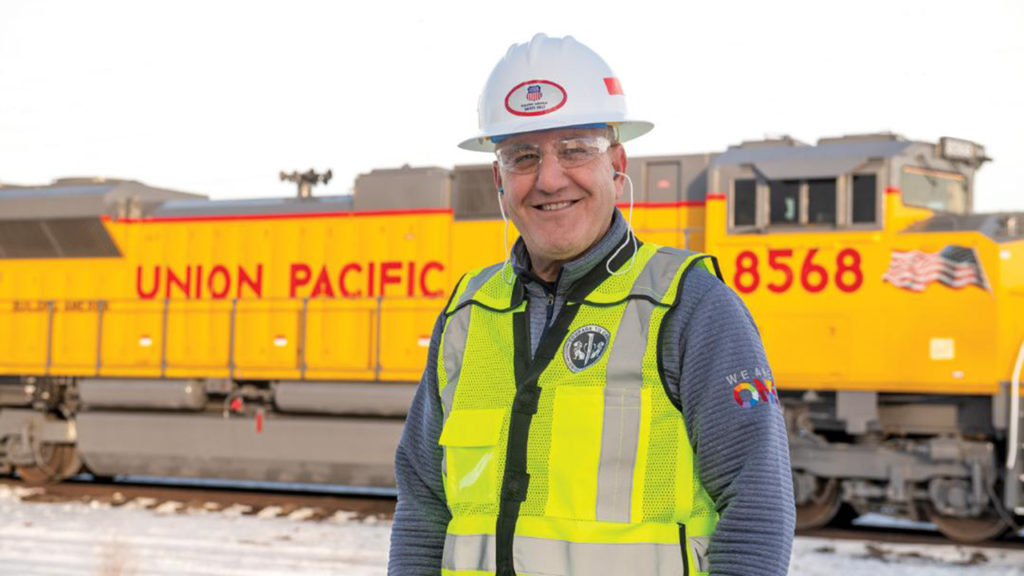
“Our strong fourth-quarter results represent a great capstone to a very successful year for Union Pacific,” said Jim Vena. “The team has fully embraced our strategy to lead the industry in safety, service, and operational excellence. That commitment has produced industry leading financial results in 2024, punctuated by our strong finish to the year. We will carry this momentum into 2025 as we seek to unlock the full potential of the UP franchise.”
Vena’s outlook on on regulation under the new Administration (with Patrick Fuchs as Surface Transportation Board Chair and career railroader David Fink awaiting confirmation as Federal Railroad Administrator) is optimistic. For example, he’s anticipating faster response time from the FRA in granting waivers and issuing rules related to new technologies that can improve safety, service and productivity. “Of course, we need regulations,” he told Railway Age. “But we’ll be better off if the FRA and STB increase their decision-making speed, so our business can move ahead. Safer, more efficient railroads are better for the country.”
Like all North American Class I’s, Union Pacific’s freight traffic includes substantial cross-border volume that benefits from the USMCA (U.S.-Mexico-Canada Agreement). The potential effect of tariffs proposed by the new Administration on Canadian and Mexican goods (finished motor vehicles from Mexico, lumber and potash from Canada, etc.) coming into the U.S. “should not be as much as people think,” Vena said. Under examination is how such tariffs, if actually levied, would affect Union Pacific. The biggest question, he noted, is “will consumers continue to spend?”
The new Administration has taken aim at DEI (diversity, equity, inclusion) programs in government, directing, through Executive Order, that they be shut down and that hiring be based “only on merit,” to quote the current President. Jim Vena’s thoughts: “We are not changing anything,” he told Railway Age. “We have always been and will continue to be a merit-based company, seeking and developing the best talent, and our workforce will continue to reflect the communities in which we operate, as well the U.S. population.”
TD Cowen Insight: “Moving More with Less’
By Jason H. Seidl, Elliot Alper and Uday Khanapurkar
Union Pacific’s 4Q24 beat our forecast and consensus estimates to cap 2024 as OR momentum carries into 2025 with productivity initiatives in place that should drive earnings, irrespective of mixed macro conditions. Intermodal volumes have started off the year strong, but 2H24 looks uncertain as tough comps in international should more than offset an improving domestic market.
UNP reported 4Q24 EPS of $2.91, easily beating our and consensus estimates of $2.78, and outperforming management’s guide of ~flat EPS sequentially from 3Q34. The beat was even better excluding a $0.05 headwind relating to a payout made to one union. The top line of $6.1 billion was approximately in line with our forecast on well-understood strength in intermodal carloads, given robust activity on the West Coast. The outperformance in the quarter was driven by material OR improvement, recording a 58% OR (ex-payout headwind), 220 bps better than our estimate. Jim Vena has publicly stated that it is his goal to have the industry’s best OR, and 4Q24 definitely set a high bar for others.
The 2025 top-line and demand environment appear mixed, and we model modest back-half weighted growth. Coal volumes will continue declining in 2025, but UNP will mitigate impacts of plant retirements with a new coal contract in the South. 4Q24 saw continued revenue per carload pressure, and management expects high inventories to persist in 2025, leaving us cautious on the coal picture for the full year despite some recovery in competing natural gas prices in January. Auto OEMs are curtailing production, but output will improve through the year. Intermodal carloads will face very tough comps in 2H25 and pricing recovery to lag TL inflection, though we note that normalizing the international-domestic mix should offer a mitigating yield tailwind later this year.
UNP grew rail volumes by 5% in 4Q24 with 3% less employees, as productivity measures drove an OR below 60 for the first time in two years. Management expects cost per employee to grow 4% in 2025 but should lean into additional productivity measures to improve efficiencies. UNP called out 75 initiatives they have this year to focus on driving productivity. The company continues to maintain service levels while moving the most volume since 2019 with ~20% fewer employees.
UNP’s 2025 outlook offered mixed volume commentary, pegged to various macro indicators, though UNP expects pricing dollars to be accretive to OR. Call commentary showed comfort around high single-digits to low double-digits earnings growth this year (vs. a long-term guide at Investor Day of a 3-year CAGR), and we reflect our estimates $0.05 lower to reflect this. UNP guided capex to be $3.4 billion and share repurchases of $4.25 billion at the midpoint. The outlook suggests that UNP should have margin opportunity in 2025 irrespective of the macro forecast, and any momentum on that front could offer upside to estimates.
We adjust our 2025 EPS estimate to $12.20 from $12.25 and introduce our 2026 EPS estimate of $13.25. We lower our multiple a half turn to 19.5x as we roll our model forward. Using our new 2026 estimate, our price target moves to $258. Reiterate Buy.




