
TSB Issues Investigation Report for 2024 CPKC Train Derailment
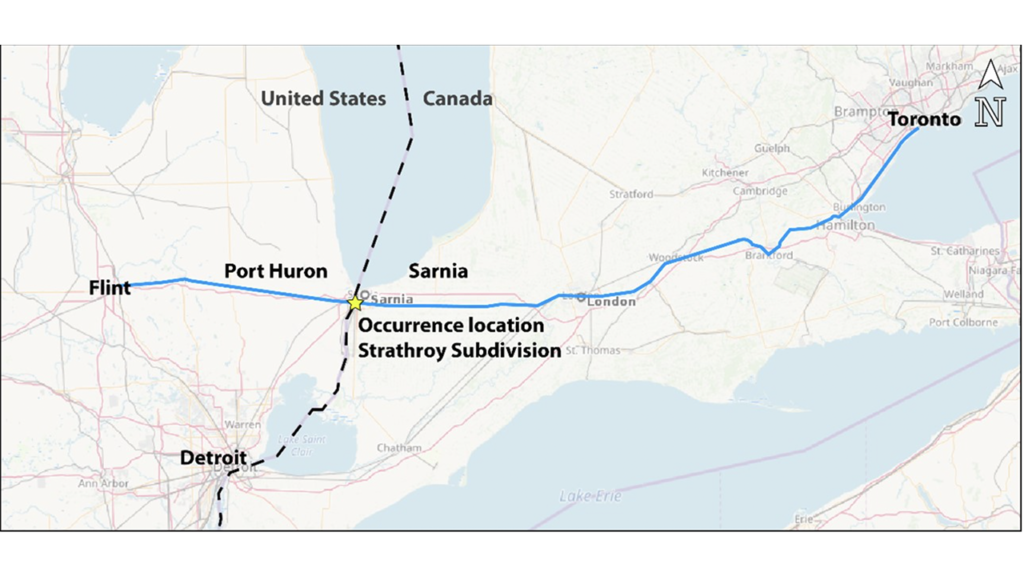
What Happened?
On Feb. 5, 2024, a CPKC freight train was proceeding westward on the Brooks Subdivision (see map, top) when a train-initiated emergency brake application occurred, according to the TSB, which is an independent government agency that investigates air, marine, pipeline, and rail transportation occurrences, and like the National Transportation Safety Board in the United States, aims to advance transportation safety and does not assign fault or determine civil or criminal liability. Upon inspection, it was determined that the trailing head-end locomotive had derailed, as well as the first 17 intermodal railcars; there were no injuries reported, and no dangerous goods were released, the TSB said.
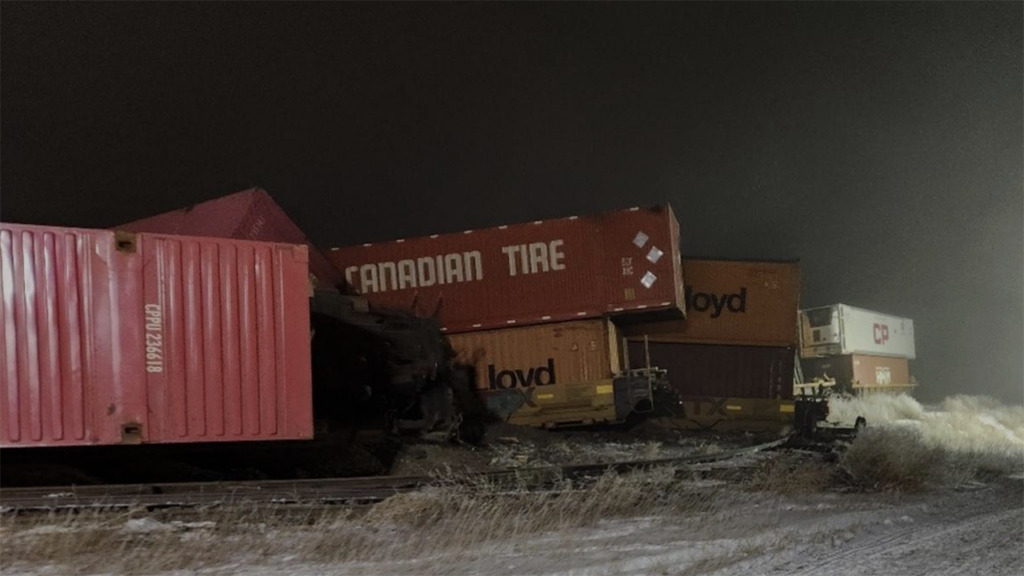
Investigation Findings
“The investigation determined that the train had to be stopped in Ontario the day before due to smoke emanating from one of the trailing head-end locomotive’s traction motors,” the TSB said in an announcement of the investigation report’s official release (download R24C0012 below). “In consultation with the supervisor mechanical (locomotive) (SML), the locomotive engineer cut out the affected traction motors and their associated speed sensor. The locomotive engineer was instructed to monitor the issue and the train continued on its trip. However, when recording the traction motor issue neither the locomotive engineer nor the SML made mention of the speed sensors in their respective fault logs. The next day, after several crew changes, the axle seized with the resulting damage to the wheelset causing a track failure and the subsequent derailment.”
“The investigation also found that cutting out the speed sensor removed an important line of defense to protect against locked axle conditions,” the TSB said. “However, neither the locomotive engineer nor the SML fully understood the implications of this action. In this case, the SML was still completing his training modules and had not yet received training on the mechanical aspects of locomotives, which covers essential information for troubleshooting. Without this specific technical knowledge, he was unaware of the potential consequences of cutting out speed sensors.
“Additionally, in 2014–2015, … [Canadian Pacific, which in 2023 merged with Kansas City Southern to form CPKC] eliminated the central locomotive specialist position, which required in-depth knowledge of all major locomotive systems and many years of hands-on troubleshooting and repair experience. When the position was eliminated, SMLs assumed many of the responsibilities, however, their role is broader. When specialist duties are transferred to a position occupied by an individual that is not specialized in those duties, unless technical training, mentoring, and operational experience are provided to bridge the gaps between the two positions, there is an increased risk that these duties will not be performed to meet safe railway operations.”
Safety Action
CPKC on Feb. 7, 2024 issued a mechanical locomotive bulletin to all locomotive facilities. According to the TSB, this bulletin explains the “critical role of traction motor speed sensors in monitoring motor functions and detecting locked axle conditions, specifying that speed sensors must not be cut out when dealing with traction motor issues.” Additionally, the bulletin indicates that “traction motor speed sensors can only be disabled in specific cases, such as when a dummy wheelset (i.e., a wheelset without the motor) has been applied in that position, or when the traction motor had its pinion cut and the speed sensor has been disconnected or removed,” the government agency noted. “Affected locomotives must be monitored for proper wheel rotation and noise, and the Crew Information Form must be updated as necessary.” The bulletin also “details the use of toggle switches for traction motor and speed sensor cut-outs, accessible through the locomotive control monitor, and advises to only disable speed sensors under mechanical guidance.”
According to the TSB, CPKC implemented a Mechanical Locomotive Support Desk, described as “a dedicated five-person team of operations support coordinators, which has taken over the locomotive troubleshooting responsibilities previously held by supervisors mechanical (locomotive).” This team’s sole responsibility, it said, is to respond to locomotive service interruption calls from Canada and the United States. The change became effective April 2024.




