News Item: The President issued an Executive Order Feb. 18 asserting direct control of independent (from the Executive Branch) federal agencies, including the National Mediation Board (NMB, which administers the Railway Labor Act); the National Transportation Safety Board (NTSB, which investigates transportation accidents, determines their probable causes, and issues safety recommendations to prevent future incidents); and the Surface Transportation Board (STB, which promulgates rules affecting the railroad industry, regulates railroad rates and practices, and adjudicates shipper-carrier disputes and applications for line abandonments and mergers).
Under a unitary executive theory of government advanced by political conservatives and embraced by POTUS 47, the President has constitutional authority (Article II) to control independent federal agencies the same as he does Executive Branch agencies—and further has license to remove from independent regulatory agencies their Senate-confirmed members and chairpersons without showing cause. Federal courts eventually will decide if all this is correct.
Notably, the Federal Railroad Administration (FRA) is not included in the Executive Order as it already is an Executive Branch agency whose single Presidentially nominated and Senate-confirmed administrator reports to the President through the Cabinet-level Secretary of Transportation and serves at the pleasure of the President.
By contrast, independent federal agencies have Senate-confirmed multi-member boards with staggered terms and no more than a simple majority representing one political party (typically, the political party of the President). While statutes provide that Senate-confirmed members of independent regulatory agencies may be removed only for cause, this job security may be lost under the unitary executive theory. Presumably, the President would control these agencies through the chairperson, who would serve at the President’s pleasure.
At the NMB, the chair rotates annually among Senate-confirmed members who serve three-year terms. At the NTSB, the chairperson is nominated by the President and Senate-confirmed to a three-year term from among already sitting members who serve five-year Senate-confirmed terms. At the STB, the President unilaterally appoints a chairperson from among already sitting members who serve five-year terms—the chairperson having no fixed term in that role and sitting at the pleasure of the President.
In all cases, the Executive Order contemplates decisions and rulemakings having to pass muster by the White House, which could remove almost every trace of independent decision making. Below, we consider what court approval of the Executive Order could mean for railroads.
National Mediation Board

Among the NMB’s rail-specific functions is mediating wage, benefits and work rules disputes, and determining when to release the parties if collectively bargained agreements are not reached—release typically triggering a strike or lockout. The NMB also adjudicates representation disputes among railroad craft unions.
Historically, the NMB delays releasing parties from mediation until a settlement pattern is established, or the parties are hopelessly deadlocked after displaying “good faith” bargaining—and always first assuring that Congress will be in session to impose a settlement so as to avoid an economy-damaging work stoppage.
Any injection of partisan politics into the timing of decisions, or hiring, firing and assignments of mediators, is a prescription for destabilization and erosion of trust in the NMB by parties before it. Perceptions can matter as much as deeds.
Moreover, while Congress typically imposes a settlement to head-off or quickly halt a rail work stoppage, the legislation most often is based on non-binding recommendations of a Presidential Emergency Board (PEB)—the members of which are chosen by the White House. While the President through these appointments already has ability to insert “ringers” in the PEB process, there is no evidence this has previously occurred. But with the President having greater control over the NMB, perceptions—right or wrong—become reality, eroding stakeholder and public trust in NMB neutrality.
The representation election function of the NMB also becomes ripe for corrosive mischief when agency independence is diluted. This is best explained by looking backward.
In 1999, the United Transportation Union (UTU, now the Transportation Division of the Sheet Metal, Air, Rail and Transportation Workers, or SMART-TD) petitioned the NMB for a winner-take-all representation election on Union Pacific, where its rival, the Brotherhood of Locomotive Engineers (BLE, now the Brotherhood of Locomotive Engineers and Trainmen, or BLET) had fewer members, presaging a UTU victory.
Rather than risk a perception of partisanship, the NMB referred the UTU petition to a three-person arbitration panel of veteran arbitrators familiar with the issues. The panel unanimously rejected the UTU petition. NMB neutrality was not questioned. Consider a less independent NMB subject to Presidential pressure deciding such a case internally. Perceptions matter.
The NMB currently has a Democratic majority—Democrats Linda Puchala and Deidre Hamilton and Republican Lauren Sweatt. Expect the President to nominate a Republican to succeed Hamilton when her statutory term expires in July—or sooner if a court victory upholding his Executive Order determines he may fire, without cause, a member ahead of term expiration.
National Transportation Safety Board
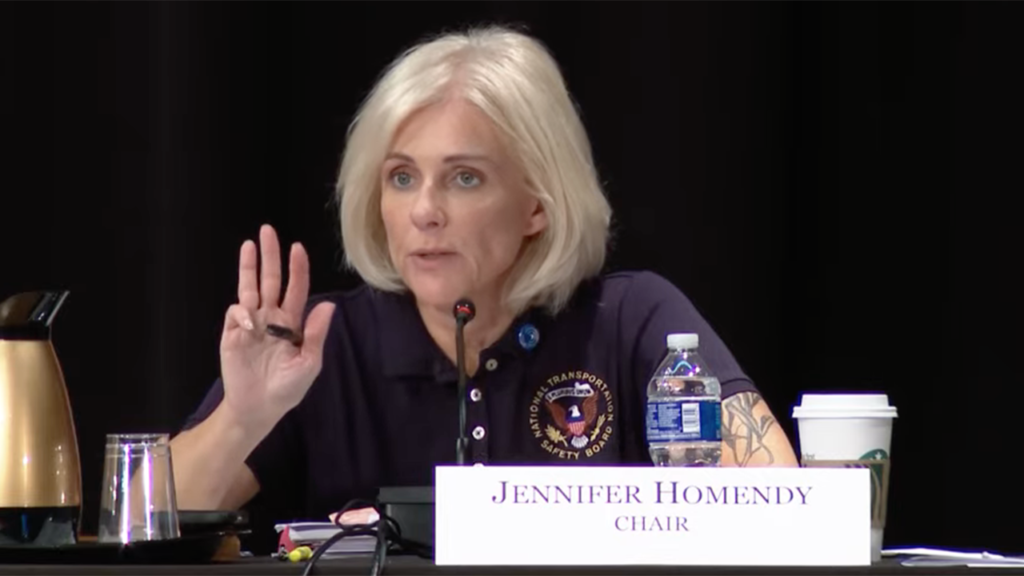
The effectiveness and credibility of the five-member NTSB flows from its ability to investigate transportation accidents objectively and impartially; identify regulatory gaps and engineering flaws; and make recommendations as to improved safety practices—all absent political pressure. NTSB members, although politically affiliated, are expected to check political leanings at the agency’s front door.
Democrat Jennifer Esposito Homendy, originally nominated to the Board in 2018 by the current Republican President, and to a second term as chairperson by Democratic President Biden—the latter post expiring in 2027—has repeatedly demonstrated a John McCain-type independence by advancing positions opposed either by rail labor or rail management. Her “just the facts” approach has her concluding there is insufficient data to take a position on minimum train crew size, that grade crossings “are among the deadly spaces in our rail system,” and technology “should be used to supplement humans, not to supplant them.”
Were the President to gain Executive Branch authority over the NTSB, public trust would depend on preserving its decision-making autonomy and not seeking to remove Homendy as chairperson.
Other NTSB members include Democrats Alvin Brown and Tom Chapman and Republicans J. Todd Inman and Michael Graham. Democrat Chapman’s term expired in 2023 and his seat most likely will go to a Republican—creating a Republican majority—when the President makes a nomination.
Surface Transportation Board

As the nation’s oldest federal regulatory agency, STB’s Interstate Commerce Commission (ICC) predecessor began life in 1887 as an Executive Branch agency housed in the Interior Department. Congress designated the ICC an independent regulatory agency in 1889. An attack on that decision-making independence came in 1910 when Congress created a short-lived (three years) Commerce Court that reopened factual questions already decided, took new evidence and acted more as a trial court than an appellate tribunal.
Although Presidents have sought to influence ICC decision-making, none was successful. Teddy Roosevelt and Warren Harding discussed pending cases with ICC members; Herbert Hoover issued a public statement taking sides in a pending case; and Hoover and John F. Kennedy proposed returning the ICC to the Executive Branch (within the Commerce Department).
In 1969, however, Richard Nixon, following earlier recommendations of Harry Truman and Dwight D. Eisenhower, succeeded in gaining legislation allowing the President to name a permanent chairperson from among Senate confirmed ICC/STB members.
As the STB chairperson sits at the pleasure of the President, independent thinking can be problematic. Ronald Reagan demoted fellow Republican and ICC Chairperson Reese Taylor and Bill Clinton demoted fellow Democrat and ICC Chairperson Gail McDonald. In theory, the threat of losing one’s chairpersonship is sufficient to bend the chairperson’s will to that of the President. However, Executive Branch influence over the STB would be constrained by four voting members other than the chairperson.
The reality is that the President likely would have to fire the chairperson and other STB members, plus gain Senate confirmation of ringers to rig a voting outcome. Unlikely—even for this President, whose need for unquestioned loyalty and desire for retribution is infinite.
The STB already lost a degree of independence with a 2024 Supreme Court decision (Loper-Bright Enterprises v. Raimondo) overturning a decades old instruction (Chevron Doctrine) that appellate courts defer to an expert agency’s interpretation of an ambiguous law.
Where the STB’s decision-making independence is most challenged is having its rulings and decisions subject to political review by the White House, presumably by either the Justice Department (DOJ), Office of Management and Budget (OMB), President’s Council of Economic Advisers, the President’s First Pal Elon Musk’s 20-something crew members at the Department of Government Efficiency (DOGE)—or several of them—before being finalized. (The Executive Branch FRA must submit its rulemakings to OMB for such approval.) Imagine if the CPKC merger application decision had been subject to DOJ review.
Serving with STB Chairperson Patrick J. Fuchs—appointed to that post by the President in January—are Republican Michelle A. Schultz and Democrats Karen J. Hedlund and Robert E. Primus. A vacant fifth seat awaits nomination and Senate confirmation of a presumed third Republican.
Onwards and Sidewards
Perhaps the takeaway is that independence is a term of art. In 1957, Sen. George A. Smathers (D-Fla.) wrote, “The Interstate Commerce Commission is independent of everybody, except the President, the Congress, the courts, the Civil Service Commission, the Bureau of the Budget, and public opinion.” Smathers retired to become a railroad lobbyist.
Railway Age Capitol Hill Contributing Editor Frank N. Wilner is author of “Railroads & Economic Regulation, An Insider’s Account,” available from Simmons-Boardman Books at https://www.railwayeducationalbureau.com, 800-228-9670.