
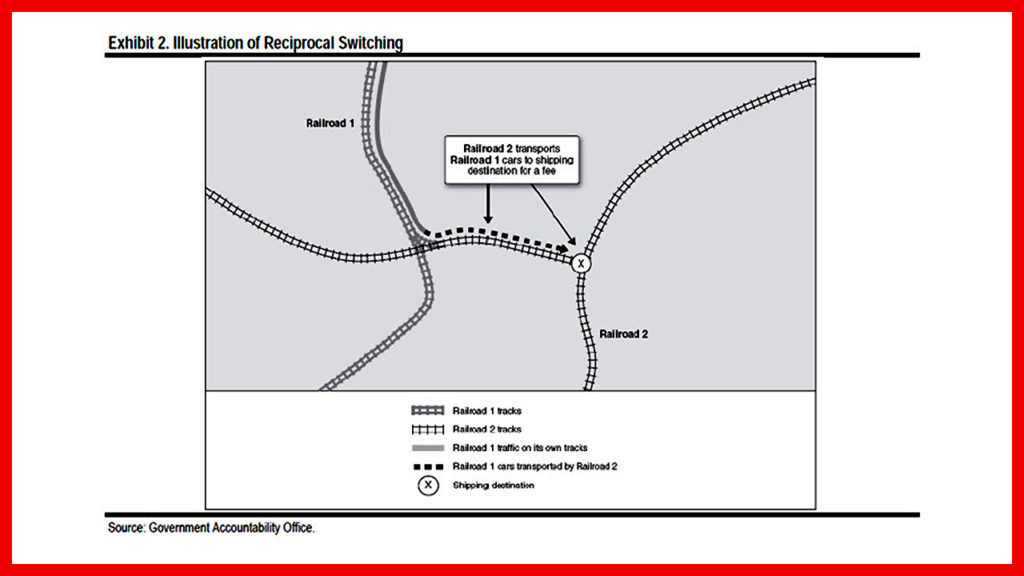
The Railroads for National Defense (RND) Program within the U.S. Army Transportation Command has submitted comments in response to the Surface Transportation Board’s (STB) decision last month proposing what it called “a significant pro-competitive action” to repeal 49 C.F.R. part 1144, which governs the prescription of reciprocal switching, through routes, and through rates.
The STB’s Jan. 7 Notice of Proposed Rulemaking “would promote market forces in the freight rail industry.” According to the Board, the NPRM “would remove regulatory barriers that limit options for American businesses critical to our economy, including both shippers, such as manufacturers, utilities, and agricultural companies, and railroads seeking to innovate and compete.” In removing these regulations, the Board said it “would employ reasoned case-by-case approaches.”
The RND Program in its Feb. 24 comments (download below) requested “consideration of military equities in the application of reciprocal switching agreements on a case-by-case basis.”
It explained that on behalf of the Department of War (DoW) and U.S. Transportation Command, the RND Program “has an ongoing interest in America’s rail network to ensure that it supports military readiness capability requirements for both defense deployment and peacetime needs.” Rail transportation, it said, “is extremely important to DoW. Heavy tracked vehicles, high-volume movements of wheeled vehicles, and other defense materiel rely on rail to meet contingency deployment timelines between inland installations and seaports of embarkation (SPOEs). The economy of scale offered by domestic freight rail transportation is a strategic advantage.”
According to the RND Program, “[w]ith the current reciprocal switching rules under 49 C.F.R. § 1145 now vacated [by the U.S. 7th Circuit Court of Appeals], the additional repeal of the anticompetitive conduct standard under 49 C.F.R. § 1144 would empower the Board to consider a prescription of reciprocal switching agreements on a case-by-case basis under the applicable statutory standards.” This “flexibility,” it said, “would allow the Board to evaluate petitions based on authority under 49 U.S.C. § 11102(c)(1), which permits the Board to require rail carriers to enter into reciprocal switching agreements when such agreements are ‘practicable and in the public interest’ or ‘necessary to provide competitive rail service.’ Establishment of competitive rail service through the application of reciprocal switching orders is necessary for the public interest and safeguarding of national defense by increasing flexibility and resiliency to deploy critical military units via rail during peace and wartime.” The RND Program told the STB that it “would strongly consider advocating for reciprocal switching agreements at critical defense activities which currently rely on a single rail carrier for service.” Such agreements, it said, “would provide DoW with necessary operational flexibility and network resiliency to proactively address any service challenges at rail dependent installations by enabling the choice of alternative carriers based on current performance, network capacity, operational efficiency needs per deployment requirements, or other constraints.” According to the RND Program, this “enhanced adaptability would significantly bolster the resilience of military operations and strengthen the homeland’s ability to project power, granting military commanders enhanced decision space in times of war or national emergency where hours in deployment delays could affect overall mission success.” Also, “the added resilience to network operations creates additional dilemmas for potential adversaries by adding infrastructure, routing, and service provider options that have been ideally exercised well beforehand,” it said. “Importantly, the RND Program would consider petition and implementation of such an order solely where it is reasonable, practicable and in the best interest of national defense. This would include an evaluation that potential service from an alternative rail carrier would be safe, reliable, and efficient to meet required timelines and other mission needs.”
The RND Program pointed out that under 49 U.S.C. § 11102(c)(1), “the Board has discretion to order reciprocal switching agreements when it determines such arrangements are either ‘practicable and in the public interest’ or ‘necessary to provide competitive rail service.’” Last July, the United States Court of Appeals for the Seventh Circuit “determined that meeting the first statutory standard requires a finding of ‘inadequate service,’” the RND Program continued. “While traditional metrics for determining inadequate service may not apply to DoW’s varied and unscheduled shipments, the adequacy of rail service to a military installation could and should be defined by its overall reliability, resiliency, and flexibility to meet military needs during times of national emergency.”
The RND Program urged “the Board to consider the unique needs of national defense when evaluating reciprocal switching petitions under a ‘case-by-case’ basis pursuant to the applicable statutory standards or under future proposed rulemaking.” Ensuring rail service “flexibility, resiliency, and reliability,” it concluded, “is critical to safeguarding military readiness, national security, and the public interest.”




