
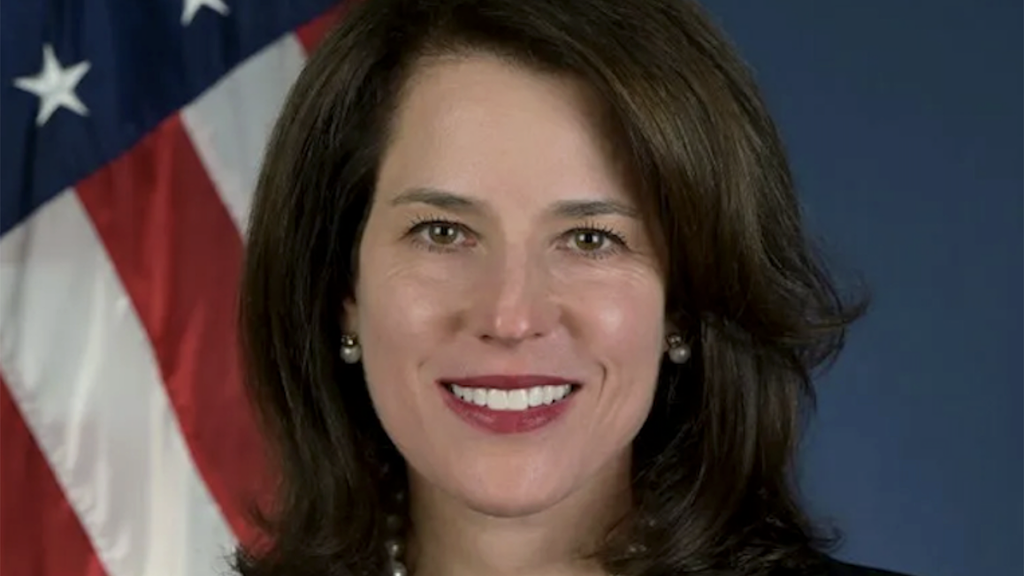
WATCHING WASHINGTON, RAILWAY AGE MARCH 2026 ISSUE: For Surface Transportation Board (STB) Vice Chairperson Republican Michelle A. Schultz, preparation and persistence paved what likely was an already preordained career path.
Serving a second and statutorily final five-year term ending Nov. 11, 2030, Schultz will be in place to vote on a Union Pacific-Norfolk Southern (UP-NS) merger application if a revised version is submitted, as expected, by April 30.
Only Republican Chairperson Patrick J. Fuchs (profiled in March 2025) is similarly assured a vote. Democrat Karen J. Hedlund, whose first term expired Dec. 31, is in a maximum 12-month holdover and must then depart if not renominated and Senate confirmed for a second term. Of the two vacant seats on the five-member board, POTUS 47 nominee and Republican Richard Kloster awaits Senate action. A Democratic seat is open after the court-challenged firing by POTUS 47 of Robert E. Primus.
Never during Schultz’ high school years—where band, cheerleading, field hockey, student council, track and volleyball filled her days, and studying her nights—did she imagine someday being nominated for a federal post by the President of the United States and having her qualifications evaluated by the United States Senate.
Nor did such thoughts occur to this human version of the Energizer bunny when studying economics, English, government administration and public policy at Penn State University—or at Widener University Law School, or later in private law practice, or subsequently working her way to deputy general counsel of Southeastern Pennsylvania Transportation Authority (SEPTA) while simultaneously earning a master’s degree in government administration at the University of Pennsylvania.
Schultz’ post-law school judicial clerkship at the bankruptcy court for the Eastern District of Pennsylvania strongly suggests career preordination. It’s the very courthouse where Penn Central filed for bankruptcy on June 21, 1970, some two years before Schultz’s birth. The echoes remain.
Even today, there is discussed in legal circles the Penn Central autopsy revealing an infamous confluence of poor management, culture clash, unrealistic projections and operational chaos compounded by STB predecessor Interstate Commerce Commission ordering an already bankrupt New England railroad, the New Haven, into the ill-fated marriage.
Might the unanimous January STB decision rejecting the UP-NS merger application, without prejudice for refiling with improved data and cured of other deficiencies, echo the wreck of Penn Central? Didn’t President Ronald Reagan counsel, “Trust, but verify?”
Schultz was Senate-confirmed in 2020 to occupy in January 2021 a new and still vacant seat created by the 2015 Surface Transportation Board Reauthorization Act.
In reviewing cases ahead of voting, Schultz is known for persistently questioning STB staff experts on economics, environmental science and agency precedent. Where Government in Sunshine laws and the 2015 Surface Transportation Board Reauthorization Act permit, she is known to prod peers aggressively to reveal the thought process and logic underpinning their concerns or likely vote.
Schultz’s capacity to appreciate and integrate opposing viewpoints flows from lessons learned lobbying the Pennsylvania legislature for SEPTA funding. To overcome rural Republican skepticism of transit subsidies, she employed data and logic to demonstrate that public transit’s statewide economic benefits far exceed subsidy costs.
While some allege Schultz’s voting record mirrors that of fellow Republican Fuchs—she has penned only 11 dissents—the claim lacks factual support. The similar voting record can be explained by Fuchs’ brand of pre-vote consensus building. Hedlund has penned fewer dissents.
Where Schultz has written some 25 separate expressions, pro and con, attorneys on both sides acknowledge they are cogent and well-reasoned. As with many attorneys, writing skill is attributable to studying styles of revered judges. In 2022, her dissent to a majority decision preserving Final Offer Rate Review was cited multiple times by the Eighth Circuit Court of Appeals, which vacated it.
Most remarkable at this STB is the collegiality among Schultz, Fuchs and Hedlund—a chemistry the White House and Senate should seek to preserve ahead of filling out the agency’s five seats. Those occupants could decide the most consequential railroad merger application in U.S. history.
Railway Age Capitol Hill Contributing Editor Frank N. Wilner is author of “Railroads & Economic Regulation,” available from Simmons-Boardman Books, www.railwayeducationalbureau.com/product/ railroads-economic-regulation-an-insiders-account/, 800-228-9670.




