California’s Great Redwood Trail Agency (GRTA) “has not satisfied the ‘heavy burden,’ Norfolk S. Ry. 2008, AB 290 (Sub-No. 286), slip op. at 5, to justify removing the MRY Line from the interstate rail network against the carrier’s wishes under the PC&N [public convenience and necessity] test,” the STB wrote in its Feb. 19 decision (download below). “The current and future potential use of the MRY Line to support rail service is enough to outweigh the public interests described by GRTA … Denial of the proposed abandonment will therefore be consistent with the Board’s duty to preserve and promote continued rail service.”
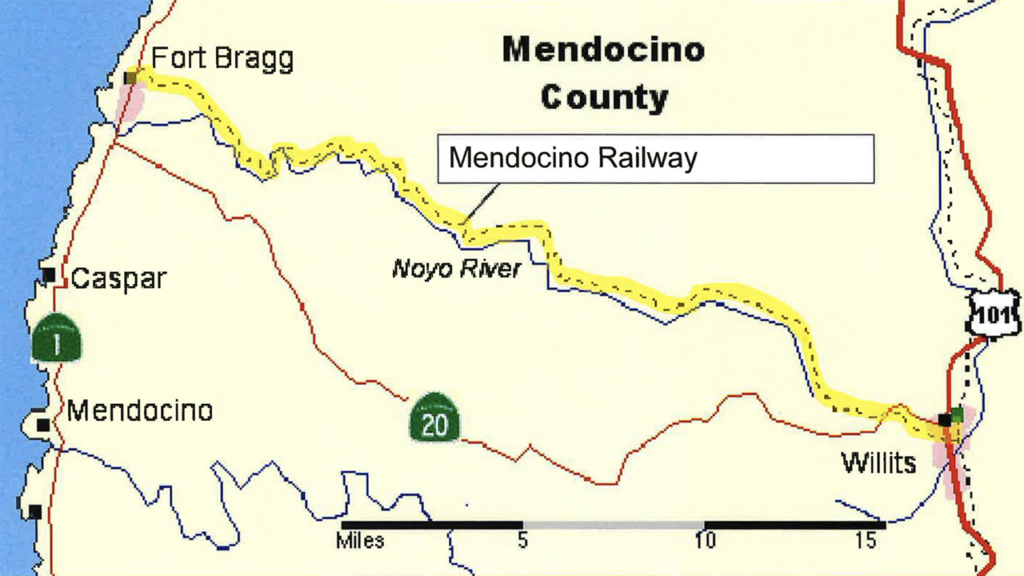
The MRY line runs about 40 miles west to east (see map, top); at Willits, it connects to a 316-mile rail line known as the Northwestern Pacific Railroad corridor (GRTA Line), according to the STB. MRY acquired its line from California Western Railroad in 2004, and the Board noted that a tunnel located approximately three miles east of Fort Bragg has been closed since 2015, making it impossible for trains to traverse the entire length of the line. The U.S. Department of Transportation in 2024 awarded MRY and its parent company, the Sierra Northern Railway, a $31.4 million Railroad Rehabilitation and Improvement Financing Loan (RRIF Loan) to finance the tunnel’s rehabilitation and certain other improvements.
While MRY operates Skunk Train excursion services between Fort Bragg and Glen Blair Junction (3.5 miles) and between Willits and Wolf Tree (16 miles), there have been no dedicated freight rail operations over its line since 2002 when Georgia-Pacific closed a Fort Bragg-based lumber mill, according to the STB. Nonetheless, the Board noted, MRY publishes a tariff for line-haul freight movements between Willits and Fort Bragg, as well as between Willits and Northspur, which is located approximately at the MRY line’s midpoint, and that MRY has occasionally performed spot moves for certain entities, transporting, for example, a milling machine by flat car for the Mendocino Land Trust and a backhoe, lumber, tools, and equipment by flat car for Camp Noyo.
According to the STB, “GRTA states that it has been directed by the State, pursuant to the Great Redwood Trail Agency Act (GRTA Act), CAL. GOV’T CODE §§ 93000-93030 (2022), to establish a long-distance recreational trail, to be known as the Great Redwood Trail, over the GRTA Line. According to GRTA, it owns the property underlying the GRTA Line from milepost 295.5 near Arcata, Cal., to milepost 63.4, located between Schellville and Napa Junction, Cal. GRTA explains that the GRTA Act expressly directs it to railbank and establish interim trail use on the GRTA Line pursuant to the National Trails System Act (Trails Act).”
The northern portion of the GRTA Line, between Eureka, Cal., and Willits, has already been authorized for abandonment by the STB and railbanked under the Trails Act, the Board wrote in its decision, and “GRTA states that it wants to seek abandonment authority for the middle portion of the GRTA Line, between the Sonoma County/Mendocino County border at milepost 89, and Willits, at milepost 139.5 (the Middle Portion), so that it can then railbank and establish interim trail use over this segment as well. GRTA states that the Middle Portion has not supported freight or passenger rail traffic in over 25 years: it has been under a Federal Railroad Administration (FRA) embargo since 1998 and ‘has not been returned to serviceable condition since [then] because of the overwhelming expense to rehabilitate it, the lack of any need for rail service on it, and the instability and flooding of the land in the right-of-way.’ But GRTA argues that it could not obtain abandonment authorization and implement the GRTA Act’s railbanking directive because a Board order authorizing the abandonment of the Middle Portion, a necessary step under the Board’s railbanking regulations, would authorize GRTA to ‘strand’ or disconnect the MRY Line from the interstate rail network, contrary to Board policy.” The STB noted that the MRY line’s connection with the Middle Portion of the GRTA Line at Willits “is its only physical connection to the interstate rail network.”
“For this reason, GRTA states that it filed the current application for adverse abandonment of the MRY Line to remove it from the interstate rail network so that GRTA can subsequently seek abandonment and railbanking authority for the Middle Portion of the GRTA Line,” the STB said. “According to GRTA, adverse abandonment is warranted because there is no present or future need for Board-regulated rail service on the MRY Line. Specifically, GRTA states that no interstate rail shipments have originated or terminated on the line since it was purchased out of bankruptcy by MRY in 2004, and that MRY has not identified a business interested in future interstate rail shipments on the MRY Line. GRTA suggests that any movement on the MRY Line necessarily must be intrastate, and thus ‘not subject to STB jurisdiction,’ because the MRY Line is no longer connected to the interstate freight rail system by virtue of the Middle Portion being embargoed and inoperable.”
The STB “has exclusive and plenary jurisdiction over rail line abandonments in order to protect the public from an unnecessary discontinuance, cessation, interruption, or obstruction of available rail service,” it explained, noting that the “standard that applies to any application for authority to abandon or discontinue a line of railroad, including in the third-party, or adverse (involuntary), abandonment context, is whether the present or future public convenience and necessity (PC&N) require or permit the proposed abandonment or discontinuance.” In making the PC&N finding, the STB said, “the statute requires the Board to ‘consider whether the abandonment or discontinuance will have a serious, adverse impact on rural and community development.’ The Board must also take into consideration, when making a PC&N determination, the goals of the Rail Transportation Policy (RTP) … and the ‘competing benefits and burdens of abandonment or discontinuance on all interested parties, including the railroad, the shippers on the line, the communities involved, and interstate commerce generally.’”
“GRTA has not established that the PC&N require or permit adverse abandonment,” the STB said. “Because MRY, which holds the common carrier obligation over the MRY Line, opposes abandonment, GRTA carries a ‘heavy burden’ … to make the required PC&N showing. GRTA has failed to meet its burden. First, MRY has put forth persuasive evidence that there is a potential for continued freight service on the MRY Line: portions of the MRY Line are operable (and operating), and MRY has taken significant steps to make the entire line operable; MRY holds itself out as a common carrier, including by publishing a tariff, and has provided occasional freight rail service; and MRY has taken reasonable steps to secure regular freight traffic once the line becomes fully operational. Second, GRTA has not overcome this ‘near dispositive’ factor. GRTA’s stated reason for seeking the adverse abandonment of the MRY Line—to facilitate development of a recreational trail on an adjacent rail corridor—is not sufficient to overcome the potential for continued spot moves and future regular service on the MRY Line, even assuming that trail and rail uses were incompatible. Moreover, nothing in the record indicates that there is such incompatibility for the Middle Portion of the GRTA Line. Indeed, no facts in the record suggest that the development of a recreational trail within the GRTA Line’s right-of-way would not be possible, provided doing so would not interfere with future rail service. Such dual use, however, would not take place under the auspices of the Board’s Trails Act regulations because, due to the Board’s precedent against stranded rail segments, the Board will not authorize abandonment of the Middle Portion while the MRY Line remains within the Board’s jurisdiction.”
Board Members Patrick Fuchs (Chairman), Karen Hedlund, and Michelle Schultz were in agreement, with Fuchs and Hedlund concurring in separate expressions.
“While I join today’s [Feb. 19] opinion, I write separately to focus on a potential solution to one of the driving issues in this case,” Hedlund wrote. “GRTA is statutorily charged with railbanking the Middle Portion of its line but is functionally prevented from doing so by the Board’s ‘stranded segment’ doctrine, which currently prohibits us from authorizing abandonment of a line where it would result in another line (here, MRY’s) becoming jurisdictionally disconnected from the interstate rail network. However, as was noted in the R.J. Corman case, slip op. at 7 (now-Chair Fuchs and now-Vice Chair Schultz concurring), nothing in the Trails Act requires that our implementing regulations be tied to a line’s abandonment, which could be altered to allow for railbanking upon a grant of discontinuance authority. In fact, just such a change has been proposed by the U.S. Department of Justice in EP 777, which is currently pending. See supra, n.21. I encourage the Board to explore ideas that could avoid application of the stranded segment doctrine in situations such as this and provide a path forward for GRTA to railbank the Middle Portion of its line despite our denial of its request for adverse abandonment in this case.”
Fuchs commented: “I write separately to emphasize Member Hedlund’s insights regarding potential reforms to the Board’s railbanking/interim trail use regulations. … Exploring ideas that allow railbanking/interim trail use via the Board’s discontinuance authority could provide rail carriers and prospective trail sponsors with additional, lower-burden options for mutually agreeable solutions to preserve established railroad rights-of-way, promote network connectivity, and encourage the establishment of appropriate trails. I intend for the Board to consider, in the near future, the petition in Docket No. EP 777 addressing potential reforms.”
MRY Responds
“We appreciate the Board’s thoughtful review,” MRY President and CEO Robert Jason Pinoli said in a Feb. 20 statement. “Our focus now is simple: protect the corridor, continue investing in it, and work constructively with regional partners on long-term solutions.”
The Board’s decision does not prevent trail development, but “makes clear that recreational trail use can coexist with rail service where properly planned,” according to MRY. The railroad is now calling for “renewed collaboration with the Great Redwood Trail Agency to pursue a coordinated rail-and-trail approach that serves both transportation and recreation goals.”
“We respect the GRTA’s vision,” Pinoli concluded. “Rail corridors are uniquely valuable because they can serve multiple public purposes. We are prepared to work together on a solution that preserves freight access, maintains passenger service, and expands trail opportunities for the community.”
MRY noted that it has “extensive experience developing and maintaining rail-with-trail projects in California and owns the specialized equipment required to build and steward trail infrastructure responsibly.”
To view the 2024 GRTA application for adverse abandonment, click here.