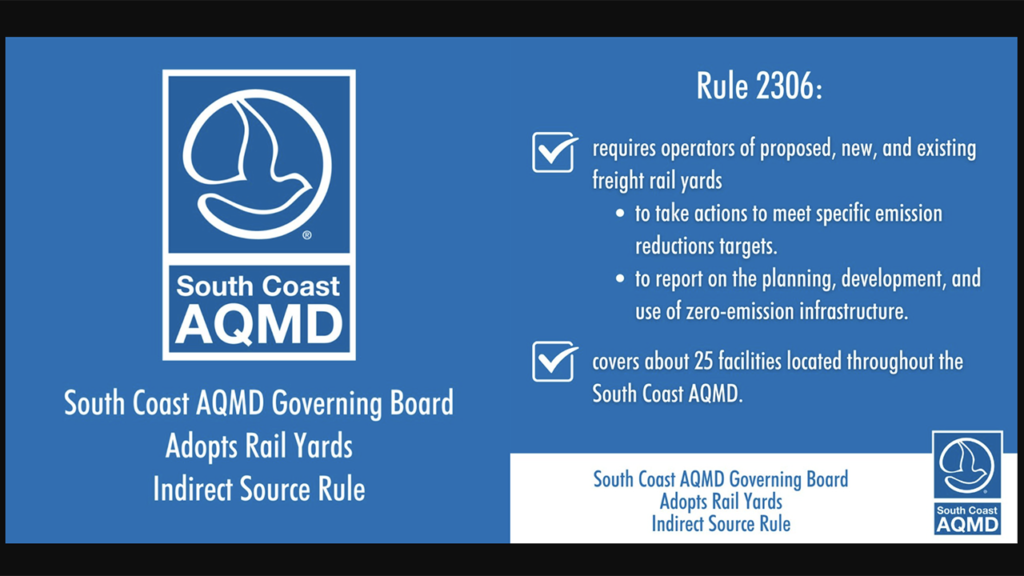
California’s South Coast Air Quality Management District’s (AQMD) Governing Board on Aug. 2 reported adopting the Freight Rail Yards Indirect Source Rule (Rail Yards ISR; Rule 2306), requiring owners or operators of proposed, new, and existing freight rail yards located within its jurisdiction “to achieve up to 82% emissions reductions by 2037 through a variety of actions including using cleaner technologies or lower emitting equipment associated with rail yards.” The rule, however, is contingent on U.S. Environmental Protection Agency approval, and EPA’s approval of the California Air Resources Board’s (CARB) associated In-Use Locomotive Rule, which would ban any locomotive that is 23 years or older from operating in California starting in 2030 and require that new locomotives only operate in the state if they are “zero-emissions,” beginning in 2030 for switch, industrial, and passenger locomotives and 2035 for line haul locomotives. The Association of American Railroads (AAR) opposes the new rule, and last year, along with the American Short Line and Regional Railroad Association (ASLRRA), filed a lawsuit, on behalf of their members, challenging the CARB rule, which they said “would limit the useful life of today’s locomotive fleet (more than 25,000 locomotives) and mandate their premature replacement with zero-emissions locomotives.”
The Rail Yards ISR covers about 25 facilities, according to the South Coast AQMD, which describes itself as “the regulatory agency responsible for improving air quality for large areas” of Los Angeles, Orange, Riverside and San Bernardino counties, including the Coachella Valley. Freight rail yards covered by the rule “are locations where locomotive switching activities occur or where cargo is loaded or unloaded from railcars for transportation to or from the rail yard using the rail yard operator’s locomotives,” it said. “Emissions associated with freight rail yards are emitted from locomotives, drayage trucks, cargo handling equipment (CHE), and miscellaneous off-road equipment like transportation refrigeration units (TRUs).”
As part of the new Rail Yards ISR, “owners and operators of freight rail yards will be required to report on the planning, development, and use of zero-emission infrastructure to support state regulations and meet broader federal and state zero-emission goals,” South Coast AQMD reported. “The rule also requires state and local government agencies to require rule compliance when they enter, renew, or amend a contract with the facility owner or operator.”
The Rail Yards ISR, the agency explained, “was carefully developed over the course of seven years through extensive outreach, beginning in 2017. Public input and feedback was solicited by engaging with various stakeholders, including communities impacted by freight rail yard emissions, potentially affected businesses and industries, environmental organizations, trade associations, public agencies, and others.”
The rule is designed to work with CARB’s In-Use Locomotive Rule, South Coast AQMD noted, and “will ensure that rail yards in the South Coast Air Basin reduce emissions.”
According to the agency, more than 80% of the NOx emissions in the South Coast Air Basin are from “mobile sources, and nearly half of these come from mobile sources associated with goods movement.” It pointed out that reductions in NOx “are essential to reducing smog and meeting federal clean air standards. Communities throughout our region are exposed to ozone and fine particulate matter caused by emissions from mobile sources going to and from rail yards. Rail yard related emissions overall contribute about 9% of total smog-forming emissions in our region.”
AAR Speaks Out
When asked for a statement regarding the Rail Yards ISR, the AAR provided Railway Age with comments it submitted late last month (scroll down to download).
“The Association of American Railroads (‘AAR’), on behalf of itself and its member railroads, respectfully submits the following comments in response to the South Coast Air Quality Management District (‘SCAQMD’ or ‘the District’) July 3, 2024, proposal for rules 2306 (‘PR 2306’) and 316.2 (‘PR 316.2’) (collectively referred to as the ‘Proposed Rules’), and the associated regulatory package,” according to a July 30 letter to South Coast Air Resource Board Assistant Deputy, Executive Officer Ian McMillan from Kathryn D. Kirmayer and Theresa L. Romanosky of the AAR, Allen Doyel of BNSF, and Nicholas J. Bryan of Union Pacific. “In promulgating this regulation, SCAQMD relies on authority granted to it under AB 617, governing Community Emissions Reduction Plans (‘CERPs’), in addition to the Clean Air Act. PR 2306 applies to owners and operators of proposed, new, and existing freight rail yards within the air district. PR 316.2 proposes fees associated with the implementation of PR 2306.
“The railroad industry is invested in reducing emissions from locomotives as quickly as reasonably possible, while protecting the efficient functioning of the national freight rail network. However, the Proposed Rules will improperly interfere with rail operations and are preempted by federal law.”
The railroad industry executives pointed out that rail operations “are not a discrete activity confined to the boundaries of a single state or air district.” The nation’s rail transportation system, they reported, “is an integrated network in which over 500 railroad companies participate, operating over 180,000 miles of track in 49 states, Canada, and Mexico.” The ICC (Interstate Commerce Act) Termination Act of 1995 (ICCTA) “preempts all state laws that may reasonably be said to have the effect of managing or governing rail transportation” and grants the Surface Transportation Board (STB) “‘exclusive’ jurisdiction over ‘transportation by rail carriers,’” the industry executives wrote. “‘Transportation’ is defined broadly to encompass ‘a locomotive, car, . . . yard, property, facility, instrumentality, or equipment of any kind related to the movement of . . . property . . . by rail’ as well as “services related to that movement. Various courts have stated the core purpose of this provision is to ensure the free flow of interstate commerce, particularly by preventing a patchwork of differing regulations across states. The Proposed Rules specifically target the operation of railroads, which means they are categorically preempted efforts to manage or govern rail transportation.”
According to the industry executives, the proposed rules are also preempted by Section 209(e) of the Clean Air Act. “Section 209(e)(1) bars states from ‘adopt[ing] or attempt[ing] to enforce any standard or other requirement relating to the control of emissions from . . . [n]ew locomotives or new engines used in locomotives,’” they wrote. “Section 209(e)(2) provides that the EPA administrator may authorize California to promulgate emissions standards relating to ‘any nonroad vehicles or engines’ not covered by section 209(e)(1)’s express preemption provision. Courts have consistently recognized that this grant of authority to California and the EPA administrator impliedly preempts any regulations of ‘nonroad vehicles or engines’ that are not so authorized.”
Among the industry executives’ other arguments:
- “Railroads cannot meet the increasingly stringent emissions reduction metrics demanded by the Proposed Rules without replacing locomotive fleets with zero-emission or near-zero emission locomotives.” They noted that “these locomotives are still in the demonstration phases and are not commercially available, nor is the infrastructure required to power such locomotives available.”
- The proposed regulations “would result in a patchwork of rules that would disrupt railroad operations and the national supply chain, particularly since the District is home to North America’s two largest intermodal ports.” They said that the “Clean Air Act preempts such de facto regulation of emissions from locomotives, even when couched in a label of indirect source regulation. The Proposed Rules are accordingly preempted.”
- “Federal law does not grant the District authority to implement ISRs regulating existing indirect sources,” such as existing rail yards.
- “The proposed rules rely on inaccurate emissions assumptions.”
“If the Proposed Rules are adopted, they would negatively impact the rail network and the global supply chain,” the industry executives concluded. “Regulation of the national rail network must be handled at the federal level. AAR and its members are committed to the reduction of emissions from railroad operations and look forward to collaborating with federal regulators on workable solutions to achieve the goals of the rail industry, EPA, and the communities in which we operate.”
Further Reading:
- Subcommittee Examines CARB’s In-Use Locomotive Regulation
- CARB Rule Discussed at Investigations and Oversight Subcommittee Hearing
- CARB’s Unattainable Rail Mandate
- Hydrogen Finds its Place in California
- BIG Reason to Blow Up CARB’s Unrealistic ‘In-Use Locomotive Rule’
- Industry Groups Urge EPA to Deny CARB Rule
- ATWG: EPA Should Deny ‘Dangerous’ CARB Rule
- ASLRRA: More Comments on CARB ‘Unworkable’ Regs
- Railroads File Suit Over CARB’s New In-Use Locomotive Regulation (Updated with TD Cowen Commentary)
- CARB Passes New In-Use Locomotive Regulation