
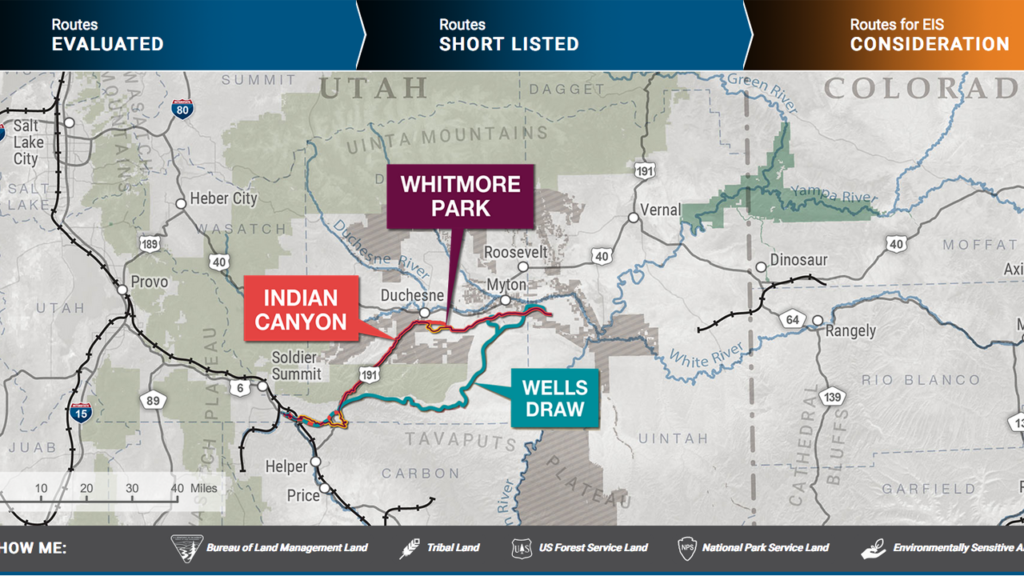
The U.S. Supreme Court (SCOTUS) on May 29, 2025 upheld 8-0 (with Justice Neil Gorsuch recusing himself) the Surface Transportation Board’s approval of the Uinta Basin Railway project, a $1.5 billion, 88-mile new-build intended to transport crude oil out of Utah’s Uinta Basin.
In Seven County Infrastructure Coalition et al. v. Eagle County et al (Case number 23-975, download below), SCOTUS reversed a 2023 D.C. Circuit Court ruling, finding that STB’s EIS (Environmental Impact Statement) for the project was sufficient and that the lower court had not afforded the agency the deference it was due. The D. C. Circuit had vacated both the EIS and the Board’s 2021 final approval order.
“D. C. Circuit failed to afford the Board the substantial judicial deference required in NEPA (National Environmental Policy Act cases and incorrectly interpreted NEPA to require the Board to consider the environmental effects of upstream and downstream projects that are separate in time or place from the Uinta Basin Railway,” SCOTUS said. “Judicial deference in NEPA cases extends to an agency’s determination of what details are relevant in an EIS. While NEPA requires an EIS to be ‘detailed,’ … and the meaning of ‘detailed’ is a legal question, … what details need to be included in any given EIS is a factual determination for the agency. The textual focus of NEPA is the ‘proposed action’—the project at hand—not other separate projects. … Courts should defer to agencies’ discretionary decisions about where to draw the line when considering indirect environmental effects and whether to analyze effects from other projects separate in time or place.”
Gorsuch “decided to sit out of the case after 13 Democratic members of Congress and advocacy groups highlighted his personal and professional relationship with Philip F. Anschutz, whose oil and gas company, Anschutz Exploration Corp., submitted an amicus brief in the dispute in support of the federal government’s approval,” Law 360 noted.
Environmental conservation groups including the Center for Biological Diversity, joined by Eagle County, Colo., challenged the STB 2021 approval, arguing the Board had violated NEPA “by not analyzing the full impact of greenhouse gas emissions from new oil extraction activity that the new line could encourage, or the potential air pollution from Gulf Coast refineries that would process waxy crude oil drilled in the Uinta Basin,” Law 360 reported. “The Board acted without assessing risks like wildfires, derailments and harm to endangered species, the opponents said.”
The D.C. Circuit in 2023 ruled that the STB improperly approved the project “by failing to fully evaluate a multitude of environmental problems with the project, including increased greenhouse gas emissions, wildfire risks and potential train derailments,” Law 360 noted. “Seven Utah counties (the Seven County Infrastructure Coalition) and the federal government fought to preserve STB’s decision, arguing it complied with NEPA’s requirements.”
Railway Age Capitol Hill Contributing Editor Frank N. Wilner said, “The Court emphasized that STB environmental reviews are to be limited to matters within the four corners of its statute and that the NEPA does not require a wandering off as de facto environmental policy czars. The STB does not regulate oil production, refining or routing. In validating the quality of STB’s review, the 8-0 SCOTUS majority rejected a dissent to that review by then-STB Chairperson Martin J. Oberman, who wanted STB to consider theories on climate change and his personal opinions as to whether a ‘need’ exists for the oil.”
In response to the SCOTUS ruling, STB Chairperson Patrick J. Fuchs said, “Over the years, some have sought to abuse NEPA by unlawfully turning a procedural tool into an ideological weapon. Today’s decision is a victory for common sense, economic growth and meaningful environmental review.”
The Seven County Infrastructure Coalition and Uinta Basin Railway LLC are represented by Paul D. Clement, Matthew D. Rowen and Kevin Wynosky of Clement & Murphy PLLC, Jay C. Johnson and Fred R. Wagner of Venable LLP and Jonathan A. Stearmer of Stearmer Law. The federal respondents are represented by Elizabeth B. Prelogar, Todd Kim, Edwin S. Kneedler, Colleen E. Roh Sinzdak, Robert J. Lundman, Justin D. Heminger and Andrew M. Bernie of the U.S. Department of Justice and Anika Sanders Cooper and Barbara Miller of the Surface Transportation Board. Eagle County is represented by William M. Jay and Jordan Bock of Goodwin Procter LLP, Nathaniel H. Hunt and Christian L. Alexander of Kaplan Kirsch LLP and Beth Oliver and Christina Hooper of the Eagle County Attorney’s Office. The environmental groups are represented by Kirti Datla, Benjamin Chagnon and Linnet Davis-Stermitz of Earthjustice and Eric Glitzenstein, Wendy Park and Edward B. Zukoski of the Center for Biological Diversity.




