
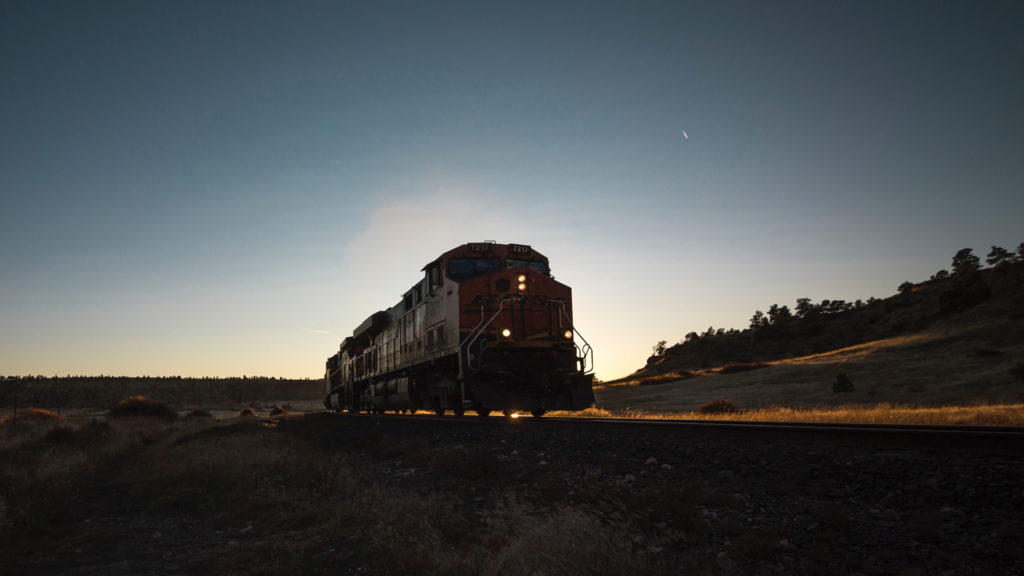
A federal judge Monday stayed railroad industry groups’ lawsuit against the California Air Resources Board (CARB), “aimed at blocking newly adopted environmental regulations which, over time, will limit pollution and greenhouse gas (GHG) emissions by locomotives,” according to a Courthouse News Service report.
According to the report, the “ambitious” set of rules, finalized in October 2023, are part of California’s overall goal of becoming carbon neutral by 2045. If the rules are implemented, “railroad companies will have until 2030 to phase out all locomotives that are more than 23 years old, and railroad companies would be forced to start setting aside more than $1 billion a year to purchase zero-emission locomotives and other equipment. Trains would also be banned from idling for more than 30 minutes.”
In June 2023, the Association of American Railroads (AAR) and the American Short Line and Regional Railroad Association (ASLRRA), representing both freight and passenger railroads, filed a lawsuit against CARB, claiming that the new regulations were “preempted by federal laws, including the Clean Air Act and the Interstate Commerce Commission Termination Act (ICCTA),” according to the Courthouse News Service report.
The two associations said in a press release after the lawsuit was filed that the new regulations “would limit the useful life of today’s locomotive fleet (more than 25,000 locomotives) and mandate their premature replacement with zero-emissions locomotives.”
“This technology has not been sufficiently tested in prototype or operational service and is not commercially available on the market today,” the associations added.
According to the Courthouse News Service report, U.S. District Judge Daniel J. Calabretta “denied the industry groups’ motion for summary judgment and granted part of the state of California’s motion for summary judgment, striking the part of the complaint that challenges the idling requirements for lack of standing.”
As for the rest of the case, Courthouse News Service reported, the Biden appointee “effectively hit the ‘pause’ button, waiting for the Environmental Protection Agency (EPA) to rule on an application by California to set air quality regulations for trains in the state.”
Federal law, Calabretta found, “preempts state regulation of emissions for new locomotives,” but not old ones, according to the report. The state has applied for permission from the EPA to regulate old locomotives. The EPA is expected to decide whether permission is required, and if so, whether or not to grant permission, according to the Courthouse News Service report.
“Given the uncertainty both as to the scope of EPA authorization required, as well as the likelihood of authorization, the Court finds that a stay is required so the Court may have the benefit of the EPA’s decision before proceeding further,” Calabretta wrote in his decision. “While the Court is cognizant that imposing this stay may result in some prejudice to Plaintiffs, the Court finds that ruling on Plaintiffs’ Motion now would be premature and would risk disrupting the regulatory scheme that Congress has put in place for regulating locomotives and their emissions.”
According to the report,” even if the EPA does grant California the right to regulate its older trains, that only takes care of the preemption question as it relates to the Clean Air Act.” The judge said he would “determine if such approval shields those parts of the regulation from ICCTA preemption.”
California, Courthouse News Service reported, has said it will “not seek to impose the new regulations until it has secured authorization from the EPA.”
Trains play a major role in both carbon emissions and air pollution in Southern California, according to the report. According to the Los Angeles Times, the 25 rail yards in LA County and the Inland Empire are responsible for about 9% of the region’s smog-forming emissions.
Further Reading:
- Stop CARB Act Debuts in Congress
- A CARB By Any Other Name
- Subcommittee Examines CARB’s In-Use Locomotive Regulation
- CARB Rule Discussed at Investigations and Oversight Subcommittee Hearing
- CARB’s Unattainable Rail Mandate
- BIG Reason to Blow Up CARB’s Unrealistic ‘In-Use Locomotive Rule’
- Industry Groups Urge EPA to Deny CARB Rule




