
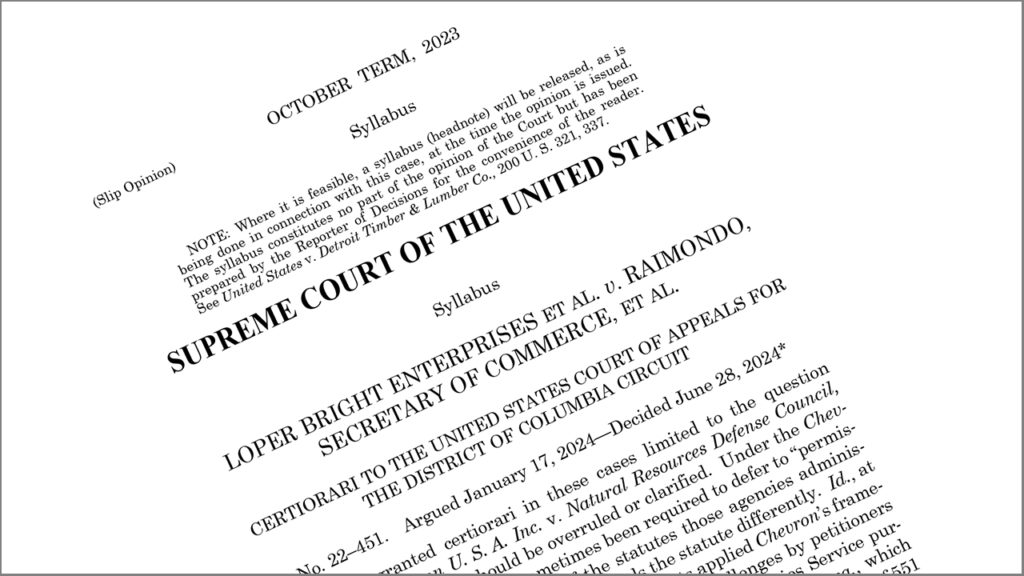
The Supreme Court has recently reshaped one of the fundamental pillars of administrative law—the Chevron doctrine, under which agencies received a level of deference in interpreting ambiguous statutes. This sea change in administrative law has significant implications for regulators and regulated entities alike, including in the rail industry.
The Supreme Court’s decision is likely to change the way that agencies like the Surface Transportation Board (STB)—the rail industry’s economic regulator—approach statutory interpretation and regulatory policy, and it will change the landscape for railroads, rail shippers, and other stakeholders affected by STB regulations. It is not clear yet how the world of rail regulation will change, but it is clear that change is coming.
The Chevron doctrine—named from the Supreme Court’s 1984 decision in Chevron v. Natural Resources Defense Council—instructed courts to give administrative agencies a level of deference in interpreting ambiguous statutory language. It set forth a two-step test. At step one, courts were to determine whether Congress has “directly spoken to the precise question at issue.” If Congress had, then that answer controlled. If Congress had not directly spoken to a question, then courts were to move to the second step, which determined whether the agency had reached a “reasonable” or “permissible” construction of the statute. If it had, then the agency’s reasonable construction controlled (even if there were other reasonable constructions available). The Chevron doctrine was a crucial part of the regulatory landscape for decades, giving agencies enormous deference on legal interpretations, especially for ambiguous or broadly worded statutes.
But Chevron deference is no more. The Supreme Court’s decision in Loper Bright v. Raimondo and Relentless v. Department of Commerce held that Chevron was incompatible with the Administrative Procedure Act (APA), which gives federal courts alone the responsibility to interpret constitutional and statutory provisions. Under Loper Bright, it is now for the courts to determine the “best” reading of ambiguous statutes rather than acceding to an agency’s “permissible” interpretation.
There is, however, room for some deference to agencies. For example, Loper Bright does not change anything about the deference to policymaking and fact-finding that is mandated by the APA. Further, the Court acknowledged that there may be cases where an agency is authorized by statute to exercise a degree of discretion. And when a court is determining the best interpretation of a statute, it may look to agency interpretations for guidance.
The Loper Bright decision will have important implications across a range of industries, including the rail industry. Several key policy debates before the STB have turned on statutory meaning, from the proper role of revenue adequacy to the circumstances under which the Board can order reciprocal switching.*
For the STB, it will have to defend its statutory interpretations—not just as a reasonable interpretation, but as the best interpretation. But arriving at the best interpretation can be a complicated endeavor. Unlike some other federal agencies, the STB—as the successor to the Interstate Commerce Commission (ICC)—administers some statutes that have their origin from more than 100 years ago. But the agency’s statutory authority has gradually decreased over time through deregulatory reforms—principally the Staggers Rail Act of 1980, which led to the financial rehabilitation of the industry, and the ICC Termination Act of 1995, which abolished the ICC and formed the STB. Further, the extensive body of ICC precedent may be highly relevant to statutory interpretation going forward. As the Court explained, administrative interpretations “issued roughly contemporaneously with enactment of the statute and remained consistent over time” are entitled to “great respect.”
For railroads and other stakeholders, Loper Bright changes the playing field, but may not upend it. The Court emphasized that it was not calling into question prior cases that relied on Chevron. Prior decisions upholding specific agency action would remain subject to statutory stare decisis,** and therefore have some degree of protection. But the decision nonetheless will likely provide opportunities for stakeholders to engage, advocate and litigate issues relating to existing rules and ongoing policy debates. At the end of the day, the post-Loper Bright world is not a world in which every policy is suddenly open to reconsideration. But it is a world in which regulatory questions will turn less on how to convince regulators to adopt policies that are a plausible interpretation of a statute, and more on how to determine the best interpretation of what Congress actually intended.

Allison Davis is a railroad regulatory lawyer who draws on her extensive government experience to help railroads achieve their business goals while complying with their regulatory responsibilities. Allison represents railroads in connection with rulemaking and other proceedings before federal agencies, such as the Surface Transportation Board (STB) and the Federal Railroad Administration (FRA). She is a counsel with Sidley Austin LLP, and earned her J.D. from Boston College Law School, where she graduated cum laude. She previously held several high-level positions at the Surface Transportation Board, including as a senior advisor to two STB Chairmen, and eventually served as the Director of the Office of Proceedings.
*The author notes that she has represented parties before the STB on issues pertaining to revenue adequacy and STB-ordered access.
**The legal principle of determining points in litigation according to precedent.




