Editor’s Note: Following are two contrasting viewpoints on Reciprocal Switching for Inadequate Service, STB Docket No. EP 711 (Sub-No. 2). If only Members of Congress could agree to disagree in respectful, knowledgeable and civil discourse like this. Not only did Dr. Huneke write the introduction to Wilner’s new book, Railroads & Economic Regulation, but the two have life-long ties. They grew up in adjoining Westchester County, N.Y., communities, they did graduate studies in economics at Virginia universities just 135 miles apart, they worked in adjoining departments at the Association of American Railroads, each spent time in senior staff positions at the STB, and both are devoted New York Yankees fans. — William C. Vantuono
Frank N. Wilner: STB’s Shift in Focus is No Remedy (Watching Washington, October 2023 Issue)

Who, pray tell, is the vampire? Is it railroads, allegedly abusing their market power to drain from captive shippers monopoly profits? Or is it aggrieved shippers, urging the Surface Transportation Board (STB) to poach from railroads the fruits of enterprise essential to maintaining and renewing plant and equipment?
Don’t look to the law for answers. In partially deregulating railroads in 1980 (Staggers Rail Act), Congress created conflicting objectives. Regulators were instructed to protect captive shippers from railroad market power abuse while simultaneously assisting railroads in earning their cost of capital (revenue adequacy).
Nor is the answer available from the STB, oft scolded for delay and favoritism.
There was no burnishing of the STB’s image last month when the five-member Board unanimously voted—Reciprocal Switching for Inadequate Service, Docket No. EP 711 (Sub-No. 2)—to shift focus from increasing shippers’ competitive options to measuring service standards as a pre-condition for competitive enhancements.
If the STB’s assumption is that railroads are in business to sell shoddy service at inflated prices, it possesses authority to create efficient and effective remedies—competition—without painting a new face on a rulemaking dating to 2011 and with roots to 1985.
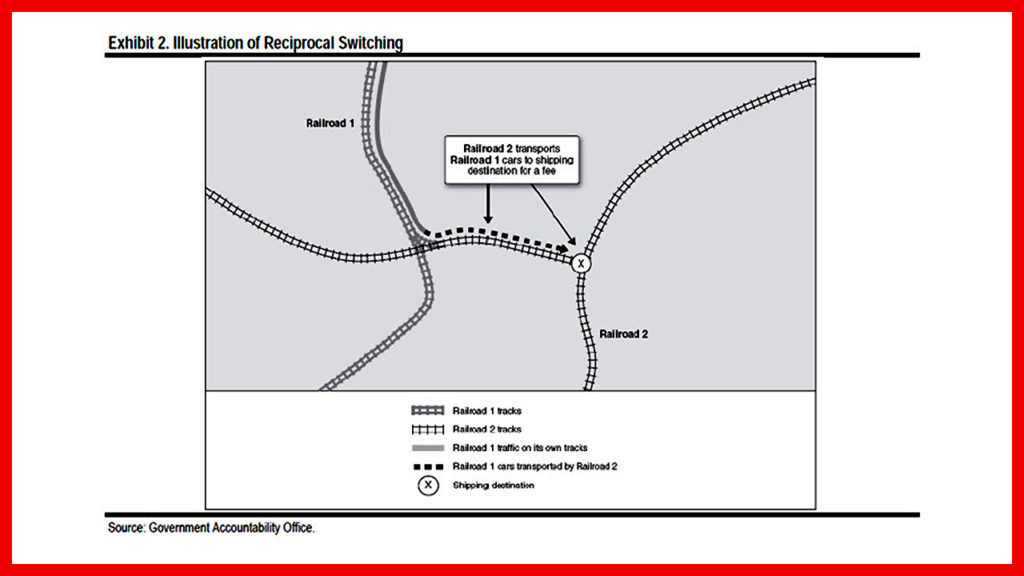
The STB’s unused and rusting tools include capping rates for revenue adequate railroads; requiring reciprocal switching at sole-served shipper origins and destinations (the interchange of freight cars with a competitor at the nearest feasible junction); or requiring the sole-serving railroad to quote a rate to such a junction over the bottleneck (railroads now are required only to quote a rate from origin to destination no matter that they have an origin and/or destination monopoly).
Regulators ruled in 1985 (Coal Rate Guidelines) that once a railroad achieves revenue adequacy it be subject to a rate cap and “not consistently earn, over time, a return on investment above the cost of capital.” Yet regulators dither over enforcement, notably ignoring tens of billions of dollars in stock buybacks by railroads, billions of dollars in asset value premiums paid to acquire competitors or offered for them by hedge funds, and that no railroad has told investors it is revenue inadequate.
At sole-served shipper facilities, competition can be enhanced by requiring unbundling of service or rates. Long available in Canada with no railroad objection—in fact, offered by Canadian Pacific and Kansas City Southern in their merger application and advocated by then-CP CEO Hunter Harrison when he sought to acquire Norfolk Southern—is a reciprocal switching remedy. It allows a captive shipper to demand its cars be interchanged at the sole-served origin or destination with a second railroad at a feasible junction, allowing for negotiation of a lower rate on the longer, more profitable (to the railroad) linehaul, and pressures the sole-serving railroad to improve service and offer a lower origin-destination rate.
A second remedy at bottleneck origins and destinations is for the sole-serving railroad to quote a separate rate for the bottleneck segment (subject to challenge before the STB). Rate unbundling similarly allows shippers to negotiate a lower linehaul rate with a second carrier. Such competition mirrors what the Federal Communications Commission and Federal Energy Regulatory Commission mandate of telecommunications, wholesale electric power and natural gas carriers.
While shippers publicly praised the STB’s Sept. 7 ruling (who but Donald Trump speaks resentfully of magistrates holding one’s fate?), their confidential assessment is condemnatory, such as: “Despite shippers having for decades put together an exhaustive record on railroad market power abuse, the STB has proposed new rules based on service failures and no rules based on competition failures—not even a schedule or commitment with respect to competition rules.”
Why the STB terminated its focus on competitive remedies that railroads adamantly oppose is open to conjecture, as the STB provided no explanation for its action. Undeniable is that the pivot betrayed the primary complaints of captive shippers—a lack of rate competition and prohibitive hurdles to bringing and pursuing rate complaints before the Board.
What the STB has done is once again kicked the can down the road.
Bill Huneke: STB’s Shift in Approach is ‘An Appropriate Next Step’

Railroad service quality has been a subject that STB has spent much time and effort to gather information and develop an approach. Moreover, the agency has struggled with an approach to reciprocal switching (RS) and whether to use it in inject competition into markets or as a tool to resolve service problems. With its recent ruling, STB taking reasonable approach.
My good friend Frank Wilner laments that STB has backed away from using RS as a tool to enhance competition. I disagree. Please remember that STB is a small agency with little more than 100 staff, which means limited bandwidth for agency activities like rulemakings.
A focus on RS to relieve service problems could make a difference, either positive or negative, which means a need for the agency to monitor impacts. Better to use this tool in a measured fashion than trying to use it to address both service and competition in one fell swoop.
STB has set its priority. Service is a problem that STB wants to address. Having spent several years at STB and watched various rulemakings start and then linger, I applaud STB’s aim to focus its effort.
Wilner writes that STB has “unused and rusting tools” to address inadequate competition: “capping rates for revenue adequate railroads, requiring reciprocal switching at sole-served shipper origins and destinations,” or “requiring the sole-serving railroad to quote a rate to such a junction over the bottleneck …”
He is suggesting that STB has used these methods and could rapidly deploy them. I disagree. In each example, STB would have to conduct a rulemaking to develop rules to determine when and what to deploy.
Before STB could cap rates on revenue-adequate railroads, the agency would have to determine what revenue adequacy meant for rate litigation purposes. The annual revenue adequacy decisions do not provide that information. Neither STB nor its predecessor, the Interstate Commerce Commission, has ever created the rules for that finding.
Then STB would have to declare what this meant for a revenue-adequate carrier. The agency could cap rates, although no rates below the statutory threshold of 180% of revenue to regulatory variable cost. It would probably have to adopt an inflation escalator. Another possibility would be opening rail bottlenecks to competition. Or STB could suggest something else, but these aspects need to be addressed in a rulemaking.
Mandated switching can have service impacts. If STB implemented RS for service issues and competitive issues and there was an ensuing rail service crisis, would STB be able determine the cause? By focusing the RS on service issues, the agency has limited potential fallout. It has put protections in place so the incumbent could provide evidence before an agency order of potential problems.
STB has also suggested approaches to setting RS fees. It has asked for comments on a couple of methodologies that it has used in prior cases. With a track record in previous cases, stakeholders will not have to digest new or unprecedented material.
STB should take the time and make the effort to see if this approach to RS might alleviate service issues and prevent future service crises. These can be a danger to the U.S. economy’s growth and resiliency.
Whether enhancing competition will also boost the economy may not be the unalloyed tonic many seem to believe. Anyone familiar with railroad history will know that railroads have high fixed costs and can be prone to cutthroat competition in economic downturns, which can mean tears and bankruptcy. Competition will not necessarily bring better service and lower rates.
One should also remember that railroads have vertical economies. Thus, separating infrastructure provision from train operations to create competition between train operators is less efficient. Many in Europe tried this approach 20 or more years ago. It proved problematic, or in the case of the UK’s Railtrack, a disaster.
Besides, there is a natural experiment already taking place. After the CP-KCS merger, the merged entity is offering reciprocal switching. That should be studied and see what impacts and lessons ensue.
Recently, Senators Tammy Baldwin (D-Wisc.) and Shelley Moore Capito (R-W. Va.) wrote to STB commending its focus on service. They wrote: “This proposed rulemaking is an appropriate next step that will improve rail service, and we encourage you to move ahead with the final rule.”
STB’s approach is a good one. It is incremental and directed at an agency priority.
Since earning his Ph.D., Dr. Huneke has worked at AAR, STB, and as a consultant for government entities and railroads