The National Transportation Safety Board’s (NTSB) ongoing investigation of the July 19, 2024, accident involving a Norfolk Southern (NS) conductor seriously injured while switching out single coal cars at a Virginia yard will focus on “analysis of evidence collected on scene including NS’s yard operating rules and procedures, surveillance video, and accident reenactment findings,“ the agency reported Aug. 8 during the release of its preliminary report.
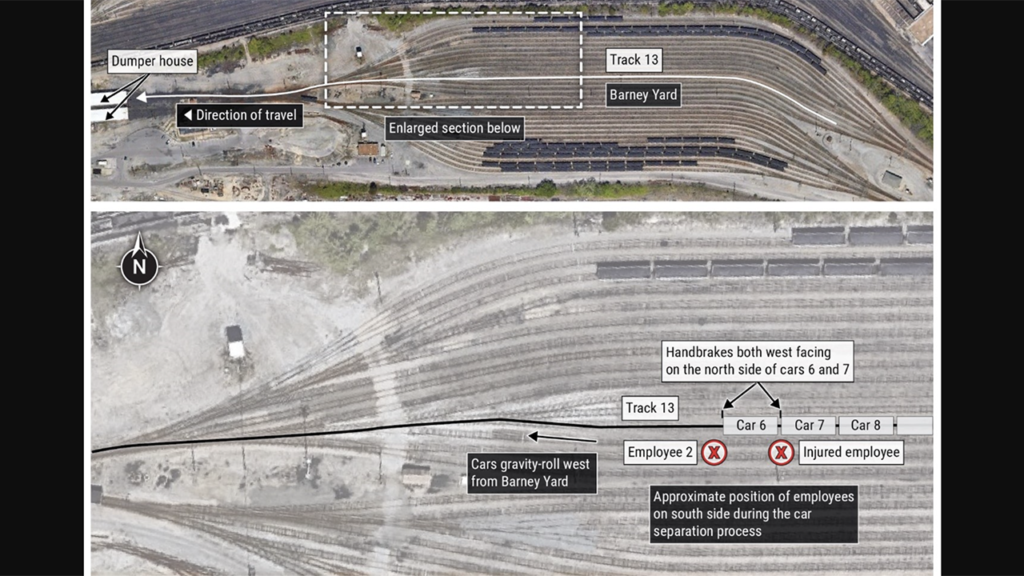
The accident occurred at about 12:35 p.m. local time at the NS Lambert’s Point Yard, within the Barney Yard section, which NTSB said operates on a westward-descending grade; railcars are manually released at the top of the grade and then roll west through a series of switches until they come to rest at the dumper house for unloading (see figure, top). What happened? At the time of the accident, “the injured employee was part of a crew preparing to release a loaded coal car at a gravity-fed switching facility [Barney Yard] when another coal car unexpectedly started to roll in his direction, running over his lower-right leg and lower-right arm, amputating both extremities,” according to the NTSB, which noted that its “information is preliminary and subject to change.” No other injuries were reported. At the time of the accident, visibility conditions “were clear, unobstructed, and sunny,” and the weather was 81°F with no precipitation, the NTSB said. No damage estimates had been provided when the agency issued its report.
“Before the accident, the injured NS employee was assigned to switching crew UC02-19, which consisted of six yard switching utility employees and one crew foreman,” the NTSB said. “The switching employees were split into three separate two-person switching crews. Each crew was tasked with releasing the brakes and uncoupling each coal car one at a time to allow it to roll down the westward-descending grade for unloading. At the time of the accident, the injured employee was working with another switching employee (employee 2 in the figure above) to release a series of coal cars from track 13 in coordination with the crew foreman’s orders. The crew had released five single coal cars from track 13 without incident. As the crew was working to release the sixth coal car, the uncoupled seventh car began to roll unexpectedly and struck the injured employee. The injured employee was transported to a nearby hospital.”
The NTSB reported that while on the scene its investigators reviewed NS’s yard operating rules and timetable instructions, conducted investigative interviews, and ran through three accident scenarios during reenactments.
Parties to the investigation include the Federal Railroad Administration; NS; the International Association of Sheet Metal, Air, Rail and Transportation Workers; and the Brotherhood of Locomotive Engineers and Trainmen.
According to the NTSB, the timing between beginning an investigation and a “probable cause determination and report varies based on the complexity of the investigation and the workload of the agency’s investigators.” Generally, the agency tries to complete an investigation within 12 to 24 months, it said.