
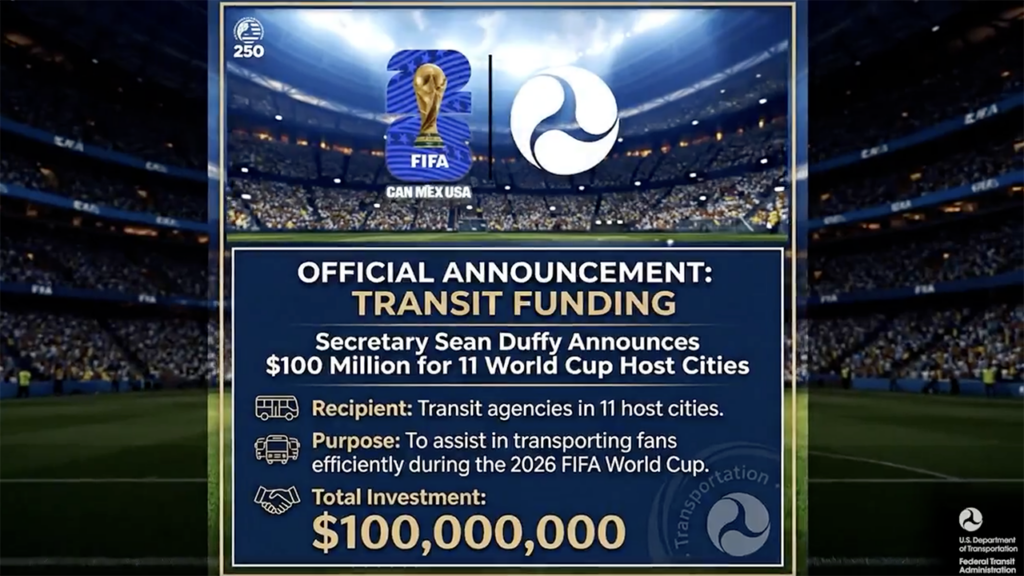
The Federal Transit Administration (FTA) on March 3 reported that it will invest $100.3 million into public transit systems within the 11 cities hosting the 2026 FIFA World Cup to ensure they can meet increased demand.
The international men’s soccer tournament will take place from June 11 to July 19, 2026, and will be hosted by 16 cities in the United States (11), Mexico (three), and Canada (two).
According to the FTA, the 2026 FIFA World Cup funding is made possible through the passage of the Consolidated Appropriations Act, 2026, and will go to the following Urbanized Areas (UZA): Atlanta, Ga.; Boston, Mass.-N.H.; Dallas-Fort Worth-Arlington, Tex.; Houston, Tex.; Kansas City, Mo.-Kans.; Los Angeles-Long Beach-Anaheim, Calif.; Miami-Fort Lauderdale, Fla.; New York-Jersey City-Newark, N.Y.-N.J.; Philadelphia, Pa.-N.J.-Del.-Md.; San Francisco-Oakland, Calif.; and Seattle-Tacoma, Wash.
It said the funding will:
- “[S]upport planning, capital, and operating expenses supporting matches and other public events held in U.S. host cities.
- “[B]e apportioned by a formula accounting for stadium capacity and number of matches in each host city.
- “Allow for 100% Federal share for these funds.
- “Require transit agencies to obligate these funds within one fiscal year of the close of the 2026 FIFA World Cup.”
FTA has prepared a frequently asked questions fact sheet and a grant-making toolkit (download both below) to help transit agencies/other transit stakeholders and “support the effective use of these funds.” Also available are guidance videos for 2026 FIFA World Cup host cities.
FTA will also hold a 2026 World Cup Funding Webinar on March 11, 2026 at 2:00 p.m. ET.
“This funding is about more than moving fans—it’s about preparing our communities to host the largest sporting event in history and ensuring the world sees America at its best,” said Andrew Giuliani, Executive Director of the White House Task Force on the FIFA World Cup 2026. “These investments will help create lasting memories for visitors and residents alike, and reinforce our commitment to safety, hospitality, and operational excellence.”
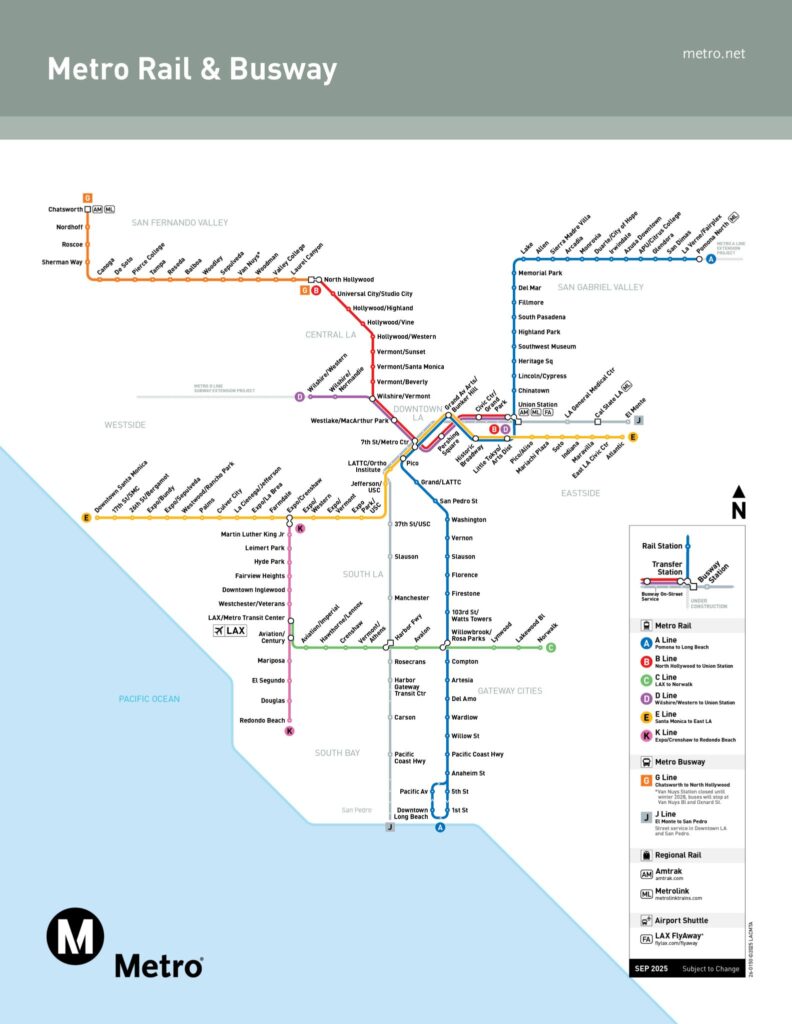
Los Angeles-Long Beach-Anaheim UZA, which is hosting eight World Cup games at SoFi Stadium in Inglewood, is receiving $9,603,284. (Click here to see all apportionments.)
“LA Metro is grateful for the leadership of U.S. Senator Alex Padilla, U.S. Senator Adam Schiff, and the advocacy of our LA County Congressional Delegation in securing federal funds to provide transit services for the 2026 FIFA World Cup games set to be held in southern California,” said Stephanie Wiggins, CEO of LA Metro (Los Angeles County Metropolitan Transportation Authority), which offers rapid transit and light rail, bus, and micro transit services. “We are also deeply appreciative for the outstanding work of the Federal Transit Administration in allocating this funding so quickly. LA Metro will continue our positive work with our transit partners across southern California to make sure fans can use transit services whether they are going to the World Cup games at Los Angeles Stadium, or enjoying the fan zones that will be held across the county.”
With Los Angeles-area residents being joined by fans from around the world and with limited parking availability at the stadium, LA Metro and more than 10 regional transit partners, including Long Beach Transit, will provide direct service from key rail stations and locations throughout the region including:
- Crenshaw Station
- Downtown Long Beach
- El Camino College
- Harbor Gateway Transit Center
- Hawthorne/Lennox Station
- LA Union Station
- LAX/Metro Transit Center Station
- North Hollywood Station
- Pierce College
Additional locations will be announced in the coming months.
LA Metro said it will also be enhancing rail service on key routes during the World Cup, plus it has developed enhanced multilingual wayfinding and plans to deploy extra Ambassadors, volunteers and security.
The San Francisco-Oakland UZA, which is hosting six World Cup games at Levi’s Stadium in Santa Clara, is receiving $8,807,888.
“After successfully delivering record-breaking transit service to Levi’s Stadium for Super Bowl 60, [Santa Clara] VTA [Valley Transportation Authority] is grateful for Senator Padilla’s efforts to secure critical federal funding to enhance safety and security as we prepare to welcome the world for the FIFA World Cup 2026,” added Carolyn Gonot, General Manager and CEO of VTA, which provides light rail, bus, and paratransit services. “These investments will help ensure a seamless, secure, and successful experience for fans and our community alike.”
Boston will receive $8,671,598 to support the World Cup matches at Gillettte Stadium. The Massachusetts Bay Transportation Authority (MBTA) “has committed to moving roughly 20,000 passengers per match in and out of Foxboro Station, using up to 14 commuter rail trains per game—a major increase compared to past events,” according to a Boston 25 News report following a Feb. 25 Massachusetts DOT Board meeting.
“Transit officials said the agency typically runs one train for Patriots games and runs four trains for the Army–Navy game,” the media outlet reported.
“Going up to 14 is monumental if you think about it,” said Phil Eng, MassDOT interim Transportation Secretary and MBTA General Manager, according to Boston 25 News, which noted that “Eng said the expanded service is being designed not only for the World Cup, but also to create a blueprint for future large-scale events.”
Public transportation will be important, the media outlet noted, because parking will be significantly reduced “due to expanded security perimeters and the setup for vendors.”
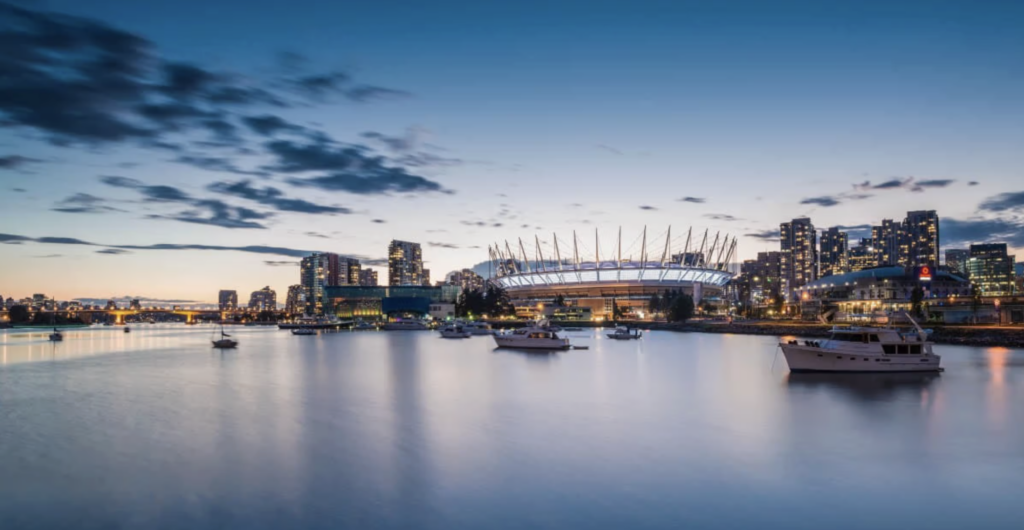
Meanwhile, TransLink in Vancouver, British Columbia, Canada has unveiled its game plan for FIFA World Cup 2026 (click here for an interactive system map). “With temporary road closures, controlled areas, and traffic management measures near venues, transit will be the fastest and easiest way to reach BC Place Vancouver and the FIFA Fan Festival Vancouver,” the agency said. Vancouver is expected to see significant surges in travel demand over a four-week period, with match days bringing the highest volumes. To meet this demand, TransLink said it will deliver service increases across bus, SkyTrain, SeaBus, and the West Coast Express commuter rail, supported by more frontline staff to manage crowds, support safety, and keep people moving efficiently.
“This region knows what it takes to host the world, and our transit system has been part of that success every step of the way,” TransLink CEO Kevin Quinn said. “Vancouver is the only 2026 host city with this track record: a World Expo, the Olympic Games, the FIFA Women’s World Cup—and now the FIFA Men’s World Cup. TransLink will leverage that experience to scale up service and move large crowds safely and reliably. Our system was built for major events, and it’s ready for the world’s biggest.”




