The Federal Railroad Administration (FRA) on May 24 reported issuing a waiver of its Buy America requirements to the Nevada Department of Transportation (NVDOT) for the planned Las Vegas-to-Rancho Cucamonga, Calif., high speed rail project. The waiver is for the non-U.S. produced high-speed rail components of the project to be operated by NVDOT-partner Brightline West.
FRA reported in the the Federal Register (download below) that because it selected the project for a $3 billion Federal-State Partnership for Intercity Passenger Rail Grant in December 2023, its Buy America requirements apply. These include: “FRA’s statutory requirements, which require 100% of the manufactured products, steel, and iron used in an FRA-funded project to be produced in the United States; and the Build America, Buy America Act (BABA), which requires all construction materials used in the FRA-funded project to be produced in the United States.” FRA said it is not waiving the applicable BABA requirements for construction materials.
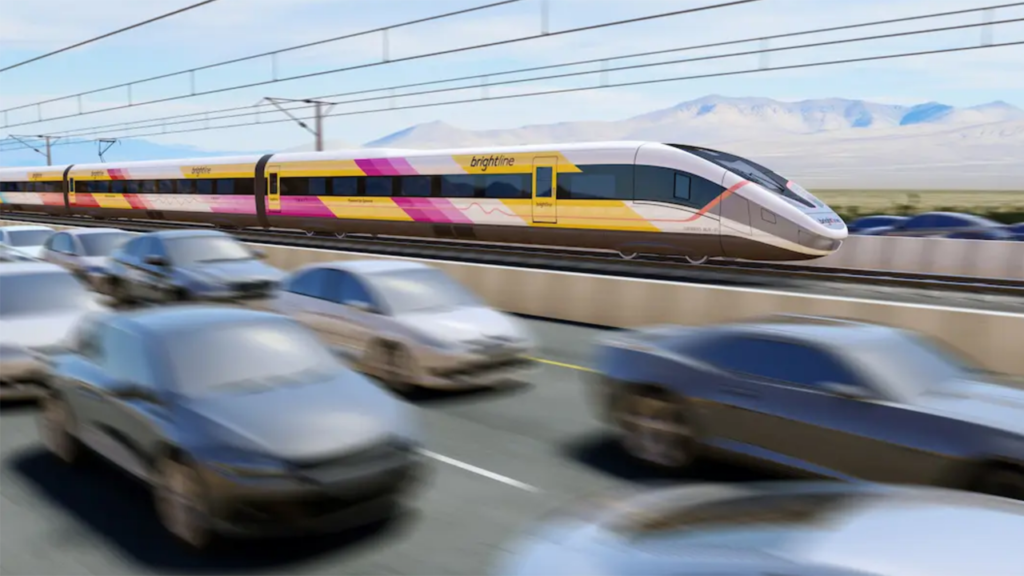
Brightline West, the project sponsor, earlier this month selected Siemens as preferred rolling stock vendor to supply 10 seven-car “American Pioneer 220” (AP 220) electric trainsets for the 218-mile, $12 billion high-speed rail system. It requested that FRA “proceed with finalizing the Buy America waiver request for the Siemens trains and other components as included in the previously submitted documentation,” according to FRA, which said it is ”waiving its requirements for the first two Siemens trainsets, car shells, signal systems, high-speed rail turnout, and fire alarm systems based on the domestic nonavailability of these components, as described in the proposed waiver.” NVDOT and Brightline West estimate that more than 95% of the total direct dollar expenditures for the project will be spent on domestically sourced products and labor, including 100% of the civil infrastructure costs, FRA reported. This waiver is effective May 29, 2024.
Background
FRA in late December 2023 sought comments on whether to grant a waiver of its Buy America requirements that would cover trainsets, signal systems, high-speed rail turnouts, and fire alarm systems, based on the “domestic nonavailability” of such components, as identified by Brightline West and at that time the two potential suppliers (Alstom and Siemens) of the rolling stock and signaling systems for the project. (Download below the announcement in Dec. 26 edition of the Federal Register.) Comments were due Jan. 25, 2024.
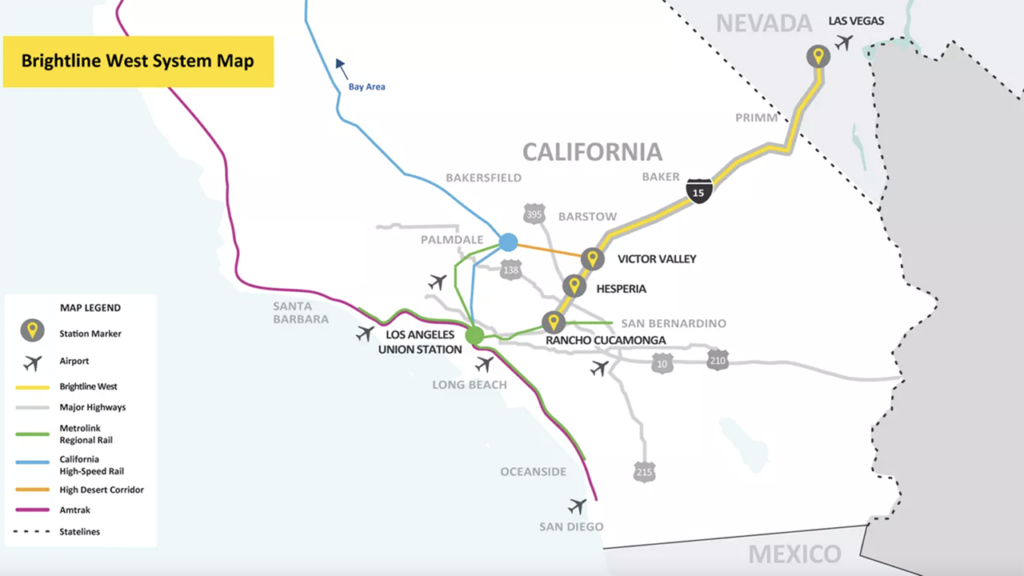
Brightline West, under the supervision and oversight of NVDOT, plans to construct the 218-mile high-speed rail project, which comprises a fully grade-separated system that will run largely within the I-15 right-of-way, with stations in Rancho Cucamonga, Hesperia, and Victor Valley, Calif., as well as in Las Vegas, Nev. Brightline West would operate and maintain the system.
According to FRA, NVDOT and Brightline West included a request for a waiver of FRA’s Buy America requirements as part of their Federal-State Partnership for Intercity Passenger Rail Grant application. The agency said that Brightline West sought to identify a domestic supplier for the rolling stock and signal system components of the project and received two responses to a Request for Interest. Siemens and Alstom “represented they could provide high-speed rail components that meet Brightline West’s specifications and applicable FRA safety requirements,” FRA said in December 2023. “However, both suppliers certified that certain non-domestic components would be required to meet the specifications, as those types of high-speed rail equipment are not produced in the United States. Brightline West consulted with each potential supplier so that their lists of non-domestic components would include only those components for which there is no available domestic option.” FRA noted that in “highly specialized systems, such has high-speed rail trainsets, components cannot be easily substituted without potential impacts to performance and safety.”
FRA said in December 2023 that Siemens was proposing to introduce “the next generation Velaro NOVO Electric-Multiple-Unit (EMU)” for the Brightline West project. “As this would be the first introduction of this technology into the United States, Siemens would plan for the first two trainsets to be manufactured and assembled in its German headquarters with American workers present to witness and learn in advance of commencing the manufacturing and assembly of the remaining eight trainsets at a new factory, which would be constructed in Nevada,” according to FRA. Under the Siemens proposal, the first two complete trainsets and the car shells for all 10 trainsets (shell structure, frame, vehicle paintwork) would not be produced in the United States.
FRA reported in December 2023 that Alstom was proposing to adapt its Avelia technology—planned for deployment on the Northeast Corridor—for Brightline West use “by increasing power capacity and traction to achieve the speed and performance capability required by Brightline West and consistent with that achieved with its TGV trains in Europe.” Manufacturing would take place at Alstom’s existing facility in Hornell, N.Y., where all 10 trainsets would be built, according to FRA. For this procurement, car shells (shell structure, frame, vehicle paintwork) and brake control units would not be produced in the United States.
According to FRA in December 2023, Brightline West noted that the project would also require the use of specialty high-speed rail turnouts “to allow trains to smoothly diverge to a passing siding, which plays a key role in safety and stability of train operations.” Fire alarm panels and devices for use in stations, garages, and maintenance facilities would be required, too. FRA said that Brightline West researched known suppliers and was not able to identify a domestic manufacturer for “Eurobalises and Euroloops,” which FRA defined as “components installed between the rails of a railway that are part of the European Train Control System [ETCS] used by Siemens. These components store infrastructure data (e.g., position reference, speed limits, line gradient, works on the line, etc.) and can send this information to the train.” They include counting heads and axle counter sensors, truck press (test stand), turnout systems including derailers, and fire alarm systems.
In their request for a waiver, NVDOT and Brightline West “indicated that they believe a waiver is justified because no manufacturers exist in the United States that can produce the components,” FRA said in December 2023, “and that the use of these non-domestic components is necessary to ensure the safety and reliability of the high-speed rail system.” Brightline West noted that it would also work to “facilitate, where feasible, a ramp up in domestic production capabilities for the materials that are not currently produced in the United States on future high-speed rail projects in the United States,” according to FRA.
Additionally, to ensure system safety, Brightline West “expects to conform with FRA’s Passenger Equipment Safety Standards governing Tier III equipment, which allows for service-proven high-speed rail technologies from around the world (in this case Europe) to be introduced to the United States with minimal modification,” FRA said in December 2023.
FRA in December 2023 proposed to waive its Buy America requirements for the Eurobalises and Euroloops, and for the rolling stock components as proposed by Siemens (if selected as the preferred supplier) and by Alstom (if selected as the preferred supplier).