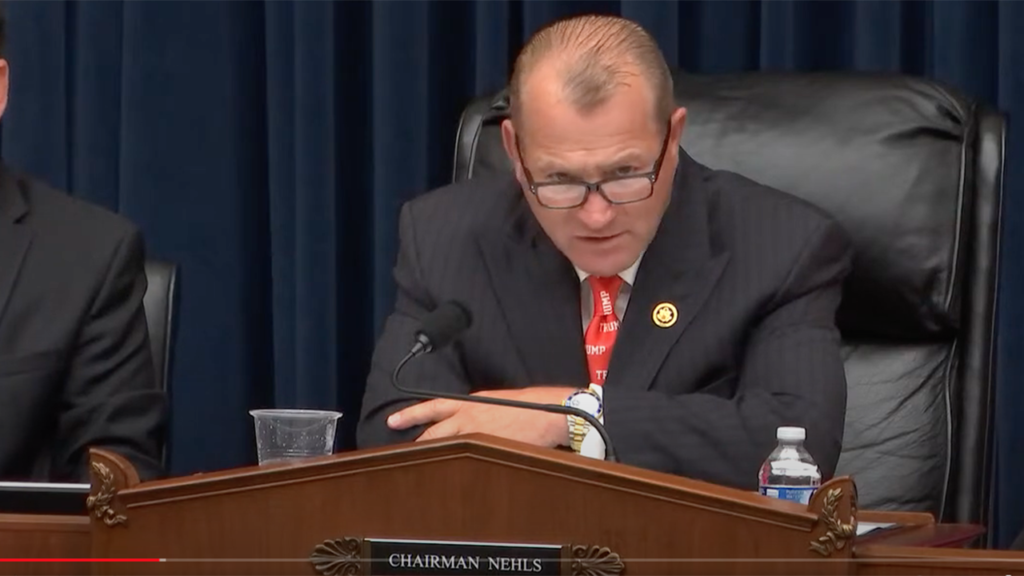
On July 23, the Rail Subcommittee of the House Transportation Infrastructure Committee convened a hearing, “Examining the State of Rail Safety in the Aftermath of the Derailment in East Palestine, Ohio,” the purpose of which, frankly, escapes me.
The National Transportation Safety Board issued its East Palestine Final Report and held a hearing three weeks prior as a sort-of preview, issuing a synopsis. The Federal Railroad Administration also issued a Final Accident Report. But I suppose that those called to testify today have little or no choice but to show up at the Rayburn House Office Building’s political circus tent and perform with a smile, repeating what has already been said.
Testifying to “review and discuss actions taken by the freight railroad industry and the federal government in response to the East Palestine, Ohio train derailment” were NTSB Chair Jennifer Homendy, Federal Railroad Administrator Amit Bose, Pipeline and Hazardous Materials Safety Administration (PHMSA) Deputy Administrator Tristan Brown, American Chemistry Council Senior Director for Regulatory and Scientific Affairs Jeff Sloan, Transportation Communications Union (TCU) National Legislative Director David Arouca, International Association of Sheet Metal, Air, Rail and Transportation Works (SMART-TD) National Legislative Director Gregory Hynes, and from the railroads or their industry associations … nobody. Yes, that’s right: nobody.
Let me get this straight: The hearing had three federal government officials, one shipper representative, two union officials … and zero railroad representation? Looks rather imbalanced and cloudy, don’t you think? Then again, when do balance and transparency have anything to do with political hearings, especially in a Presidential election year? Call me a cynic …
Yet, here is something you might find surprising—or not: Three of the “Big 6” Class I CEOs were invited to testify but declined, I was told by Subcommittee Chair Troy Nehls (R-Tex.):
“I personally invited three Class I CEOs to attend the hearing, and all of them declined, which is unfortunate because the hearing would have been a great opportunity for them to offer their perspective regarding pending legislation in both the House and Senate. It would have also been a great opportunity for them to detail the safety measures they have taken and the technologies they are deploying to make our nation’s rail network safer. I even offered to change the date of the hearing to accommodate their schedules, but it became abundantly clear they did not want to come before the subcommittee.”
And, a source familiar with the situation told me that lobbyists for the remaining three Class I’s told Nehls’ office they “would not want to testify.”
That could seem a bit disconcerting, but the individual railroads had their reasons for declining the invitation. This was supposed to be a hearing on matters pertaining to the entire rail industry, not one particular railroad. As such, the railroads would defer to the Association of American Railroads (AAR), as is typically done. My source said yes, that’s what happened, but the AAR was not invited to testify because “Congress chooses who comes before committees—AAR doesn’t.” Read into that what you like.
As well, according to the American Short Line and Regional Railroad Association (ASLRRA), “Association staff attended to listen for any discussion of short line railroads. Staff reported no mention of short lines during the hearing.”
Nevertheless, AAR President and CEO Ian Jefferies submitted a “for the record” statement (download below) to the Rail Subcommittee that details “how FRA data indicates the industry’s continued sustained safety record, proactive steps railroads have taken to further advance safety, and suggestions on how policymakers can promote a safer rail network.” Whether anyone on the Subcommittee, Republican or Democrat, will read and learn from it remains to be seen.
Here’s AAR’s statement synopsis:
“Ahead of Tuesday’s Transportation and Infrastructure Committee rail safety hearing, it is critical to recognize that rail remains the safest way to move goods over land. Regardless of the absence of a rail industry voice at the hearing, policymakers and the public should be aware of the industry’s longstanding safety record and its unwavering commitment to implementing data-driven solutions aimed at further enhancing rail safety.
“FRA Safety Data Demonstrate Broad Rail Safety Improvements
“Since 2000, rail industry effort has resulted in:
- “22% reduction in the train accident rate.
- “48% decrease in employee injuries for all railroads and 62% decline for Class I injury rate, reaching an all-time low in 2023.
- “40% drop in the main line accident rate, which represents potentially the most serious incidents on the rail network. Class I railroads reached their lowest rate of main line accidents ever in 2023.
“Freight rail remains the safest option for transporting hazardous materials over land.
- “More than 99.99% of all hazmat moved by rail reaches its destination without a release caused by a train accident.
- “The rail hazmat accident rate per carload was its lowest ever in 2023 and fell 75% from 2000 to 2023.
“Investments, Training and Technology Drive Safety Gains
“Railroads work each day to bring the industry closer to an accident-free future. This dedication drives their daily efforts to enhance safety and empower their people—from the C-suite executives to frontline workers—to prioritize safety above all else. Each year, the industry invests more than $23 billion to enhance and maintain infrastructure and deploy proven safety technologies. These sustained investments, combined with an uncompromising safety culture and a highly skilled workforce, are the foundation to the industry’s robust safety achievements.
“When Incidents Occur, Railroads Act to Enhance Safety. East Palestine is No Exception
“Following an accident, railroads fully assess their operations and apply lessons learned to drive safety enhancements. With the full NTSB report now released, the industry has collaborated to review the findings and take concrete action. In response, AAR has taken the following steps to act on the recommendations that compliment prior industry-wide response actions:
- “Develop a database of bearing failures and replacements and make it available to railroads, regulators, and investigators to help determine and address failure risk factors. AAR Actions: The rail industry tracks rail car equipment repairs and replacements, including its wheels and bearings, through an existing shared electronic records system. Railroads also have an active program to tear down failed bearings and report the information gathered. Those tear down reports are shared with an AAR Committee made up of railroads and rail suppliers who review the information to identify any systemic issues, which enables railroads and car owners to take proactive steps to prevent future accidents. Importantly, these Committee meetings have been, and will continue to be, open to the Federal Railroad Administration.
- “Revise the Manual of Standards and Recommended Practices, M-1002, Specifications for Tank Cars, to establish criteria and procedures for manufacturers of tank car service equipment to demonstrate compatibility of pressure relief devices and other Association of American Railroads-approved service equipment with intended ladings. AAR Actions: AAR is committed to establishing requirements for manufacturers to demonstrate compatibility of tank car devices with the commodities they transport (lading).
- “Revise the definition of key train in Circular OT-55 to designate as a key train any train containing tank cars transporting hazardous materials that do not meet the DOT117 standard. AAR Actions: AAR and its members are actively discussing expanding the “key train” definition.
“In addition to the recommendations explicitly made to the AAR, railroads have been reviewing NTSB recommendations to other parties and federal agencies including:
- “Inward Facing Cameras: Inward facing cameras are ubiquitous across the freight rail network, and railroads will continue to work with federal regulators on this issue.
- “Vent and Burn Procedures: Railroads have convened a working group to review current vent and burn procedures and stand ready to work with FRA on updating that decision-making process.
- “Wayside Detectors: For decades, railroads voluntarily have deployed tens of thousands of wayside detectors across the network. Following the East Palestine accident, the industry worked together to standardize and lower temperature thresholds and add thousands more detectors to the network. The industry stands ready to actively engage with FRA should it undertake the research recommended by NTSB.
- “Safer Tank Cars: The freight rail industry has supported accelerating the timeline for removing DOT-111 tank cars from service and will continue to work with FRA and Congress to change the statutory deadline for DOT-111 use.
“Policymakers Role in Enhancing Rail Safety
“Railroads continuously engaged with policymakers to implement data-driven solutions while mitigating unintended consequences. A policy response must emphasize innovation, not stifle it. In his statement, Jefferies’ outline that a successful regulatory framework should:
- “Promote equal consideration and opportunities to develop, test, and deploy new technology across all modes of transportation.
- “Use performance-based regulations to encourage investment in cost-effective, innovative solutions that enhance safety and efficiency.
- “Base regulations on solid data and sound science.
- “Encourage innovation and avoid “locking in” existing technologies and processes.
- “Ensure transparency and engage in meaningful dialogues with industry stakeholders and the public.
- “Assess the benefits of regulations against their costs, considering the overall regulatory burden.
- “Encourage waivers and pilot programs that allow for the demonstration of new safety technologies and practices and pave the wave for industry adoption when proven to successfully enhance safety.”
There you have it, from the AAR.
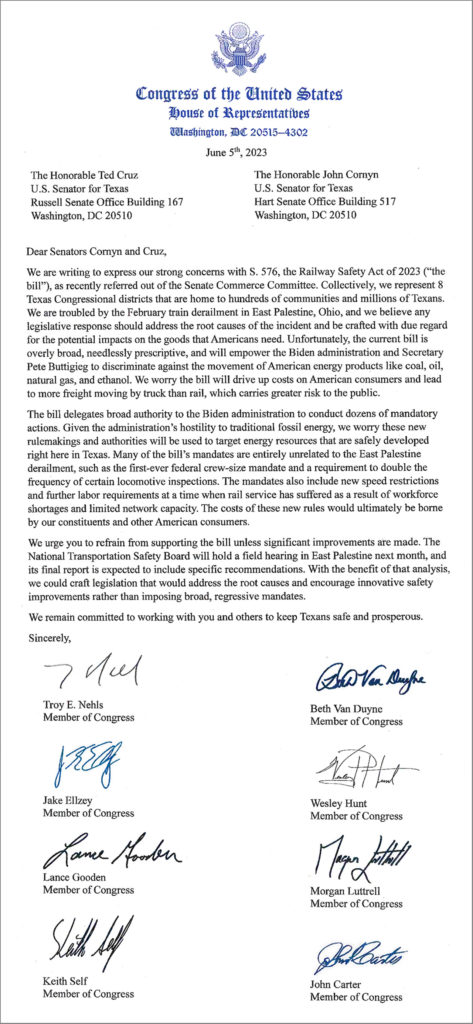
Now, H.R. 8996, the Railroad Safety Enhancement Act of 2024, co-authored by Subcommittee Chair Nehls and Ranking Member Seth Moulton (D-Mass.)—legislation virtually identical to S. 576, the Railway Safety Act of 2023, which the Senate Commerce Committee passed in May 2023 but has since died and now resides in Limbo (or Purgatory, take your pick)—was recently introduced. Excuse me, Chairman Nehls, but didn’t you and seven of your fellow Republicans from the Texas Congressional delegation only one year ago send a letter to Texas Senators Cruz and Cornyn (both Republicans) calling S. 576 “overly broad” and “needlessly prescriptive”? Remember that one?
What else is new?
What’s different about H.R. 8996 from S. 576? Not much. A few highlights:
C3RS Requirement (Section 118): Requires all Class I railroads and Amtrak to enroll in the Confidential Close Call Reporting System (C3RS) for two years.
ASKRAIL (Section 119): Requires the State Department of Transportations’ eligible for specific grants to notify first responders in their state about the existence of the app and to certify to the FRA they have completed this requirement. Because derailments often occur in remote and isolated areas, service for the application can be unreliable. Creates the ASKRAIL Connectivity Pilot Program and authorizes $25 million per year. The pilot program creates a competitive bidding process to provide service in areas along the national rail network in most need of connectivity.
Railroad Crossing Elimination Grant Program (Section 120): Authorizes an additional $1 billion on top of the Infrastructure Investment and Jobs Act (IIJA) advanced appropriations funding.
Telematics Grant Program (Section 121): Authorizes $100 million annually for the FRA to establish a grant program for railcar manufacturers to install onboard freight railcar telematics systems and gateway devices. The program will prioritize new freight railcars, as this is the easiest installation time and these cars have the longest lifespan, and tank cars carrying hazardous materials. The FRA will issue a report on the number of railcars with onboard telematics due to these funds.
Telematic Pilot Program (Section 122): Authorizes $10 million annually for an FRA pilot program to develop onboard sensors, and look to the future capabilities of these sensors, including real-time visibility, wheel/bearing/hand brake/hatch, and temperature readings.
Freight Train Crew Size (Section 154): MINIMUM CREW SIZE: A freight train operated by a Class I railroad may not be operated without a 2-person crew consisting of at least 1 appropriately qualified and certified conductor and 1 appropriately qualified and certified locomotive engineer. EXCEPTIONS: The requirement shall not apply with respect to train operations on track that is not a main line track; locomotives performing assistance to a train that has incurred mechanical failure or lacks the power to traverse difficult terrain, including traveling to or from the location where assistance is provided; locomotives that are not attached to any equip or are attached only to a caboose; and do not travel farther than 50 miles from the point of origin of such locomotive. TRAINS INELIGIBLE FOR EXCEPTION: A high-hazard train; or a train consist with a total length of at least 7,500 feet. A railroad can seek a waiver under certain conditions.
The Railroad Safety Enhancement Act of 2024 (download below) is purportedly supported by the International Brotherhood of Teamsters, Brotherhood of Maintenance of Way Employes (BMWE), Brotherhood Of Locomotive Engineers and Trainmen (BLET), TCU, Transport Workers Union (TWU), Brotherhood of Railway Carmen (BRC), International Brotherhood of Electrical Workers (IBEW), SMART-TD and SMART-MD. Do the union leaders who represent this industry’s skilled, hard-working agreement employees understand that this piece of legislation and today’s hearing may be just for show? That the objective of the Subcommittee could be to prevent such legislation from being enacted? Sen. J.D. Vance (R-Ohio), the Republican Party’s Vice Presidential nominee, was a co-sponsor of S. 576. House Republicans, I’m told by another source, “now have an obligation to not bury this new bill prematurely, simply as a courtesy to Vance. In any case, there is not sufficient floor time in the House or Senate to pass a bill that will require a House-Senate conference. The two chambers will barely have four full weeks, if that, to find floor time before the elections. And once the elections are over, there is no longer a need to play politics with this legislation, and it will probably be allowed simply to die with expiration of the 118th Congress. So at least for the foreseeable future, no bill with a crew-size mandate will pass in Congress.”
As well, House T&I Committee Chairman Sam Graves (R-Mo.) reportedly will not allow this bill out of Committee.
Here’s H.R. 8996: