The Canadian Transportation Agency (CTA) has set its determination of the Volume-Related Composite Price Index (VRCPI) for CN at 1.9281 and Canadian Pacific Kansas City (CPKC) at 1.8760 for the 2024–2025 crop year beginning Aug. 1. This is an increase in the VRCPI over the prior crop year of 5.39% for CN and 6.49% for CPKC. CTA’s Determination is No. R-2024-63
The VRCPIs will be used in determining CN’s and CPKC’s Maximum Revenue Entitlement (MRE) for the movement of western Canadian grain in the 2024–2025 crop year. The MRE limits the overall revenue earned by CN and CPKC for shipping grain, whose transportation is regulated in Canada. CTA said the VRCPIs will be applied when the agency makes its Maximum Revenue Entitlement determinations by Dec. 31, 2025, for the 2024–2025 crop year.
VRCPI determinations are based on detailed submissions from CN and CPKC on their historical price information for railway inputs involving labor, fuel, material, and other capital items as well as forecasted future changes in these price components. CTA describes the VRCPI as an “inflation factor” that reflects a composite of the railroads’ forecasted prices.
Background
The MRE is “a statutory limit on the overall revenue that can be earned by a prescribed railway company (currently only CN and CPKC) for the movement of western grain over a railway line from any point west of Thunder Bay or Armstrong, Ontario,” to: (a) Thunder Bay or Armstrong; (b) Churchill, Manitoba, for export; (c) a port in British Columbia for export, other than export to the U.S. for consumption in that country; or (d) a point west of Thunder Bay or Armstrong, if the grain is to be carried to a port in British Columbia for export, other than export to the U.S. for consumption in that country.
If a prescribed railroad’s revenue exceeds its MRE, the company must pay out the excess amount plus a penalty to the Western Grains Research Foundation. The CTA applies the formula set out in subsection 151(1) of the Canada Transportation Act (Part III, Division VI, SC 1996, c 10) to determine a railroad’s MRE. The VRCPI is one of the inputs to the formula. The CTA is required to determine the VRCPI on or before April 30, prior to the beginning of the crop year to which they relate.
Analysis
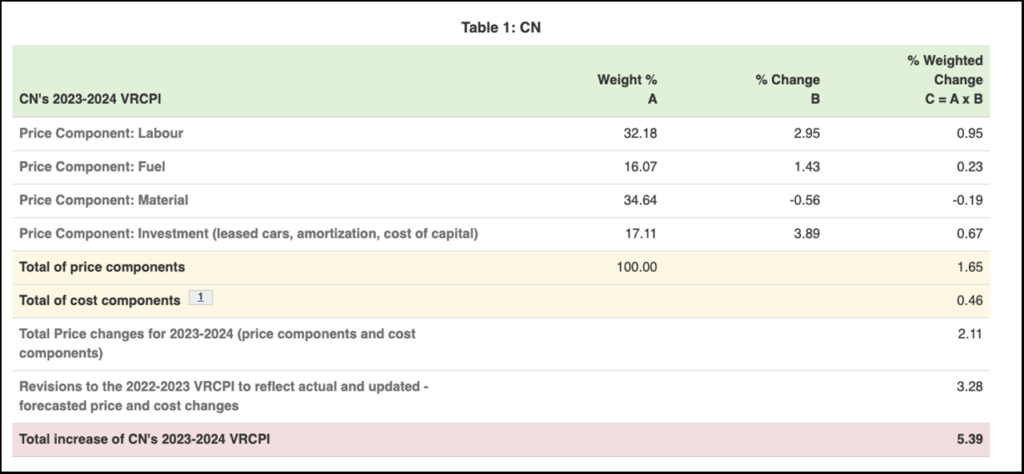
CTA said the 5.39% increase in CN’s VRCPI stems from a 3.28% increase attributable to updating previous Agency forecasted price changes for 2023 with actual price changes and incorporating revised forecasts for 2024; and a 2.11% increase in forecasted price changes for the 2024–2025 crop year as detailed in the table below:
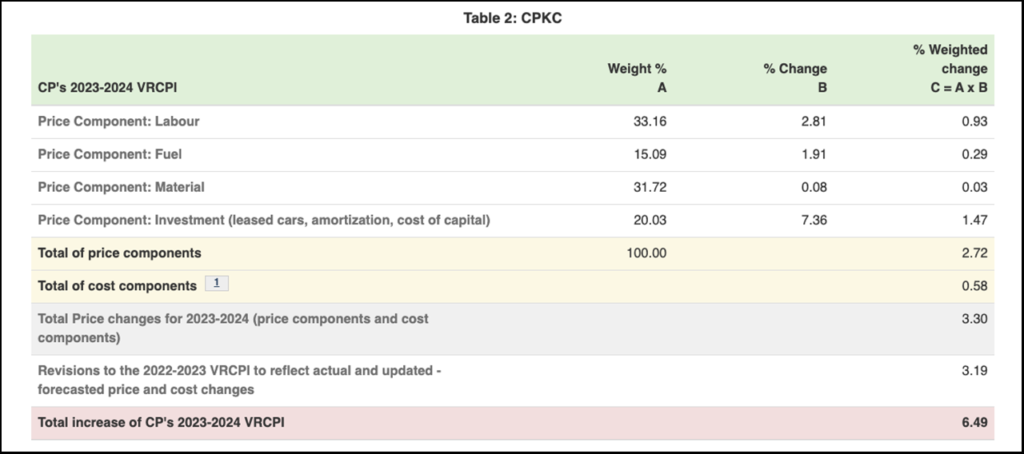
The CTA said CPKC’s 6.49% VRCPI increase in CPKC’s stems from a 3.19% increase attributable to updating previous Agency forecasted price changes for 2023 with actual price changes and incorporating revised forecasts for 2024; and a 3.30% increase in forecasted price changes for the 2024–2025 crop year as detailed in the table below:
Labor
The labor price index captures price changes in wages, wage-related items (such as bonuses and stock-based compensation), and fringe benefits (such as government and railway company pension, and employment insurance contributions). The CTA, “consistent with its practice in previous years, considered established labor contracts that extend into the future and relied on projections of historical trends for the remaining subcomponents.
For CN, the CTA forecasts a 2.95% increase in labor for the 2024–2025 crop year. “Projected increases in general wages and wage-related items, such as bonuses and stock-based compensation, were slightly offset by projected modest declines in fringe benefits which includes benefit plans and pensions,” the agency explained.
For CPKC, the CTA forecasts a 2.81% increase in labor for the 2024–2025 crop year, based on “projected increases in general wages and in wage-related items such as bonuses and stock-based compensation were slightly offset by a projected modest decline in fringe benefits.”
Fuel
“The railway fuel price index reflects changes in the average annual price per litre of diesel fuel,” the CTA noted. “The Agency uses a model based on the relationship of railway fuel prices and the price of crude oil, using the common WTI (West Texas Intermediate) benchmark, to arrive at the projected fuel index. The model also accounts for any known hedging practices, federal fuel excise tax, provincial fuel sales taxes, and carbon taxes. The Agency relies on forecasts of international crude oil prices and on the Canada/U.S. exchange rate from several expert third-party forecasters as inputs to the Agency’s fuel forecasting model.”
The CTA said the average of the third-party forecasts for the price of crude oil is US$79.80/bbl. for 2024 (an increase of 2.8% from 2023), which is forecasted to decrease by 3.0% to US$77.40/bbl. for 2025. An important element in railway fuel price index forecast development is the Canada/U.S. exchange rate, as crude oil is purchased in U.S. dollars. The average of the third-party forecasts for the exchange rate is US$0.736 for 2024 (a decline of 0.7% from 2023) which is forecasted to increase by 3.0% to US$0.758 for 2025.
The CTA forecasts a 1.43% increase for CN and a 1.91% increase for CPKC in fuel prices for the 2024–2025 crop year, “after taking into account the projected increase in the price of crude oil in 2024 and the projected decline in 2025 compared to 2023 and 2024 respectively, the associated fluctuations in the Canada/U.S. exchange rate, and increases in fuel-related taxes in the Canadian jurisdictions where the respective railways purchase their fuel.”
Material
The material price index, the CTA said reflects changes in the average annual price of “a basket of railway materials. The Agency’s long-established methodology involves a series of regressions based on the major railway material components to forecast, based on third-party data, the average material price change. The model also incorporates forecasts for the Canadian/U.S. exchange rate, as approximately 70% to 85% of materials purchased are affected by the exchange rate.
The CTA forecasts “a modest decline” of 0.56% for CN and a “relatively flat” 0.08% increase for CPKC in their respective material price indices for the 2024–2025 crop year. “These relatively flat crop year projections are a result of projected declines in the price of primary steel, fabricated metals and petroleum and coal products that were partially offset by projected increases in the Industrial Products Price Index (IPPI) and the Consumer Price Index (CPI) indicators as well as a projected increase in the Canada/U.S. exchange rate in 2025,” the agency noted. “Since railway companies purchase a large percentage of materials in U.S. dollars, a stronger Canadian dollar provides more buying power and decreases the railway companies’ overall material prices. The opposite is true when the strength of the dollar declines.”
Investment and Cost Components
Investment components include cost of capital and amortization of investments, and leased grain hopper car costs. “One of the elements used in calculating the cost of capital component of the VRCPIs is the cost of capital rate,” the CTA explained. “The Agency determined the Western Grain cost of capital rates for CN and CPKC in Determination R-2024-52 and Determination R-2024-53, respectively. This crop year, the projected cost of capital rate for CN is 6.05%, up slightly from 5.98% last year, and CPKC’s projected cost of capital rate is 8.00%, up from 7.46% a year ago. For the 2024–2025 crop year, the Agency forecasts an 3.89% increase for CN and a 7.36% increase for CPKC in their respective overall investment component indices. These increases are largely attributable to increasing infrastructure and equipment investment, and to increases in the cost of capital rates for both CN and CPKC.”
For the cost component portion of the VRCPI, the CTA forecasts a 0.46% increase for CN, “primarily attributable to the increase in lease prices,” and a 0.58% increase for CPKC, “due to an increase in the usage of U.S. subsidiary cars in moving western grain in the 2024–2025 crop year as compared to prior crop year and an increase in lease prices for Canadian leases.”