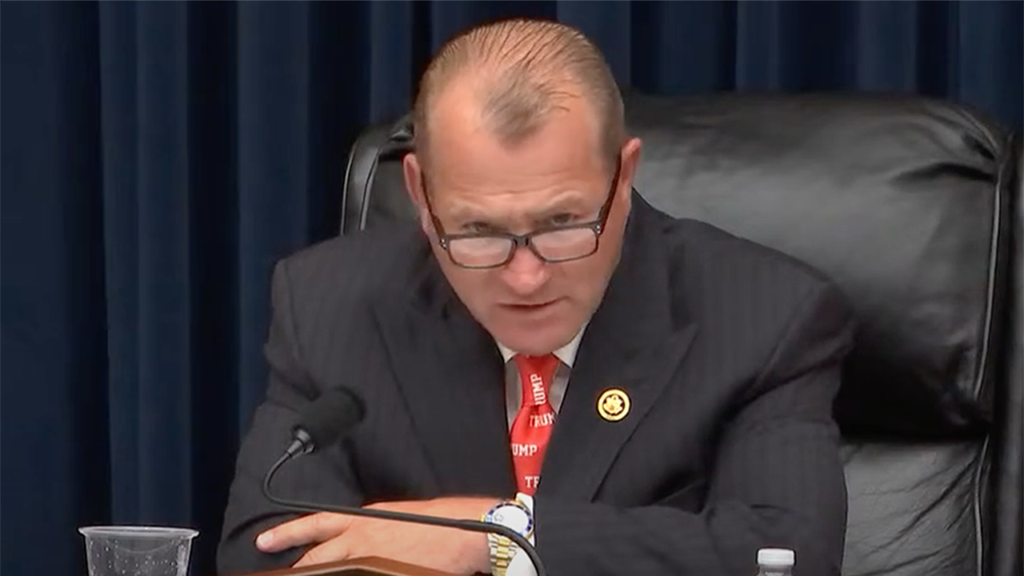
WATCHING WASHINGTON, RAILWAY AGE AUGUST 2024 ISSUE: A heap of chutzpah was served up last month by House Railroad Subcommittee Chairperson Troy Nehls (R-Tex.) at a hearing more masquerade ball than inquiry into rail safety. Imagine Nehls costumed as duplicity, the American Chemistry Council (ACC) as hypocrisy, and rail labor as false reality. By Nehls’ design, railroads were spectators.
Fraudulently billed “Examining the State of Rail Safety in the Aftermath of the Derailment in East Palestine, Ohio,” Nehls instead introduced H.R. 8996, the “Railroad Safety Enhancement Act,” with threadbare relevance to the subject matter; lacking evidentiary foundation; ignoring an impressive rail safety record—99.99% of rail-hauled hazmat arrives without incident; and binding Nehls more closely politically to Senator and Vice Presidential candidate J.D. Vance (R-Ohio), co-sponsor of S. 576, the “Railway Safety Act of 2023,” which Nehls largely duplicated.
No matter that Nehls previously termed S. 576 “overly broad” and “needlessly prescriptive.” Nehls and Vance are populists—solicitous of blue-collar workers while publicly pummeling big business. It now matters to Nehls’ political career that Vance may become Vice President and President of the Senate.
Conspicuously absent at the hearing was the Association of American Railroads (AAR). This was Nehls’ doing, over objection of his senior, Sam Graves (R-Mo.)—a trustworthy factfinder and advocate of bi-partisanship—who chairs the parent House Transportation & Infrastructure Committee.
AAR President Ian Jefferies, a former Senate staffer and no stranger to absurd political theater, could have—rather than submit a statement for the record—been in attendance and raised his hand to testify, when, on cue from Nehls, Rep. Derrick Van Orden (R-Wisc.), in costume as mendacity, excoriated railroads for their Nehls-choreographed absence.
Nehls had invited three railroad CEOs, knowledgeable that on industry issues, the AAR speaks on their behalf—and they so declined. Even Graves so-reminded Nehls. “Ethical” is not a Nehls-preferred label.
Nehls swims in self-created controversy. He is under House Ethics Committee investigation for misuse of campaign contributions; attended President Biden’s State of the Union address wearing a T-shirt decorated with Donald Trump’s mugshot; was ordered by the U.S. Army to cease wearing a Combat Infantryman badge for which he didn’t qualify; and in 1998 was fired by the Richmond, Tex., Police Department after collecting 19 violations of departmental regulations, including destruction of evidence and misleading superiors.
Abstemious public servants meticulously consider proposed mandates through a speculum reflecting expert advice, benefit/cost analysis and risk assessment to navigate a best-path forward. H.R. 8996 and S. 576 follow a populist paradigm.
A toady ACC—representing folks making things that go BOOM!, and which railroads must haul safely under a common carrier obligation—issued a press release supporting Nehls’ legislation.
Asked if that means support of the bill’s two-person train crew mandate, which has no evidenced linkage to rail safety, the ACC, hypocrisy writ large, said it has no position. Yet crew size redundancy translates to higher freight rates. As the ACC is an advocate of regulatory actions to force freight rates lower, ACC’s “what, me worry?” strategy would push railroads back toward revenue inadequacy, meaning reduced investment in safety-focused technology. It is not an outcome ACC advocates for its members.
The ACC’s hypocrisy is writ larger in supporting other provisions, such as additional locomotive and car inspections for which neither benefit/cost analysis nor risk assessment has been made; and other mandates entailing substantial costs for problems unidentified. Rail labor’s support focuses solely on a false reality that redundant headcounts should never decline.
For sure, there are positive provisions—increased investment in grade-crossing elimination and close-call reporting. The way forward is not sneaking a sophistic, politically motived, populist themed bill through the chaos of a closing congressional session or its short lame-duck aftermath. The issues are ripe for collaborative consideration, with provisions vetted as to economic efficiency and safety necessity included in a Surface Transportation Reauthorization bill in the 119th Congress next year.
A starting point is setting goals (performance standards) rather than mandates, so as to encourage, through competition among railroads, new and emerging technologies. Absolutely, technology moves faster than the ink can be applied on prescriptive regulations.
What’s Ahead?
The House and Senate are in recess until after Labor Day, and will recess again in October ahead of Election Day, meaning there is scant floor time in the Senate to debate and vote on S. 576, while the House bill must first be voted out of subcommittee and then move through the Transportation & Infrastructure Committee before reaching the House floor.
The bills are more likely to be debated during the lame-duck session following elections—a period extending to Jan. 3, 2025, when a new Congress convenes. Bills not passed by each chamber, and without textual difference, die with the close of the 118th Congress.
Then there is the Federal Railroad Administration’s (FRA) recent and independent ruling mandating two-person crews.
While the FRA rule mandates two-person crews for Class I’s, the rule offers regional and short line railroads, which already operate engineer-only, the flexibility to continue doing so—except where hazmat is carried or if operational changes are made. The American Short Line and Regional Railroad Association (ASLRRA) says small railroads wishing to inaugurate engineer-only operations will find it “very difficult” under the rule’s provisions.
In a first railroad test of the Supreme Court’s overturning the Chevron doctrine—a judicial precedent giving regulatory agencies considerable leeway in interpreting federal statutes—the Association of American Railroads (AAR) and ASLRRA have challenged the FRA’s rule as outside the agency’s authority, with the challenge also alleging the rule is arbitrary and capricious in violation of the Administrative Procedure Act.
In briefs filed July 26 with the conservative-leaning Eleventh Circuit Court of Appeals, the AAR and ASLRRA say FRA acted without evidence, quoting the National Transportation Safety Board that “there is insufficient data to demonstrate that [rail] accidents are avoided by having a second qualified person in the cab.” Railroads also cited a 2019 FRA admission that it lacked “reliable or conclusive statistical data” linking train safety with crew size.
By contrast, the railroads offered evidence that “one-person crews are just as safe as—and possibly even safer than—two-person crews,” and said “it is not a permissible exercise of [regulatory] authority to issue a regulation as necessary for railroad safety while simultaneously admitting there is no evidence that the regulation is necessary for railroad safety.”
Responses to the petitioners’ briefs are due Sept. 24; intervenors’ briefs are due Oct. 1; and petitioners’ reply briefs are due Oct. 31. There is no timetable for the court to issue a decision.
The U.S. Chamber of Commerce Aug. 2 filed a “friend of the court” brief supporting the AAR-ASLRRA position. Many ACC members are members of the U.S. Chamber. In its brief, the U.S. Chamber said, “When an agency has previously decided that the need for regulation is unsupported by the relevant facts, courts must closely examine an abrupt change in position that would impose the same regulatory burdens previously found to be unjustified.”
Also filing a “friend of the court” brief in support of the railroads was the National Taxpayer Union Foundation.
As for S. 576 and H.R. 8996, each directs the FRA to make a crew-consist rule for Class Is. Although a congressional edict to do so would exempt the rule from judicial challenge as regulatory overreach (in the wake of the Chevron doctrine’s demise), the rule might still face challenge as arbitrary and capricious under the Administrative Procedure Act for failure to be evidence based.
Notably, each bill is specific as to Class I’s. But in writing the rule as directed by Congress, the FRA might unilaterally include regional and short line railroads through its own interpretation of the statute. Yet such an interpretation, absent Chevron-doctrine protection, would risk a judicial challenge of regulatory agency overreach.
Wilner’s new book, Railroads & Economic Regulation, An Insider’s Account, is available from Simmons-Boardman Books at https://www.railwayeducationalbureau.com, 800-228-9670.