
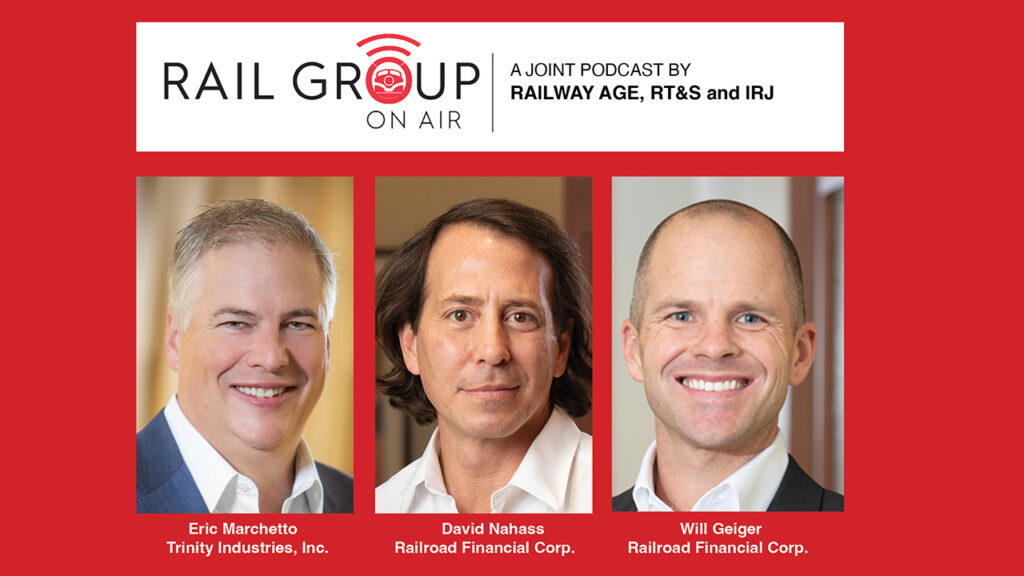
This edition of Rail Group On Air features Trinity Industries Inc. Chief Financial Officer Eric Marchetto, Railroad Financial Corporation President and Railway Age Financial Editor David Nahass, and Railroad Financial Corporation Senior Vice President Will Geiger. It’s a companion to Nahass’s “Financial Edge” column in the March issue of Railway Age.
“The abundance of capital chasing investment opportunities in rail spans the industry from railroads to maintenance and repair to—what else?—railcars and locomotives,” notes Nahass. “However, for industry veterans, the current era’s investment patterns differ from historical investment interest. Formerly, highly structured tax-affected (often leveraged) leases and Equipment Trust Certificates (ETCs, a sophisticated word for a well-collateralized loan) were the investment products of choice for asset acquisition and finance. During this time, shorter term operating leases were the province of a handful of investors taking above average risk and receiving above average, but occasionally slightly erratic, returns that followed the cyclicality of the rail equipment marketplace.
“Eric Marchetto notes that today’s capital ‘stack’ looks very different. One difference is the types of capital coming into the rail market today, including long horizon passive capital from infrastructure funds and insurance companies. These are potentially very large investors that can use one billion in equity to buy three to four billion in railcar assets. Furthermore, there are shorter-term investors repackaging rail asset backed loans as collateralized debt obligations parsing out portfolios into credit-rated tranches.This is all in the shadow of an industry expected to build 25,000 railcars in calendar year 2026.
“What do these investors love about rail? Marchetto notes that ‘rail assets represent an attractive risk-adjusted investment.’ There is low default risk, and the long-lived nature of railcars represents an inflation hedge. Marchetto sees, directly and anecdotally, more funds looking to get into the rail equipment leasing business. He sees growing demand from these investors looking for attractive returns. Investors see an opportunity for steady and consistent returns in the railcar leasing space. Think of it this way: While many railcar owners may feel that post-COVID railcar prices have risen dramatically, Marchetto notes that new railcar prices have risen 3% to 4% annually over the past 20 years. Contrast this against lease rates that have risen 1% to 2% over the same 20-year period. This gives conviction in the long-term returns and the opportunity for lease rates to continue to increase to match the rise in asset value. Couple that with the abundance of liquidity available in today’s market, which when it gets deployed will have to assume that lease rates will rise in the future to justify paying today’s prices.”




