WMATA Proposes FY2027 Budget; Adopts Updated Strategic Transformation Plan
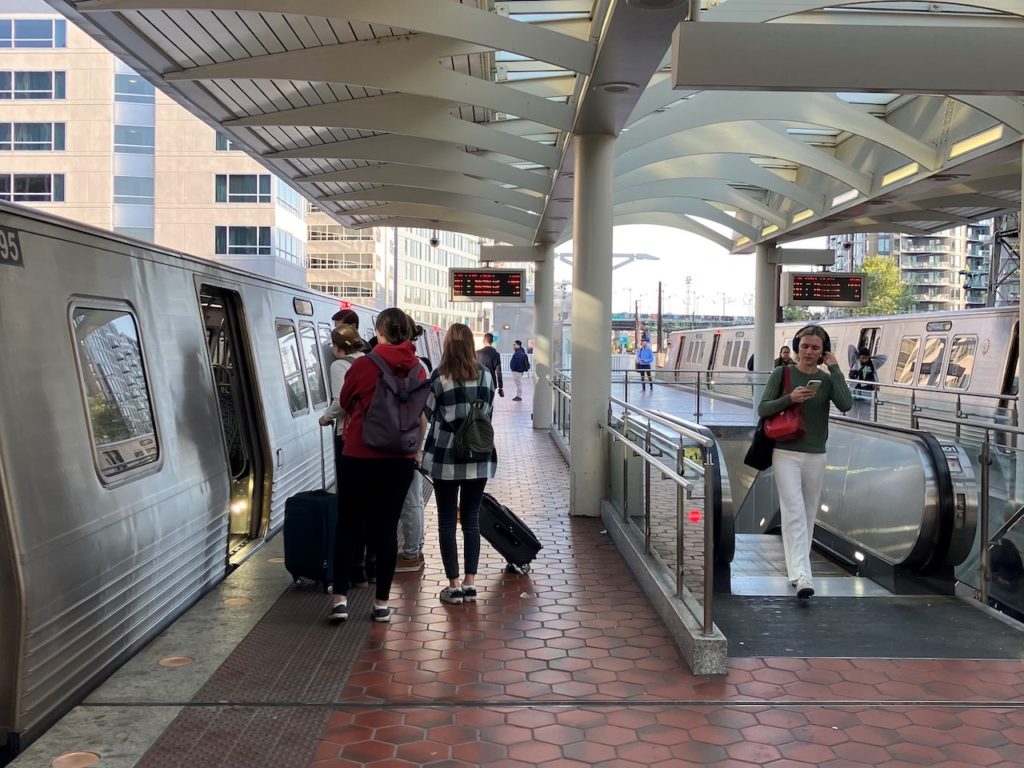
The service plan calls for shorter weekday wait times on the Orange, Silver, and Blue lines, and reduced wait times on the Red Line at night. Additionally, bus service would increase on 15% of routes across the region.
“Metro ridership has grown in recent years, and we want to continue to meet that demand for the region,” said Clarke. “This proposal reflects our commitment to delivering safe, frequent, and reliable service, while preparing Metro for the potential long-term capital challenges ahead.”
Overall, the proposal (download below) will make rail and bus operations “more efficient through schedule optimization and by adding capacity to address emerging crowding while improving reliability,” according to the agency.
For the first time, the budget proposal, WMATA says, includes a multi-year budget and service plan forecast “to foster better planning and predictability for Metro and our regional partners.”
Rail would have better all-day and late-night service with trains running every 3-6 minutes in the core and 6-10 minutes in other parts of the system on weekdays. After 9:30 p.m., trains would run every 4-8 minutes in the core.
Overall, the proposal calls for 6% more daily train trips on weekdays.
Specific increases include:
- Orange, Silver, and Blue line trains would run every 10 minutes on weekdays, an improvement on the current 12-minute service.
- Red Line trains would run every 7 to 8 minutes after 9:30 p.m., an improvement from the current 10-minute service.
WMATA is proposing two scenarios for its six-year Capital Improvement Program outlook:
- “One scenario is significantly constrained and assumes no new regional DMVMoves investment. Under this scenario, Metro will reduce capital spending and defer projects that will lead to declining reliability, worsening customer experience, and increased safety risk over time.
- “The other scenario includes the additional $460 million regional investment called for in the regional DMVMoves endorsement. DMVMoves calls for Metro to modernize its bus and rail system. Part of the improvements would address and update the rail signaling system, ensure bus reliability, and make Metro safer and more cost efficient.”
Additional information on the capital program fiscal cliff can be found here. Additional information on the DMVMoves initiative can be found here.
The WMATA Board of Directors approves the final budget in April 2026. The new budget year starts July 1, 2026, and runs through June 30, 2027.
In related news, the WMATA Board of Directors on Dec. 11 adopted the agency’s updated Strategic Transformation Plan, “a refreshed roadmap shaped directly by feedback from customers, employees, regional partners, and community stakeholders.”
The updated plan (download below), which WMATA says, “sharpens the agency’s focus on service excellence, talent development, and long-term financial and organizational efficiency,” builds on the original Strategic Transformation Plan adopted in 2023 and reflects progress the agency has made in recent years, including improvements across the system and national recognition as the 2025 Outstanding Public Transit Agency of the Year by the American Public Transportation Association (APTA).
The refresh streamlines WMATA’s strategy around three core goals—Service Excellence, Talented Teams, and Financial and Organizational Efficiency—supported by Regional Partnership and Long-Term Transit Planning actions and practices which help advance these goals, the agency noted.
“Metro is committed to delivering a transit system that is safe, frequent, and reliable every day,” said Clarke. “This updated Strategic Transformation Plan creates a clear path forward, aligns our teams and resources, and reflects the input we heard from employees, customers, and regional partners.”
Revisions to the plan were shaped through extensive engagement, including more than 40 interviews with Board members and staff, nine employee town halls, a public hearing, outreach to more than 14 regional partners and community groups, and benchmarking with peer transit agencies. Public and employee surveys and comments also informed the updates. In all, WMATA received 379 written comments from the public and staff.
The updated plan, WMATA says, “reaffirms the agency’s mission—Your Metro: Connecting you to possibilities—and vision as the region’s trusted way to move more people safely and efficiently. It introduces updated objectives and key results focused on safety and security, reliability, convenience, workforce development, financial responsibility, and organizational efficiency. The plan also strengthens Metro’s commitment to the agency’s core values: Safe, Customer Centric, Ethical, Innovative, and Continuously Improving.”
“The Strategic Transformation Plan captures our shared commitment to Metro’s future,” said Board Chair Valerie Santos. “It strengthens our ability to provide excellent service now and lays the foundation for the world-class transit system our region will depend on tomorrow.”
With Board adoption, WMATA will begin implementing the updated plan immediately, with regular public reporting to track progress and maintain transparency.