Transit Briefs: WMATA, RTA of Middle Tennessee, CTA, Denver RTD, NCTD, OC Transpo
WMATA
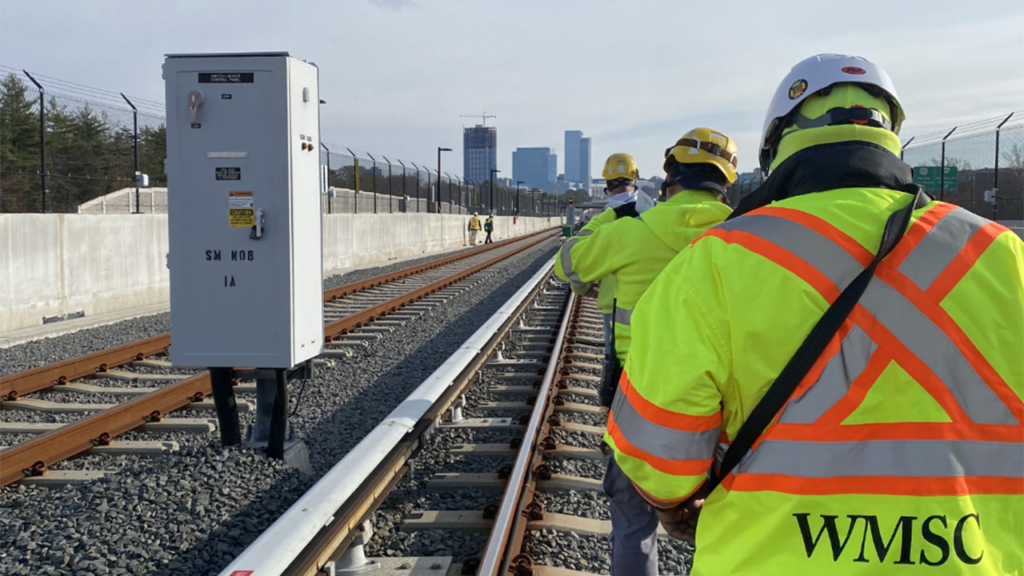
The Washington Metropolitan Safety Commission on July 31 issued a safety audit (see above) on WMATA’s Metrorail Roadway Worker Protection Program (RWP). Performed through in-depth interviews, field observations, and document and data reviews, the audit “demonstrates that although Metrorail has established policies and procedures, rules, training, and oversight of its RWP program, there are still deficiencies that put the safety of workers at risk,” according to the safety commission, which noted that during the audit, its “personnel observed unsafe practices contrary to Metrorail policies and procedures at every observation activity conducted.”
The audit includes 13 findings:
1. “Metrorail is not effectively ensuring that its personnel on and around the roadway are consistently following the Roadway Worker Protection rules designed for their safety.” The safety commission reported: “This increases the risk that personnel may be injured or killed. Between 2005 and 2010, eight Metrorail employees were struck and killed by rail vehicles. In the years since, there have been several near-miss collisions with roadway workers, including a 2016 safety event where two Federal Transit Administration (FTA) track inspectors were forced to jump out of the path of a train traveling at excessive speeds to avoid being hit near Ronald Reagan Washington National Airport Station. Since then, there have been near misses of such events that include workers narrowly escaping a fatal collision, including events that occurred in 2021, 2022, and 2023.”
2. “Metrorail is not providing its personnel with up-to-date and accessible information about the locations where additional Roadway Worker Protection is required to prevent serious injury or death.”
3. “Metrorail is not systematically identifying, tracking, and mitigating hazards related to Roadway Worker Protection as required by its Agency Safety Plan.”
4. “Metrorail is training and qualifying personnel on outdated Roadway Worker Protection-related procedures and rules.
5. “Metrorail has no process to ensure that areas requiring additional Roadway Worker Protection are accurately identified on an ongoing basis.”
6. “Metrorail directs its personnel to use forms of protection without training on the proper use of the protection. Specifically, Metrorail has no training or qualification related to local control. This contributes to an inconsistent application of Roadway Worker Protection rules.”
7. “Metrorail is not following its existing safety rules and does not have adequate training and supervisory oversight to ensure safe operation under mobile command.”
8. “Metrorail has no controls to ensure that rules in areas it designates as an ‘Authorized Construction Site’ provide the same or greater level of protection for roadway workers as those workers have in other parts of the WMATA Rail System.”
9. “Metrorail is providing RWP qualifications without following the listed requirements for those qualifications.”
10. “Metrorail is not following its procedures regarding Roadway Worker Protection Training.”
11. “Metrorail is not providing critical roadway worker-related safety information and training. Instructors do not follow the standardized curriculum and omit materials.”
12. “Metrorail is providing incorrect information about cardinal rules and incomplete testing for non-English speaking contractors in Roadway Worker Protection Training.”
13. “Metrorail requires on-the-job Roadway Worker Protection training without outlining the requirements or process for this training.”
What are WMATA’s next steps? According to the safety commission, Metrorail is required to propose corrective action plans (CAPs) to address each finding no later than 30 days after the issuance of its report. “Each proposed CAP must include specific and achievable planned actions to remediate the deficiency, the person responsible for implementation, and the estimated date of completion,” the commission said. “Each proposed CAP must be approved by the WMSC prior to Metrorail’s implementation.”
RTA of Middle Tennessee
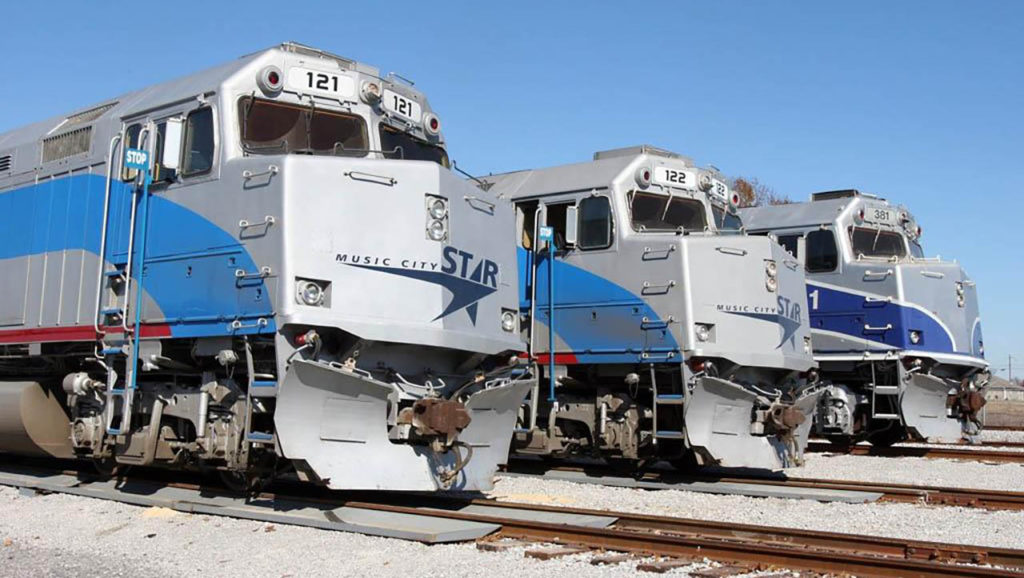
The RTA of Middle Tennessee recently released a draft transit plan (see above) for its 32-mile, seven-station WeGo Star commuter rail system (formerly the Music City Star), which has run between Lebanon and downtown Nashville, Tenn., since 2006. “A preferred future service plan is proposed that is a culmination of project team efforts involving extensive financial analysis, public feedback, modeling, and market assessments,” RTA said. “The draft transit plan proposes improvements that accommodate additional service, changing customer needs, maintain a state of good repair for the Star, and provide a positive impact on the region and station communities.”
The improvements include evening train service on weekdays, the addition of Saturday service during the day and evening, routing all train trips between Lebanon and Nashville, midday bus service between stations, and continued special event/Titans game service on Sundays.
The recommendations will go to the RTD Board for consideration. Implementation of the draft transit plan is contingent on Board approval, continued coordination host freight railroad Nashville & Eastern (an R.J. Corman Railroad Group subsidiary), and the identification of funding for increased annual operations and maintenance and one-time capital investments, according to RTA of Middle Tennessee.
CTA
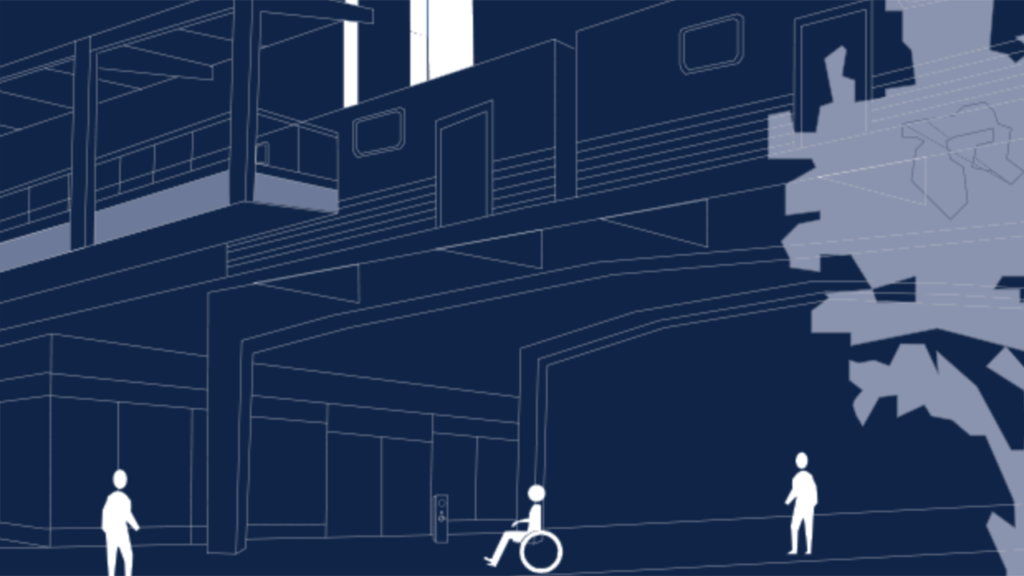
CTA’s All Stations Accessibility Program (ASAP) Strategic Plan has been updated to reflect ongoing planning, modernization and construction work, the transit agency reported July 31. The plan incorporates changes to project phasing, cost estimates, and funding sources, for example.
Unveiled in 2018 with a $2.1 billion price tag, the ASAP’s aim has been to make the 42 remaining non-accessible rail stations “vertically accessible” by 2038.
“The ASAP plan exceeds federal requirements and includes the rehabilitation and/or replacement of all 162 existing station elevators, as well as enhancements to rail system signage and wayfinding to make it easier and more intuitive for people who are Deaf-Blind, blind, and visually impaired,” CTA said. The plan, it said, also creates spaces that support riders with a range of physical, sensory and cognitive abilities to be able to independently use CTA services.
“Since the ASAP plan launched in 2018, we have secured $740.8 million in funding and construction has begun at numerous stations,” CTA President Dorval R. Carter Jr. said. “We look forward to welcoming our customers to six newly accessible CTA rail stations in 2025: Lawrence, Berwyn, Bryn Mawr and Argyle as part of the Red Purple Modernization Project in addition to the Forest Park Branch Racine and Lake Street Line–Austin stations.”
The ASAP program is broken into four phases. Stations with higher needs and lower complexity scores are prioritized for near-term improvement plans; more complex stations that require more time for planning, design, construction, agency coordination and community input are listed as part of long-term project plans, according to CTA.
Phase One is fully funded at $423.5 million and will be completed by 2027, CTA reported. The stations included are:
- Blue Line: Montrose, California, Racine.
- Green Line: Austin.
- Loop: State/Lake (CDOT-Led Project).
- Red Line: Argyle, Berwyn, Bryn Mawr, Lawrence (Red Purple Modernization Program).
According to CTA, Phase Two projects are 45% funded and projected to be completed by 2028. The total projected budget is $617.5 million. Stations include:
- Blue Line: Irving Park, Belmont, Cicero, Pulaski, Austin.
- Green Line: Oak Park, Ridgeland.
- Red: North/Clybourn.
Systemwide elevator replacement has $37 million funded to-date, CTA said. It is expected that elevator replacements will start in 2025.
While updating the plan, CTA said it also updated the overall cost for the ASAP program. The revised cost is $4.9 billion, which the agency said “is reflective of industry trends and largely the result of market conditions and cost escalation.” It noted that it has not yet received funding for stations in Phases Three and Four, and continues to seek out available funding options.
Denver RTD
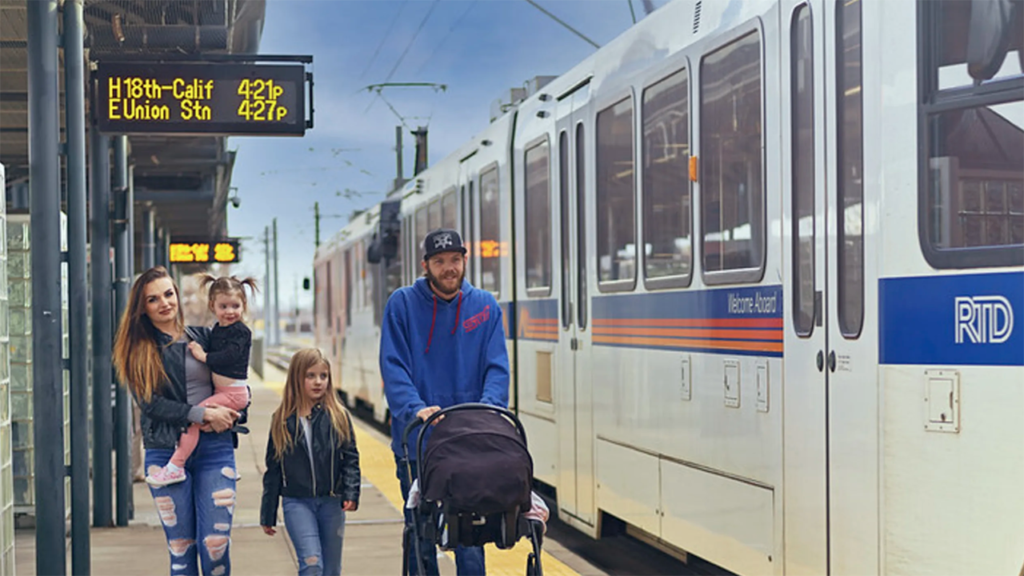
The Denver RTD Board of Directors on July 30 unanimously approved extending the Zero Fare for Youth program beyond the pilot’s scheduled end-date of Aug. 31, according to the transit agency. The program, which enables youth ages 19 and under to use all Denver RTD light rail, commuter rail and bus services at no cost, will now become permanent. To quality, youth will continue to present fare inspectors or bus operators with a valid student or government-issued ID, alien registration/permanent resident card, Military ID/dependent card with date of birth, or RTD-issued youth special discount card.
“The pilot was based on a key recommendation from the agency’s fare study and equity analysis,” Denver RTD reported. “RTD received positive feedback from many schools about the program’s impact in reducing truancy, and it garnered support from school districts, youth organizations and customers across the entire Denver metro area. The Colorado legislature passed a bill in May 2024 to appropriate up to $5 million to RTD to continue a zero-fare program for youth. SB24-032 Methods to Increase the Use of Transit outlines RTD’s eligibility to apply for and receive grant money to provide year-round, zero-fare transit services for youth.”
Denver RTD’s Community Engagement Team is scheduling outreach activities and presentations with schools and youth-focused organizations to inform parents and youth about the continuation of the program.
“Since Zero Fare for Youth began last year, my team and I have heard directly from the public that the program has proven to be a game-changer, enabling youth to have access to schools, work and extracurricular activities without the concern of how they will pay their fares,” Denver RTD General Manager and CEO Debra A. Johnson said. “Zero Fare for Youth is helping RTD’s youngest customers understand how their new habits are aiding air quality in their communities and supporting their freedom to explore and gain independence. RTD is also developing transit customers for life.”
According to Denver RTD, the Board also unanimously approved Zero Fare to Vote by offering no-cost fares during Early Voting Day on Oct. 29 and Election Day on Nov. 5.
Separately, Denver RTD recently reported multiple cases of copper wire theft near track signals, switches, and rail crossings, as well as the launch of a six-month pilot outreach program to assist customers using the system.
NCTD
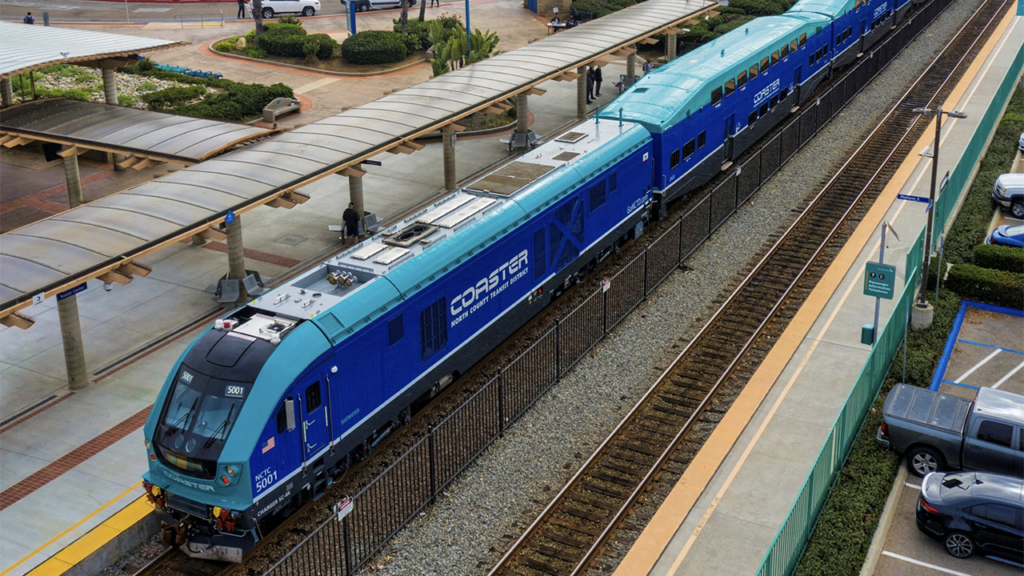
The Brotherhood of Locomotive Engineers and Trainmen (BLET) has welcomed 36 new members: train and engine service employees for NCTD’s 41-mile COASTER commuter rail service that runs through San Diego County between Oceanside and downtown San Diego. The union reported that employees voted to join during a July 31 election certified by the National Mediation Board.
Contract negotiations will now begin for the employees, which will be represented by BLET’s Amtrak General Committee of Adjustment.
COASTER is the third new property organized by BLET in the past year. Train and engine service employees at the Arizona Eastern Railway voted to join BLET in June, while those at the Florida Gulf & Atlantic voted to join in July 2023.
In other NCTD news, the COASTER Connection began operating in June to provide first-mile/last-mile service for COASTER riders who disembark at the Sorrento Valley Station in San Diego.
OC Transpo
Michael Morgan, Director of Rail Construction at OC Transpo, Ottawa’s public transportation agency, is stepping down this fall, according to media reports.
OC Transpo General Manager Renée Amilcar said in a memo to the Ottawa Mayor and the City Council that Morgan will resign to pursue another opportunity.
“Michael has built a strong, experienced team who will continue to progress the opening of O-Train Lines 2 [formerly known as the Trillium Line] and 4, as well as the completion of the east and west extensions of Line 1,’ reads the memo,” CTV News Ottawa reported July 31. “‘That team includes significant support from independent firms such as Ricardo Rail and Sener Canada who have key responsibilities for engineering and safety assurance.’”
According to CTV News Ottawa, Amilcar has asked City of Ottawa Director of Transit Engineering Richard Holder to serve as Acting Director of Rail Construction until a permanent replacement is found; the recruitment process is already under way.
“The memo notes the importance of Stage 2 south extension to the city, which is two years behind schedule,” the media outlet reported. “‘Richard is very familiar with the Stage 2 South project; he was formerly manager of Systems and Operations Integration for the Rail Construction Program, and he is actively engaged in the commissioning process,’ Amilcar wrote.”
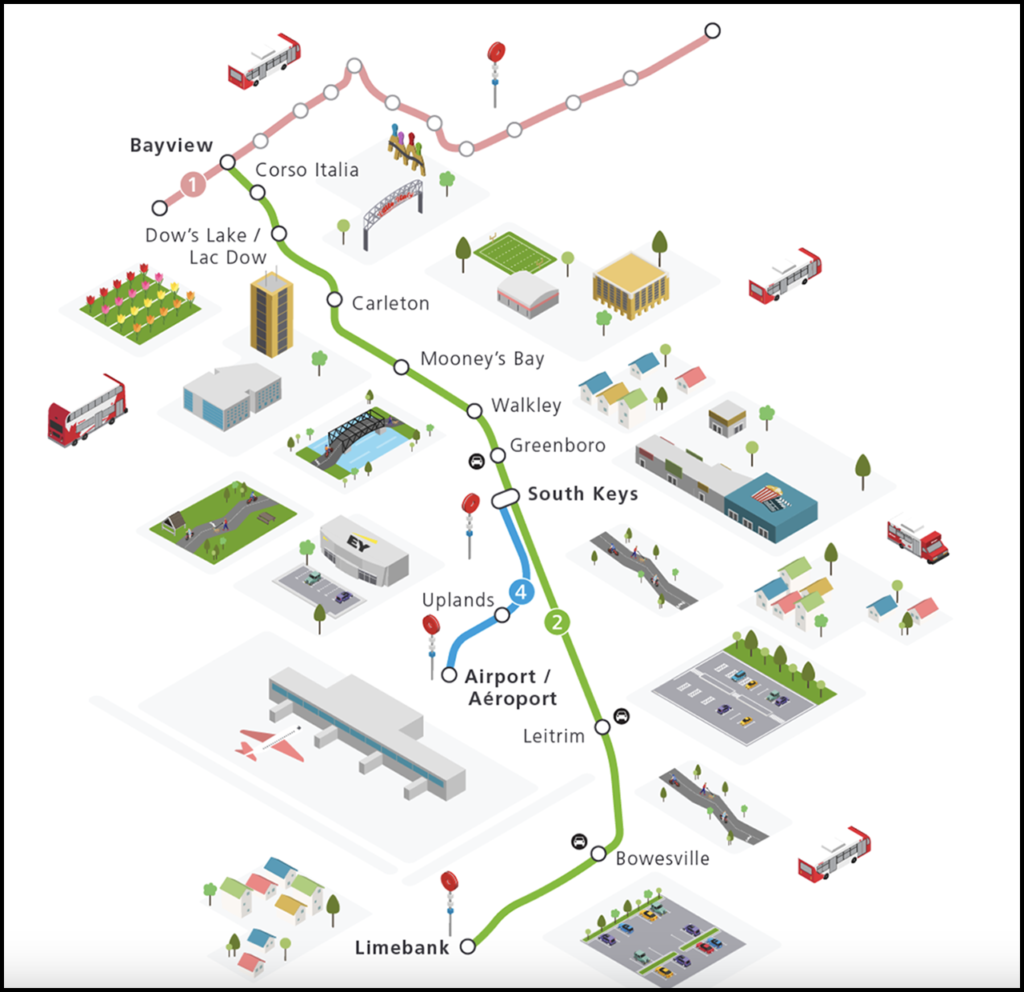
That project will connect Bayview Station downtown to Limebank Road in Riverside South and provide a link to Line 4; it will also offer direct access to the Ottawa Macdonald-Cartier International Airport. The Line 2 extension spans eight new stations and 10 miles (16 kilometers) of track, and will be served by Stadler FLIRT trains.
For more, read stories by the Ottawa Citizen and CBC News.
Further Reading: Report: OC Transpo Withheld Confederation Line Payments