WMATA
After weeks of certifying operators to use Automatic Door Operations (ADO) on the Blue, Orange, Silver, Yellow, and Green lines, the Washington Metrorail Safety Commission gave its concurrence to allow WMATA to fully operate in Auto Door mode starting July 8, the agency recently announced.
According to WMATA, customers will notice faster entries and exits with doors opening within 3-5 seconds after the train stops on the station platform. The time saved per stop is up to 10 seconds.
WMATA previously launched Auto Doors on the Red Line last December.
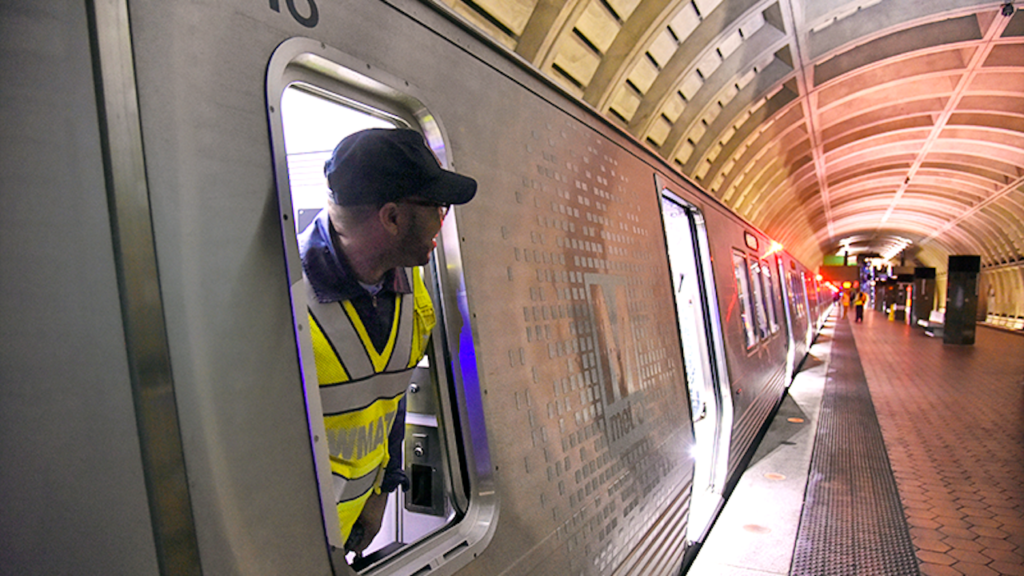
While train doors will open automatically upon arrival, operators will still close train doors manually for departure, “allowing safe and ample time for customers to enter and exit,” the agency noted. Auto Doors are controlled by technology already onboard trains that “ensures trains are safely stopped at the platform before the doors open.” Before departing, operators will close the doors manually after checking outside the driver’s side cab window to “ensure all customers have cleared the platform.”
“Auto Doors on the Red Line has been very successful with more than 1.3 million safe door openings since launching last year,” said WMATA General Manager and Chief Executive Officer Randy Clarke. “With Auto Doors, we’ve achieved better schedule consistency and now we’re excited to bring this safety and convenience improvement to all our customers.”
Upgrading and restoring the technology for Auto Doors, the agency says, will enable WMATA to safely automate 20,000 daily door openings systemwide. This is a critical step in WMATA’s rail automation program that the agency says will improve the customer experience.
ATO and ADO
In 1976, WMATA opened its doors with Automatic Train Operation (ATO). Now, the agency is restoring ATO functionality systemwide to “create another layer of safety and performance to its operations.”
ATO provides energy saving enhancements through optimized acceleration and braking. Additionally, ATO makes the starts and stops of train operations smoother. The technology also helps operator efficiency by helping customers keep consistent arrival and departure schedules, achieving better on-time performance for the entire system.
At WMATA, restoring the ATO function would place the agency on par with its peers and upgrade its train control technology. Reinstating ATO, the agency says, would automate control of a train’s acceleration, deceleration and speed, as well as automate the opening of train doors.
With upgraded systems and a clear understanding of what it takes to maintain equipment for optimal performance, WMATA says it has worked hard since the collision of 2009 on educating customers and training operators for better operational safety and efficiency.
ADO is the next customer improvement as part of the agency’s larger Rail Automation Program. Like ATO, Auto Doors capability has been a part of WMATA’s features since the rail system opened in 1976.
More information is available here.
Caltrain
Beginning July 8, Caltrain is offering new and improved service alerts, allowing riders to get personalized updates regarding their commute via text and email.
Caltrain riders can sign up at www.caltrain.com/textalerts. From there, they can choose to receive alerts via phone or email, and select the train number, stops and timeframe they are interested in. Riders can personalize and save multiple alerts, making it easy to get separate notifications for their commute, trips to sports games and concerts, or any other trip they rely on Caltrain for.
Caltrain developed this new tool in partnership with SimplifyTransit, which focuses on passenger-centric transit communication tools. The automated platform pulls in real-time alerts published in Caltrain’s real-time transit information system and distributes those alerts to subscribers via text and email.
“Caltrain offers a convenient and affordable alternative to 101 traffic,” said Caltrain Executive Director Michelle Bouchard. “These modernized alerts will make it easier than ever to stay informed, so our riders can adapt to changing circumstances and get home safely and on time.”
“We are thrilled to see Caltrain expanding its use of SimplifyTransit products to keep their riders better informed. I think riders are especially going to appreciate the immediacy of the SMS alerts,” said Cody Kraatz, SimplifyTransit Founder and CEO, and Caltrain rider. “I’m also excited that Caltrain is leading the way in more timely, helpful and detailed elevator outage alerts. They’ll be the first agency to use our Elevator Impact Alert Template to easily and quickly create the consistently high-quality alerts elevator users deserve.”
Caltrain ambassadors will be at stations this weekend helping riders sign up for alerts. There was a soft launch of the service on Monday, June 24.
Amtrak
Amtrak announced July 3 that it has increased Northeast Regional service at EWR after a review of its schedules to “better align with customer demand across the Northeast Corridor (NEC) and airline travel schedules.” This includes 33 additional weekly stops at the station throughout the morning, afternoon, and evening, a 26% increase of previous service.
“We’ve heard from our customers who asked for more and better-timed stops at Newark Airport, and are implementing these upgrades based on their feedback,” said Amtrak Vice President Commercial Strategy and Performance Fred Gazzolo. “By adding more Northeast Regional stops at Newark Airport, there’s more opportunities to experience the benefits of train travel.”
Amtrak also recently announced that it has added more service throughout the NEC to meet growing customer demand. These new schedules from both initiatives “drive Amtrak’s ambitious goal of doubling annual ridership to 66 million by Fiscal Year (FY) 2040,” the company noted. Momentum has already begun with FY24 2nd Quarter NEC ridership achieving 29% above pre-pandemic levels and Northeast Regional ridership growing more than 33% compared to FY19. Adding service on the NEC also helps with Amtrak’s sustainability goals to achieve net zero greenhouse gas emissions by 2045.
In related news, Amtrak, in conjunction with the Vermont Agency of Transportation (VTrans), New York State Department of Transportation (NYSDOT), and the Vermont Rail System (VRS), has made operational improvements in its Ethan Allen Express service. This includes reducing trip times, providing more reliable service, and introducing new schedules. Customers will also now have more and improved train connection options to and from New York City.
“Vermont and New York represent two of the most popular states for train travel demand throughout the country, and we appreciate the support of all of our partners, as residents and visitors from these two states will benefit from our collaboration,” said Amtrak Vice President, State Supported Services Ray Lang. “The new, faster trip times, combined with the earlier southbound departure out of Vermont’s largest city, makes train travel even more appealing to our customers and allows us to build upon our recent, successful expansion to Burlington.”
In FY 2023, 86,638 Amtrak customers traveled on the Ethan Allen Express, a significant increase from 50,515 customers in FY19, “highlighting a strong demand for train travel between New York and Vermont,” the company noted. Driving this growth, Amtrak says, stems from the July 2022 expansion of Ethan Allen Express service from Rutland to Middlebury, Vergennes, and Burlington.
Separately, preliminary figures from the first full month of state-sponsored Borealis trains between St. Paul and Chicago show a ridership of greater than 18,500. That is an average of about 300 passengers aboard each of the eastbound and westbound trains operated daily by Amtrak under contracts with Wisconsin, Minnesota and Illinois.
The Borealis service, whose name “was determined in a collaborative process,” was first announced in early May.
“Amtrak and our state partners have always believed the Twin Cities-Milwaukee-Chicago corridor was a great one with tremendous opportunity,” said Lang. “The ridership numbers we have seen so far confirm our belief and we expect this trend to continue as the service matures and we head into the peak summer travel season.
“With strong college and university markets on this route, we are confident Borealis will continue to perform well when students and staff travel in greater numbers this fall,” said Lang, who added Amtrak ridership nationally is on a trend this year to set a new all-time record.