

Valley Metro
The Phoenix City Council on Jan. 27 approved a new expansion of Valley Metro’s light rail system to west Phoenix after voting to end the Capitol light rail extension that would have connected downtown Phoenix to the state Capitol.
The City Council voted by a 7 to 2 vote to expedite light rail along Indian School Road, which will “provide west Phoenix with its fair share of transit and development opportunities and will connect Valley Metro and west Phoenix’s residents, businesses, and neighborhoods.”
The City of Phoenix and Valley Metro had been working to extend light rail to the state’s Capitol and west down the middle of Interstate 10. However, the Arizona State Legislature, the City Council says, “has the specific legal authority to block stations within a certain part of the state Capitol Mall, via legislation previously signed by then-Governor Ducey.”
The new path will serve Maryvale, as well as the Encanto and Alhambra villages, allowing residents to more easily access jobs, education, entertainment, and a host of other amenities across the Valley.
“Valley Metro appreciates the City Council’s thoughtful consideration of transit options that will best serve west Phoenix residents and businesses,” the agency said in a statement.
“We remain committed to advancing high-capacity transit to west Phoenix to meet significant demand, support mobility in this corridor and to continue to deliver upon the community’s vision for transit and transportation. Following the Phoenix City Council’s decision, Valley Metro will exit project development and the Capital Investment Grant process for the Capitol Extension (CAPEX) project.
“As directed by Phoenix City Council, we will advance planning of the West Phoenix corridor along Indian School Road. Comprehensive community engagement will be central to this work, ensuring we hear from all residents, business owners and stakeholders along the corridor as we develop solutions that serve the needs of west Phoenix. We will work closely with the City of Phoenix on project development and begin coordinating with our partners at the Federal Transit Administration to explore funding opportunities.”
Santa Clara VTA
As the primary public transit agency serving Levi’s Stadium, VTA says it is prepared to “deliver record ridership safely, smoothly, and reliably” for crowds attending the Super Bowl LX. Planning began immediately after Levi’s Stadium was named host, building on lessons learned during Super Bowl L 10 years ago.

“We know what it takes,” said VTA General Manager and CEO Carolyn Gonot at a press conference Monday, Jan. 26, 2026. “We’ve taken every lesson from Super Bowl L and built an even stronger, smarter, more efficient plan for Super Bowl LX.”
VTA is working closely with local, state, and federal partners to ensure a coordinated, region-wide security approach.
A comprehensive emergency management plan for large-scale events is in place, supported by extensive training and exercises over the past year. A dedicated Emergency Operations Center will be activated to monitor conditions, coordinate responses, and share real-time information. VTA’s cybersecurity teams will operate around the clock to protect critical systems.
On Super Bowl Sunday, VTA will operate 22 additional light rail trains on top of regular service. Most will be three-car trains, each carrying approximately 450 passengers directly to the stadium.
Due to security constraints around Levi’s Stadium, VTA has adjusted its service plan. Passengers traveling from downtown San Jose or Milpitas BART will arrive and depart from Lick Mill Station on the east side of the stadium. Passengers connecting from Caltrain in Mountain View will arrive and depart from Great America Station on the west side. This post-game departure plan, VTA says, is expected to reduce wait times and move fans out faster.
VTA expects to transport approximately 25,000 fans, surpassing previous record ridership levels seen during the Taylor Swift concerts in 2023.
System-wide preparations include track repairs to eliminate slow zones, upgraded ticket machines and information displays, and enhanced station readiness. Up to 100 VTA ambassadors, wearing blue VTA vests, will assist riders throughout the system on game day.
NYMTA
The New York MTA on Jan. 28 announced a record increase in subway customer satisfaction in the Fall 2025 Customers Count survey. The subway system saw increases across all key metrics, with 62% of subway riders reporting they feel satisfied with the system overall, which is a five-point increase from the Spring 2025 survey, and the highest percentage since the current Customers Count survey was launched in 2022, according to the agency.
The questionnaire, which was offered online in nine languages and included a phone option, gauged satisfaction levels of 92,269 customers between Oct.14 and Nov. 2, 2025. Now in its fifth year, the Customers Count survey allows the Authority “to better understand riders’ most significant concerns and prioritize issues that need to be addressed across the MTA network.”
Customer safety is at record highs, with 63% saying they feel safe on trains. This is a six-point increase from the Spring and the highest level reported since the survey began in 2022. Fifty-nine percent feel safe in stations, up from 54% in the Spring; 53% of riders feel safe on subway platforms, a five-point increase from the Spring. This is also the first-time platform safety was above 50% since the question was introduced in Spring 2023, according to the MTA.
According to the survey, 65% of subway riders say they are satisfied with their train line, up four points from 61% in the Spring 2025 survey. The top performing lines all gained from the previous survey—the 7 is at 73%, the G is at 72% and the Q is at 72%. Satisfaction with service reliability is also up two points to 62%. Other metrics, including satisfaction with waiting time (59%) and frequency of delays (53%) also saw two percentage point increases from the Spring. Satisfaction with cleanliness on board trains substantially increased from the Spring 2025 survey, up to 59% from 52%.
Overall subway satisfaction increased among subway customers in four boroughs, with 52% of Bronx customers satisfied, up from 46% in the Spring. This, MTA says, is the first time Bronx customer satisfaction is more than 50%. In Brooklyn, 63% of subway customers were satisfied, up from 57% in the Spring. Manhattan saw a five-point increase from the Spring, with 65% of subway customers satisfied; 59% of Queens customers were satisfied with the subway overall—a two-point increase from the Spring; Staten Island remained at 79%, consistent with levels reported in the Spring 2025 survey.
These survey results, MTA says, “reflect record-breaking 2025 operational performance for the subway system.” Subways hit six milestone months with historic on-time performance highs outside of COVID years, culminating in the best on-time performance year achieved since modern reliable record keeping began with a weekday on-time performance of 83.7%—a 2.1% increase from 2024. In May 2025, subway weekday OTP reached 85.2%, the best single month for performance in history.
These on-time performance improvements, the agency says, come as the MTA “explores new ways to use data to deliver better and more efficient service by making schedule adjustments based on ridership patterns and other factors.” This resulted not only in faster and more frequent service but also 13,000 fewer delays in 2025 compared to 2024, the MTA noted. In addition, service was increased service on several lines in 2025, including the A and L in November and the M in December in conjunction with the F/M swap.
The subway continues to see record increases in ridership growth, with nearly 1.3 billion rides taken in 2025—up 7% from the previous year. The subway also broke its post-pandemic single-day weekday and weekend ridership records on numerous occasions in 2025, most recently on Dec. 11 with 4.65 million customers. Notably, the MTA celebrated its one billionth subway rider of 2025 in mid-October—three weeks earlier than 2024 and nearly three months earlier than 2022.
More information is available here.
In related news, the New York MTA on Jan. 28 also announced that it has made a record $15.8 billion in capital commitments in 2025, “marking the largest single-year investment in transit infrastructure in the agency’s history.”
The commitments advance critical accessibility upgrades, state-of-good-repair work, and major megaprojects across the system, including more than $5 billion made possible through Congestion Relief funding. Projects advanced also included the first round of investments made possible by the MTA’s historic 2025-2029 Capital Plan, which was fully funded by Governor Kathy Hochul and the state legislature in the FY26 Enacted State Budget.
This historic year for capital awards includes investments across the transit system to improve reliability and accessibility, along with targeted investments in system expansion.
- Signal improvements: $2 billion
- Rolling Stock: $6.6 billion
- Expansion: $2.7 billion
- Accessibility: $500 million
- State-Of-Good-Repair & other program support: $3.4 billion
The MTA also awarded a significant $166 million contract for engineering and design of the Interborough Express last August, which advanced the project from planning to active phase. The MTA’s 2025-2029 Capital Plan includes $2.75 billion for this transformative transit expansion project between Brooklyn and Queens.
Thanks to funding from congestion pricing, the MTA says major projects are advancing, including:
- “Second Avenue Subway Phase 2 Contract 2 for tunneling. This major expansion is advancing on time and on budget.
- “Signal Modernization on the Fulton & Liberty AC lines in Brooklyn and Queens. Thanks to a new delivery approach, this project is 33 percent cheaper on a per-mile basis than prior signal modernization projects.
- “Accessibility upgrades at seven stations, including the Bryant Park Complex on the BDFM7 trains. These accessibility projects came in 6% below engineering estimates.”
In addition, 2025 saw progress on the MTA’s new 2025-2029 Capital Plan. This includes new contracts for more than 300 new train cars on the Long Island Rail Road.
The record-breaking year, the agency says, surpasses the previous mark set in 2022, when $11.4 billion in contracts were awarded.
In addition to the “record-setting commitments,” the MTA completed $6.7 billion in projects in 2025, trailing only 2023’s $7.1 billion as the strongest year for capital project completions.
Customers saw major benefits throughout the system in 2025, with 41 elevator replacements and 10 new accessible stations across the subways and railroads. That record setting number of replacements saw the average project duration drop by more than two months, the MTA noted.
Other major projects completed included circulation improvements at Grand Central as part of the 42nd Street Connection program, which saved $46.5 million; the opening of New York City’s new Rail Car Acceptance Facility in Brooklyn; and the rehabilitation of the lower-level main span deck of the Verazzano-Narrows Bridge. In addition, the MTA awarded a contract to Kawasaki last fall to construct 378 new R268 subway cars, which will ultimately replace nearly 50-year-old cars and improve reliability and performance.
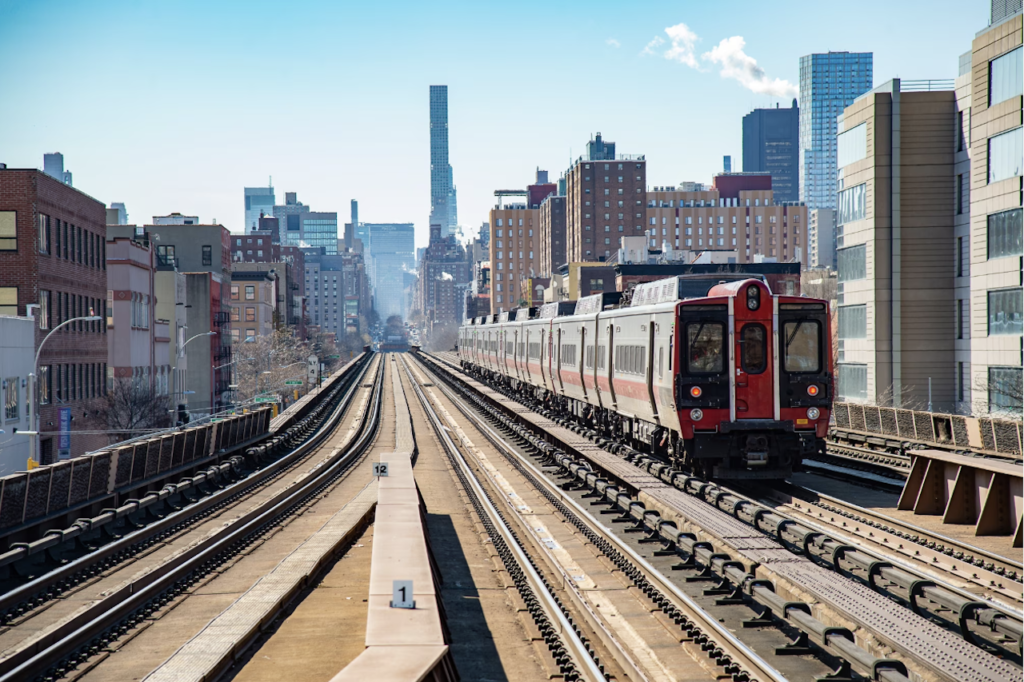
Megaprojects also made major advances, according to the MTA. The first phase of the full replacement of the Park Avenue Viaduct—the elevated steel structure that carries four Metro-North Railroad tracks and serves all Metro-North trains traveling into and out of Grand Central Terminal—saw bridge replacement completed 21 months ahead of schedule and $93 million under budget. Further south, additional savings were achieved during the rebuilding of the Grand Central Train Shed that holds up Park Avenue and the surrounding skyscrapers above Metro-North tracks near Grand Central, which came in $20 million under budget in its first phase and has secured $75 million in private funding for the second phase.




