TriMet
Following the Oregon Legislature’s failure to pass House Bill 2025, the Oregon Transportation Reinvestment Package (TRIP), TriMet announced that it will make a series of budget reductions beginning this year, including service cuts, to address “a significant, growing fiscal challenge.”
Service cuts, TriMet says, are necessary now for the agency to “avoid drastic cuts in the future and continue providing the vital transit service our riders rely on to get to jobs, schools, services and other vital destinations across our 533-square-mile service district.”
“The failure of HB2025 leaves many of Oregon’s transit agencies, including TriMet, without the sufficient funding needed to sustain service levels in the years ahead,” the agency said in a release. “We are encouraged by Gov. Tina Kotek’s call for a special session to address funding for the Oregon Department of Transportation, local jurisdictions and transit districts. But the absence of legislative action in June has forced TriMet to make service cuts this November and in March 2026, with additional reductions necessary in the years ahead to begin closing a projected $300 million gap between our annual expenditures and revenues.”
“We are facing a fiscal cliff in 2030, so we must act now to balance our budget for the long term,” said TriMet General Manager Sam Desue Jr. “As Oregon’s largest public transit provider, we have a tremendous responsibility to keep people in our region moving. Cutting service now means avoiding sudden, catastrophic cuts in the future.”
According to TriMet, the agency must begin reducing its service this winter, with a series of further cuts over the next few years resulting in at least a 10% overall cut to service by the end of August 2027. Without additional revenue, TriMet says it will be forced to cut another $48 million in service and other spending.
Initially, service cuts will focus on reducing frequencies on some bus lines. Following that, TriMet says it will need to eliminate some bus lines, adjust some bus routes, and adjust MAX service. If the agency is unsuccessful in increasing its revenue by fall 2027, more service cuts will be needed, the agency said.
More information is available here.
LA Metro
LA Metro Board Chair Fernando Dutra recently announced that the A Line Extension to Pomona will open on Friday, Sept. 19.
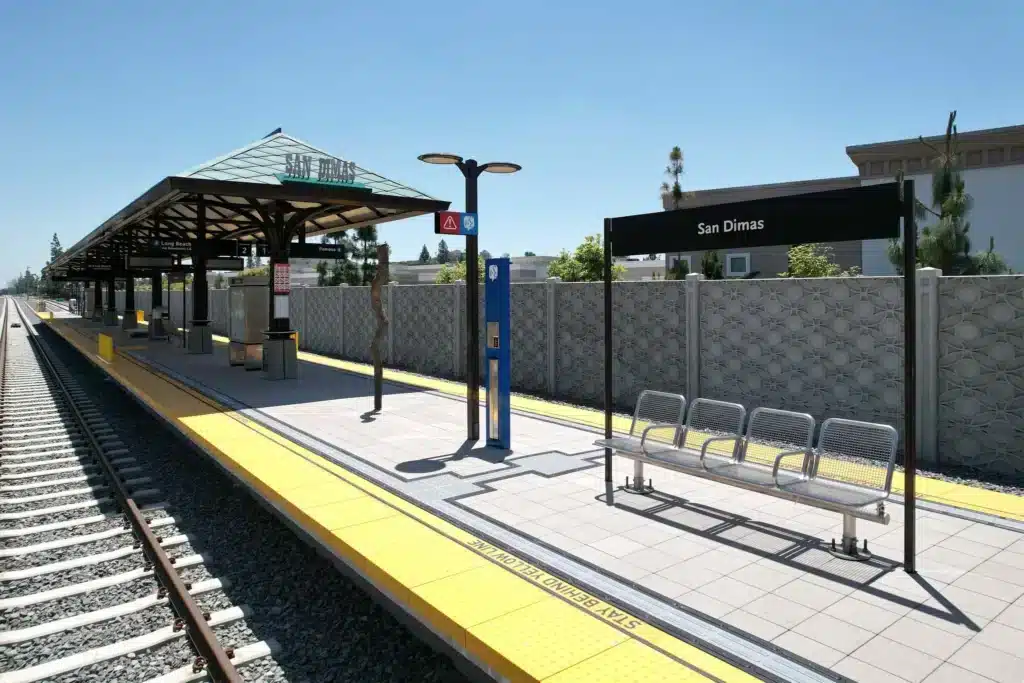
The A Line Extension will add 9.1 miles of track and four new stations in Glendora, San Dimas, La Verne, and Pomona, connecting the people who live and work in these San Gabriel Valley cities with one another, Greater Los Angeles and beyond. Riders will be able to transfer between Metro and Metrolink at Pomona Station, giving everyone a new, faster way to ride between the Inland Empire and Foothill Cities corridor.
The extension, LA Metro says, will improve access to educational institutions (such as Cal Poly Pomona, University of La Verne, Mt. San Antonio College, and Pomona College among others), recreation centers like the Los Angeles County Fairplex (where cricket will make its official return to the Olympic Games in 2028!), as well as regional parks, museums, and historic downtowns.
The project marks the ninth project completed in LA Metro’s Twenty-Eight by ‘28 initiative, “an ambitious plan to enhance the region’s transit infrastructure in time for the 2028 Olympic and Paralympic Games.”
LIRR
The New York Metropolitan Transportation Authority (MTA) on July 24 announced that the LIRR shattered its post-pandemic daily ridership record twice this week, carrying 298,419 passengers on Wednesday, July 23, and 295,419 passengers on Tuesday, July 22. Both milestones contributed to the railroad’s busiest seven-day period since the pandemic, with a total of 1.72 million passengers riding between Thursday, July 17, and Wednesday, July 23. Before this week, the previous post-pandemic ridership high was 287,437 on June 19. The pre-pandemic 2019 average weekday ridership of 316,692 was the highest since 1949.

The ridership highs, MTA says, reflect the railroad’s increasing customer satisfaction rate and record-breaking on-time performance statistics. Through the first half of the year, 96.6% of trains reached their destination on time, the railroad’s best rate in its history outside of pandemic years, and nine tenths of a percentage point above last year’s rate of 95.7% covering the same period of the year.
Overall customer satisfaction with the railroad reached 81% in the spring of 2025, up five percentage points from the fall 2024, when it reached 76%, which was itself a six-point increase from spring 2024’s rate of 70%.
Sound Transit
The Sound Transit Board on July 24 approved plans that will support an earlier than expected opening of the Federal Way Link Extension, now projected to begin operating as soon as winter 2025. As final testing and commissioning gets underway on the 1 Line extension from Angle Lake to Federal Way, work continues to open the Crosslake Connection of the 2 Line in early 2026 as expected.
This phased approach, Sound Transit says, will enable the agency to successfully open both projects as soon as possible.
“Sound Transit is proving its ability to assess the way projects are progressing in real time and pivot quickly to provide people throughout the region with more transit options,” said Sound Transit Board Chair and Snohomish County Executive Dave Somers. “This resequencing of opening dates reflects the actual status of each of the projects and allows us to continue moving them both forward in the most efficient way possible.”
The Federal Way Link Extension project has nearly completed system integration testing and is ready to move into the pre-revenue testing phase. At the same time, live wire testing, the second phase of system integration testing, is scheduled to start on the Homer M. Hadley floating bridge this month as planned.
The Federal Way Link Extension will add nearly eight miles to the regional light rail system via mostly elevated tracks between the cities of SeaTac and Federal Way. This project includes three new stations, in Kent Des Moines near Highline College, Star Lake, and Downtown Federal Way.
The full 2 Line will be completed with the opening of the 1-90 segment of East Link. This final segment will add the Mercer Island and Judkins Park stations to the 2 Line and connect to the 1 Line at the International District/Chinatown Station in downtown Seattle.
“Sound Transit is constantly exploring creative ways to deliver our projects sooner, while ensuring a safe and reliable system,” said Sound Transit CEO Dow Constantine. “Opening projects when they are ready makes the best use of agency resources and best serves the people who use transit to get where they need to go every day.”
More information is available here.