Sound Transit
The Sound Transit Board earlier this month gathered in Tacoma, Wash., to discuss the Enterprise Initiative: “a comprehensive agencywide effort to ensure that project delivery and operations are affordable going forward while delivering on the objectives of the ST3 [Sound Transit 3 regional transit system plan for Central Puget Sound] plan,” according to the Seattle-based transit agency (see presentation above). “Our mission remains clear: delivering safe, reliable, and connected mass transit while addressing unanticipated financial hurdles.”
Since voters approved the ST3 plan in 2016, there has been “unprecedented inflation, rising construction and labor costs, and a pandemic combined with improved cost estimating created a significant gap in our long-term budget,” Sound Transit reported. The agency’s Fall 2025 Long-Range Financial Plan estimated that an additional $34.5 billion is needed to fully fund the ST3 program through 2046 (download plan below).
“We are committed to using all the tools at our disposal to deliver the ST3 program [and] to close this [funding] gap,” Sound Transit said. “To do that, we launched the Enterprise Initiative (EI) in May 2025—a proactive effort to find cost savings and project efficiencies across the entire agency.” The Enterprise Initiative is a three-step process to align the agency’s finances and project plans:
- “Step 1: Understanding the measure of the challenge.
- “Step 2 (Where we are now): Developing possible approaches that represent trade-offs between priorities.
- “Step 3: Updating the ST3 system plan to reflect a balanced, affordable path forward.”
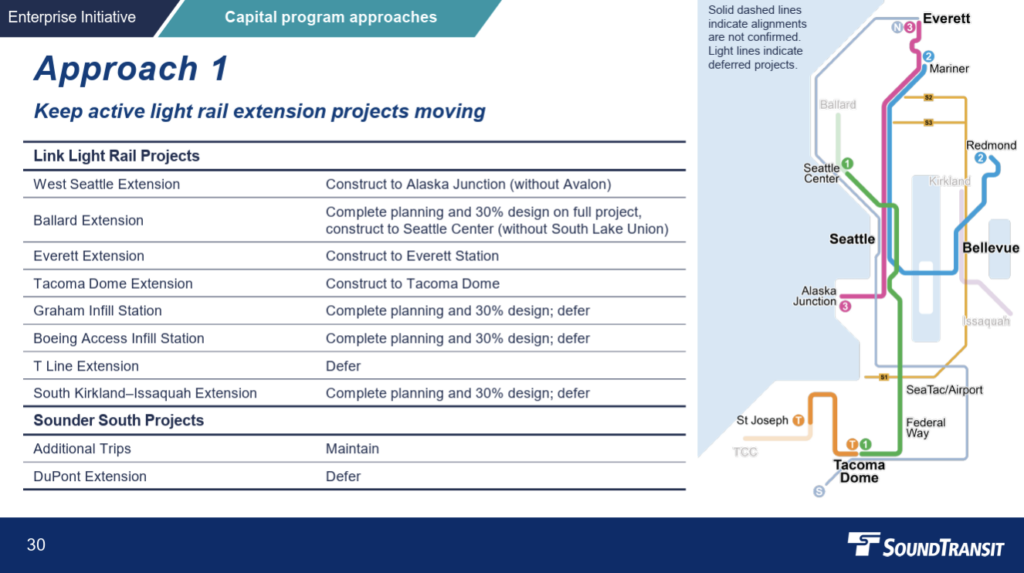
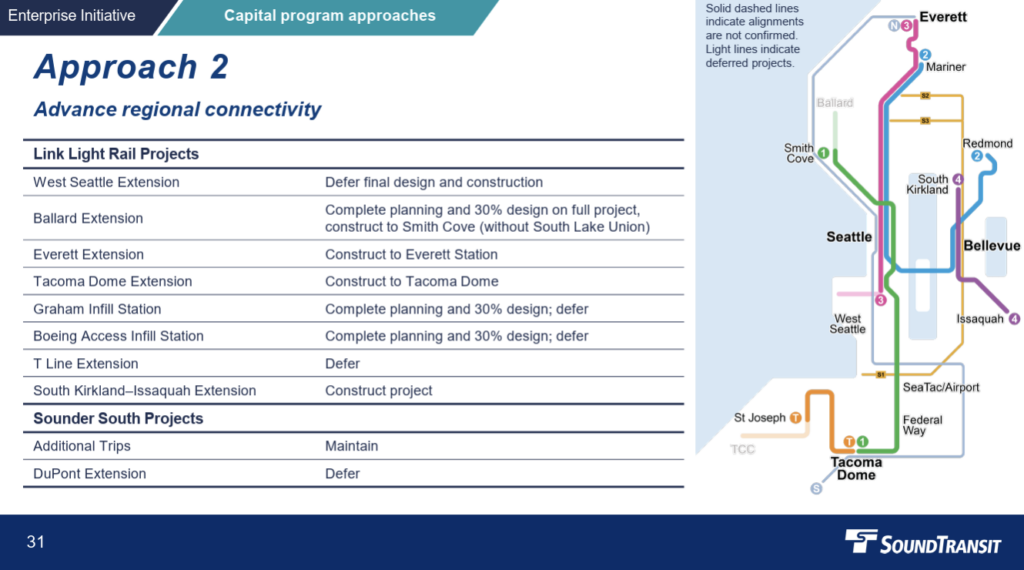
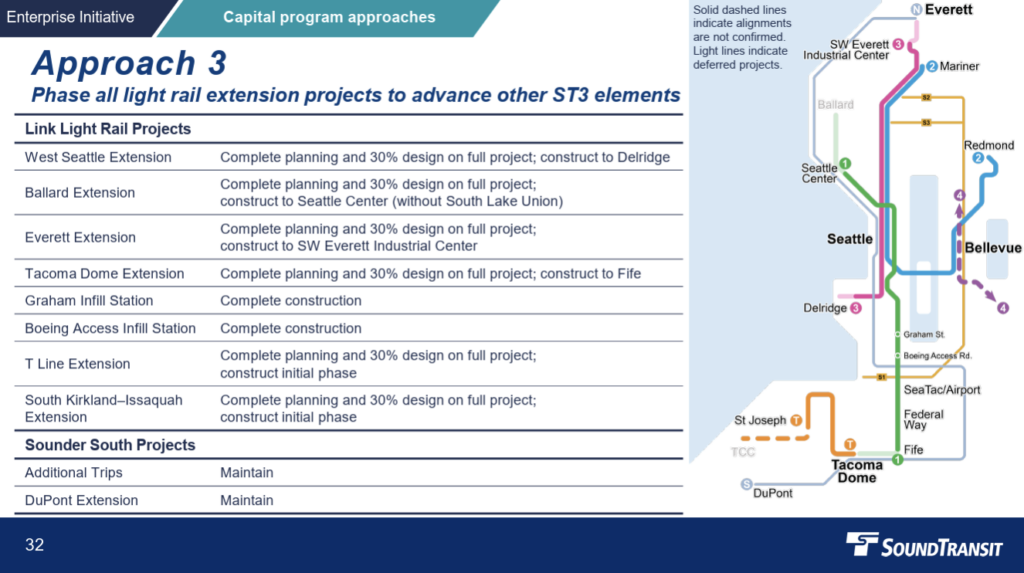
At the recent retreat, staff presented the Board with three approaches to illustrate trade-offs, according to Sound Transit (see images below). “These approaches are not decisions; rather, they exist to help the Board understand the policy considerations of different strategies,” it said. “By looking forward, we can create a system plan that navigates an upcoming financial crunch to maintain momentum on ST3 projects.”
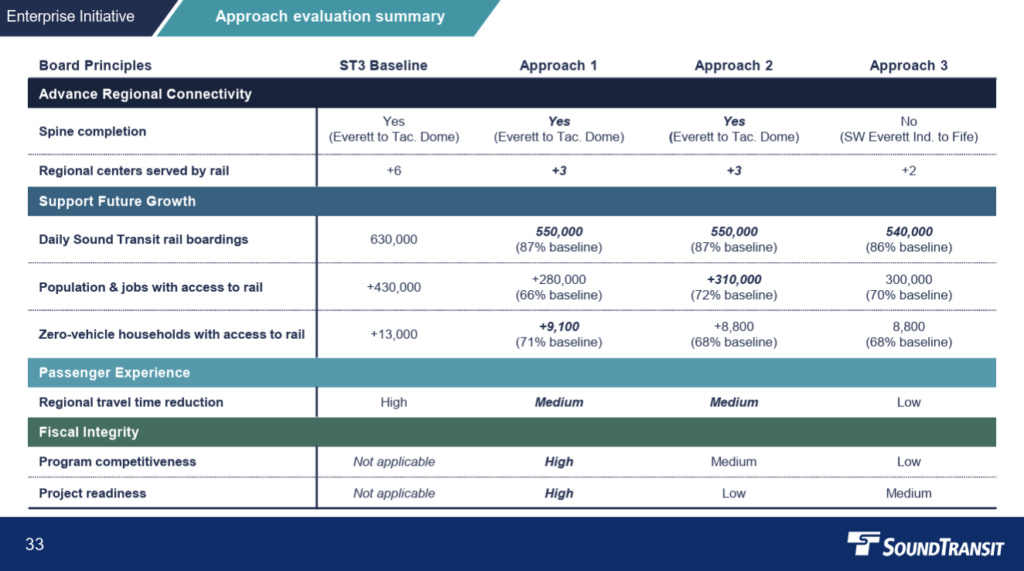
According to Sound Transit, the Board’s work is guided by four core principles:
- “Advance regional connectivity.
- “Support future growth.
- “Prioritize the passenger experience.
- “Protect public investments with fiscal integrity.”
“Beyond construction costs, we are assessing every tool available to make our projects more affordable,” said Sound Transit, which has created an “Achieving long-term affordability” webpage. “We are moving forward with urgency,” it continued. “The Board has directed the agency to address this shortfall and submit an updated system plan by June 2026.”
Sound Transit said that it will now “refine the approaches” based on the Board feedback, and prepare to launch public engagement; next, it will gather feedback via surveys and town halls to inform the Board’s deliberations; and later work will culminate in a new Regional Transit Long-Range Plan and a balanced Long-Range Financial Plan to guide progress through 2046.
“In the face of unprecedented inflation of construction costs, the Sound Transit Board is putting pressure on everything the agency does to find savings,” Snohomish County Executive and Sound Transit Board Chair Dave Somers said in a March 20 statement. “By adopting an affordable system plan, the Board is committed to giving the region’s residents the benefits of Sound Transit 3. Since May of 2025, the agency has created a full toolbox of potential cost savings, and we look forward to analyzing the approaches offered by the agency to ensure revenues and expenditures are balanced and affordable while delivering on ST3 objectives. Sound Transit has a strong track record of delivering complex transit projects, and the Board has confidence in the agency’s ability to navigate these fiscal challenges and continue moving the region forward.”
Further Reading:
- Sound Transit Adopts 2026-2030 Sustainability Plan (part of Transit Briefs)
- Sound Transit Readies for ‘Crosslake Connection’
- Meet Seattle Mayor Katie Wilson, Transit Advocate
- Sound Transit Launches Federal Way LRT Extension
PATH

The Port Authority of New York and New Jersey (PANY/NJ) Board of Commissioners on March 13 authorized $3.5 million to begin planning for the replacement of all PATH’s fare gates with “modern next-generation” equipment, according to PANY/NJ.
PATH operates 341 standard and ADA-compliant fare gates across its 13 stations. The current gates have been in service for approximately 22 years, which PANY/NJ said is “beyond the standard useful life of 15 to 20 years.” The gates and their supporting infrastructure, it noted, “have become outdated for PATH’s needs, with frequent breakdowns and growing maintenance obligations.”
According to PANY/NJ, the funding authorization will “expand an existing agreement with consultant JHP, a partnership between Jacobs and HNTB,” and fund Port Authority staff support services, station condition surveys, and associated internal cost allocations.
Planning work will include development of the fare gate replacement project’s scope and technical specifications, preparation of a project cost estimate, and the equipment procurement process. PANY/NJ said it will “prioritize structural and technological initiatives that will help reduce fare evasion while improving ease of entry and exit for customers with varying needs, including those traveling with mobility devices, luggage, strollers, and bicycles.” The new fare gates will also be fully integrated with TAPP, PATH’s contactless fare payment system.
Planning work is expected to begin in second-quarter 2026 and contine through second-quarter 2027.
“PATH has undergone a remarkable transformation over the past several years, from track and station upgrades through PATH Forward to the service enhancements we began rolling out earlier this month,” Port Authority Vice Chairman Jeffrey H. Lynford said. “We’re looking to continue that progress with modern fare gates. This planning authorization sets the process in motion, and we look forward to bringing riders a system that works for them at every step in their journey, from the fare gate to the platform to the train.”
Further Reading:
- PATH 2025 Ridership Surpasses 60MM (part of Transit Briefs)
- PATH: $2.6B Capital Plan for 2026-2035
- An Ambassador of Change for Women at PATH
Denver RTD
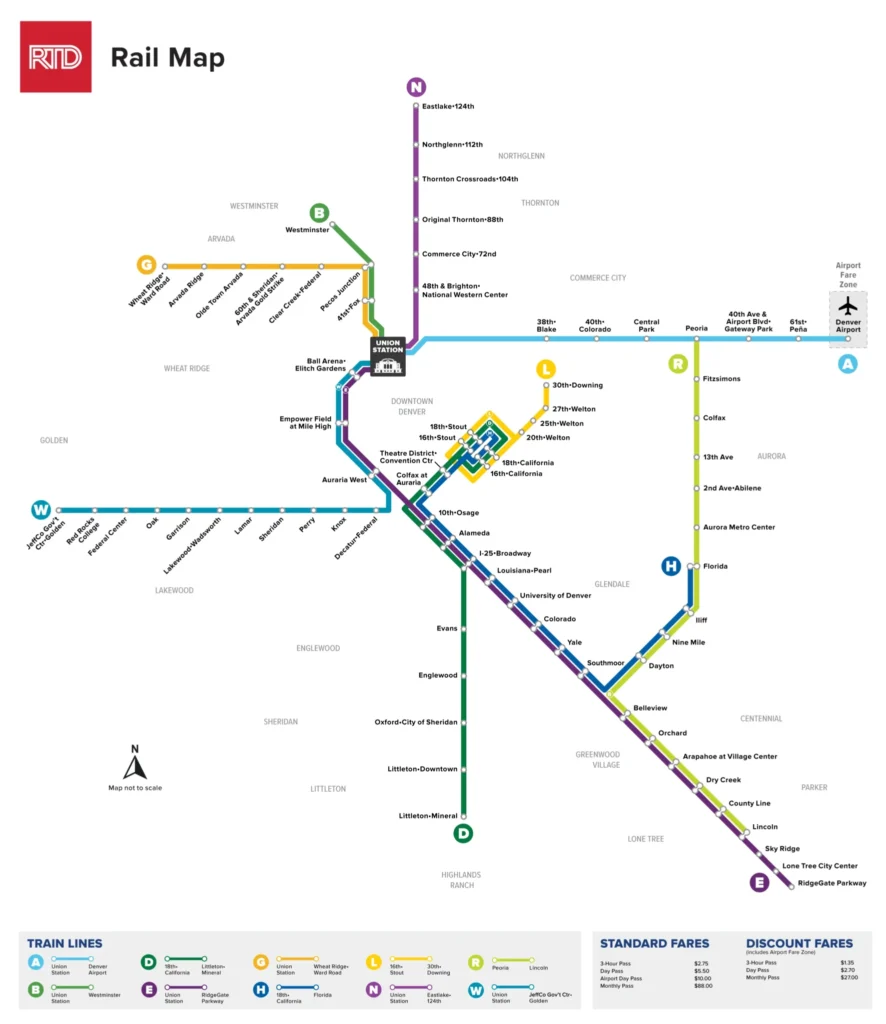
Denver RTD on March 19 reported launching an analysis to redesign its transit network and “meet the needs of a changing region by improving reliability, connectivity, equity, and long-term sustainability.” The Comprehensive Operational Analysis (COA), it said, is an 18-month, districtwide effort “to evaluate how transit service should evolve to meet the region’s current and future needs” (see timeline below).
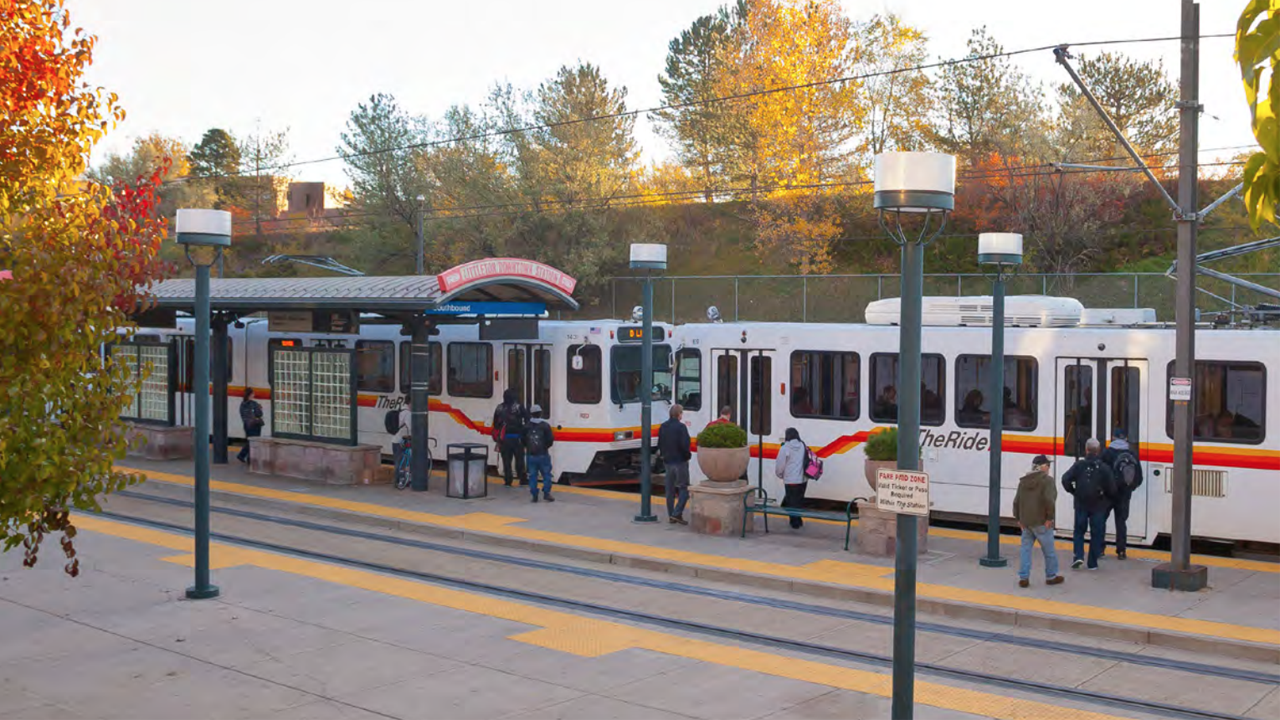
“The COA is an extensive, forward-looking planning initiative that will assess RTD’s entire network, including bus, rail, demand-response, and paratransit services,” the transit agency said. “Similar to the agency’s previous COA, which was titled the 2022-2026 System Optimization Plan, the effort will present a short-range service plan aligned with RTD’s projected resources for 2028 to 2032. The COA will also provide a long-range vision informed by population growth, land usage, and travel trends across the greater Denver metropolitan region. The recommended future network design will consider customer, community, and stakeholder feedback.”
The COA is designed to answer how RTD can “best align its services with today’s travel patterns, community priorities, and available resources,” according to the agency. “In recent years, mobility needs have changed substantially across the metro area while creating new demands on the transit system. The analysis will provide a comprehensive assessment of the existing network of services, including performance, route design, and cost effectiveness, while identifying gaps and opportunities for improvement. It will also evaluate travel markets and customer needs to ensure future service reflects how and where people are moving today. Equally important, the COA will help the agency focus its limited operating resources on improvements that provide the greatest benefit to customers.” Equity is another component of the COA; all proposed changes in the near-term service plan will undergo a Title VI equity review to evaluate the impacts on underrepresented communities.
Rather than producing a single final report, RTD said the COA will unfold in phases, with deliverables shared publicly throughout the process. In summer 2026, RTD will release a Current System Assessment, which will provide a “clear picture” of how the system currently performs and where demand is expected to grow. Later in 2026, a Network Alternatives and Analysis will outline different approaches to meeting that demand, including potential changes to routes, frequency, and service types. The process will continue with a preferred network and final recommendations, giving the public and stakeholders multiple opportunities to review and provide input, according to RTD.
The COA is supported by a $3.5 million funding authorization approved by RTD’s Board of Directors in July 2025, the transit agency reported. “This investment ensures the agency can fully evaluate how to efficiently use its limited operating resources to deliver the most benefit to customers and RTD’s service area,” it said.
Following a competitive procurement process in late 2025, RTD selected Jarrett Walker and Associates as the prime consultant. The firm specializes in transit network design and will lead a team of subconsultants with “strong local expertise, ensuring the work reflects the unique characteristics and needs of the Denver region,” according to RTD.
While the COA is an analysis, it is also intended to support future decision-making by “clearly outlining options and tradeoffs,” RTD said. The outcome will include an updated transit network with detailed routing, service frequencies, resource requirements, and a step-by-step rollout of changes, the agency noted. It will also provide the Board with “data-supported choices to guide policy decisions about service priorities.”
The project formally kicks off next month, with initial assessments expected this summer and draft network concepts publicly available later this year. The short-range plan developed through the COA will guide service changes beginning in 2028.
“The COA is about doing the work needed to understand where our system is today and what it will take to meet the region’s needs tomorrow,” RTD Deputy CEO Angel Peña said. “That means building alignment around choices and ensuring decisions reflect both the agency’s financial reality and our responsibility to provide equitable access to transit. We have an obligation to deliver a plan that is data-driven and responsive to the diverse communities we serve.”
Further Reading:
- Denver RTD Releases 3Q Financial Results (part of Transit Briefs)
- Denver RTD Increases Rail System Fare Checks (part of Transit Briefs)
- Denver RTD Earns ‘Stable Outlook’ From Three Credit Agencies (part of Transit Briefs)
- Denver RTD Tabs Tran as CPO
- For Denver RTD, FY26 Budget Tops $1.5B