

Sound Transit
The Sound Transit staff on Aug. 28 “reported a need for an additional $14 [billion] to $20 billion in today’s dollars to cover capital program costs to complete” the ST3 light rail projects that voters approved in 2016—“unless cost-saving measures are applied,” according to KIRO 7 in Seattle. This is 20%-25% more than “what’s currently outlined in the Long Range Financial Plan,” the media outlet reported on Sept. 1. Sound Transit, it said, cited “challenges including lower-than-expected revenues, rising costs and uncertainty surrounding tariffs and federal funding commitments.”
The agency also said “it will need a few billion dollars more to cover service delivery costs, including new and replacement light rail vehicles, investments to improve light rail system resiliency and other maintenance and operations costs,” according to KIRO 7.
The Sound Transit Board for the past few months “has been focused on implementing an action plan, deemed ‘the Enterprise Initiative,” KIRO 7 reported. “It describes the initiative as a comprehensive effort that helps identify affordability gaps and tools available to cut costs. The initiative aims to update the system plan, while staying in line with the original voter-approved ballot measure.”
According to the media outlet, the initiative’s first phase “calls for analyzing how the region has changed since 2016, building a deep understanding of the scale of the problem and understanding how to use available tools to solve these challenges (or coming up with new tools to fix them).” The second phase, “which the agency has previously said will begin in 2026, calls for identifying approaches for updating the ST3 System Plan and adopting a new long-range financial plan,” reported KIRO 7, which noted that the process is expected to wrap up in the first half of 2025, “but the deadline is not set in stone.”
According to a Sept. 2 KIRO-7 report, “[t]his is not the first time Sound Transit has had to realign its budget for ST3.” It adopted in 2021 a realignment plan “after recognizing an estimated $6.5 billion affordability gap for delivering on ST3.”
“It’s not about whether these projects are going to happen, it’s about when they’re going to happen,” Sound Transit Board Member and Seattle Councilman Dan Strauss said, according to KIRO 7.
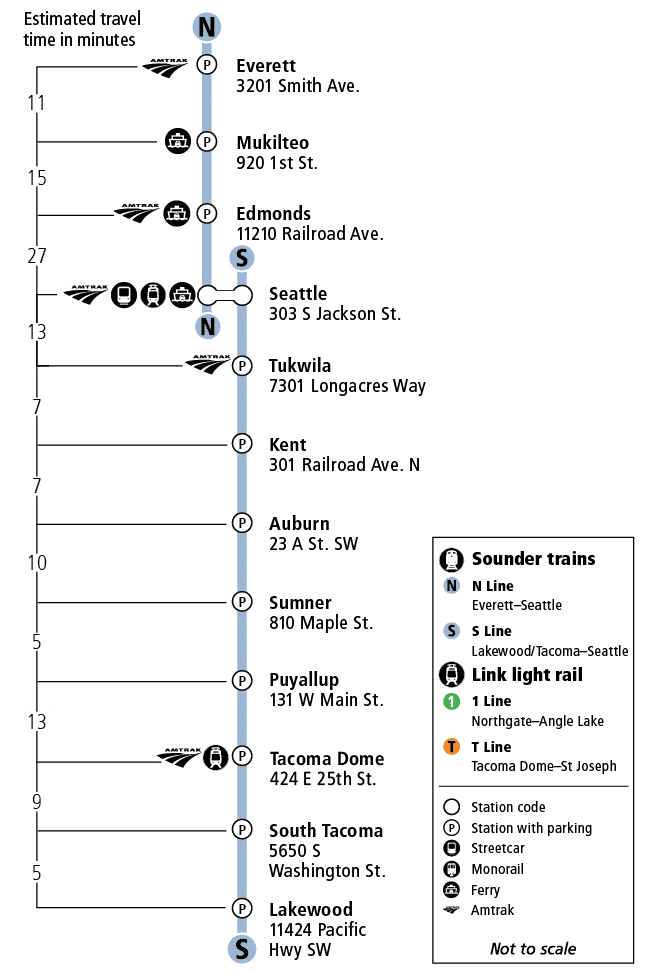
Meanwhile, the Sound Transit Board on Aug. 28 also approved a six-year $92.7 million contract with the Systra-Brookville Joint Venture for the mid-life overhaul of all 58 Sounder commuter railcars (18 cab cars and 40 coaches). The work covers the door system, HVAC control system, floors, restrooms, lighting, painting, couplers, and trucks, and other key components will be rebuilt. Rider amenities such as USB power outlets and improved bicycle storage areas will also be included.
“The 58 existing cars, which were manufactured by Bombardier, are all between 22 and 26 years old, and have been in use since Sound Transit started launching commuter rail service in 2000,” The Urbanist reported Sept. 2. “The aging cars will be overhauled in stages, with an average of five cars out of service for overhauls at any given time over the next six years. Those cars will be subbed out for new railcars Sound Transit purchased from Alstom, which acquired Bombardier in 2021. Those 11 cars were purchased in 2020 for $46.5 million, as part of a joint order with two California transit agencies, the San Joaquin Regional Rail Commission and North County Transit District.”
NJT

NJT and Alstom on Sept. 3 released the following statement regarding the 34-mile River LINE light rail system in Southern New Jersey:
“NJ Transit and Alstom are committed to providing safe and reliable service for our customers on the River LINE. After several years of working closely together to assess the conditions of the River LINE, NJ Transit and Alstom today announced that responsibility for the operation and maintenance of the line will begin to transition to NJ Transit on Sept. 3, 2025. NJ Transit will assume all responsibility for the operation and maintenance of the River LINE by the end of this year.
“This mutually agreed decision reflects the evolving investment needs of the service, which have grown beyond the current scope of Alstom’s contract covering River LINE operations and maintenance. This transition will enable NJ Transit to be best positioned to shape and implement the next steps that will strengthen and enhance the future of the service.
“Alstom remains committed to ensuring a safe and efficient transition, while continuing its support of NJ Transit’s success through other ongoing projects—including the manufacturing and delivery of hundreds of new multilevel commuter railcars, the first of which are expected to arrive beginning in the middle of next year. Both NJ Transit and Alstom value the strong partnership built over many years and look forward to continuing to work together on projects that deliver safe, reliable and innovative public transportation for New Jersey and the region.”
The Camden-to-Trenton River LINE (download map below) was originally operated by the Bombardier Transportation, which in 2021 was acquired by Alstom. It has a fleet of 20 Swiss-built Stadler Rail GTW (Gelenktriebwagen, or “articulated railcar”) 2/6 DMUs (diesel multiple-units).
NJ.com on Sept. 3 reported that the joint NJT-Alstom statement “had an upbeat, conciliatory tone,” but the transit agency’s “own data reporting reflected dissatisfaction with River Line operations.”
“In July, the line had the highest number of canceled trains, 15, out of all NJ Transit’s three light rail lines,” according to the media outlet. “The majority of light rail rider feedback in July was about the River Line. NJ Transit officials blamed it ‘largely due to the contractor’s inability to maintain a sufficient level of available equipment throughout the course of the month.’ River Line trains rolled the least mileage between breakdowns of the three light rail lines. River Line trains averaged less than 5,000 miles in July. It also had the worst on-time light rail performance at 82% of trains arriving on schedule, NJ Transit data said.”
Additionally, NJ.com reported, “problems with trains [in August 2023] prompted a reduction in the frequency of weekday service from trains every 15 minutes to every 30 minutes during the morning and afternoon commuter rush periods [which lasted until October 2023].” The problems included “engine and heating, ventilation and air conditioning issues,” according to the media outlet. “A $700,000 program to rebuild River Line rail car diesel engines that was announced in 2020 had resulted in only one of 18 engines being completed as of Oct. 2023,” it reported.
Amtrak

“The Atlanta Regional Commission (ARC) and the City of Atlanta have joined forces to conduct an in-depth $625,000 Passenger Rail Station Alternatives Study to determine where a new Amtrak station should be built in Atlanta,” according to the SaportaReport, a online media outlet based in Atlanta. “ARC, through federal funds, allocated $500,000 towards the study, while the City of Atlanta is contributing $125,000. The team has commissioned the engineering firm WSP to lead the planning effort. It is working with Decatur-based Sycamore Consulting, which is overseeing public outreach.”
According to ARC, relocating the current Atlanta Amtrak Station on Peachtree Street in midtown to another, modernized site in the downtown area “could create opportunities to improve customer service, ADA-accessibility, and multimodal connections for rail travelers” on Amtrak’s Crescent route, which links Atlanta to New Orleans, Birmingham, Charlotte, Washington D.C., and New York City. The relocated station, it said, would also serve as a “signature local destination and gateway to the city for visitors while providing scalability for longer term service improvements between Atlanta and other cities.”
“I’m very optimistic that we are going to put together a plan that identifies an ideal location and outlines the next steps,” ARC Principal Transportation Planner Tejas Kotak said, according to the SaportaReport. “By the end of December, we will identify our ideal location for a future Amtrak station.”
Metrolinx

Metrolinx’s two new tunnel boring machines (TBMs) have officially been named “Libby” and “Corkie.” A naming contest launched in June 2025 saw more than 900 submissions and 1,000-plus votes cast. According to Metrolinx, Jason Paris submitted the winning names as a tribute to two of the communities the Ontario Line subway will serve in the City of Toronto: Liberty Village and Corktown (see map below). Libby and Corkie are slated to dig about 3.7 miles (6 kilometers) of twin tunnels beneath the city’s downtown core.

The 9.7-mile (15.6-kilometer) Ontario Line will have 15 stations, running from Exhibition Place through the downtown core and connecting to the Line 5 Eglinton at Don Mills Road. During peak periods, the Ontario Line is slated to reduce crowding by up to 15% on the busiest stretch of TTC’s Line 1 between Bloor-Yonge and Wellesley.
According to Metrolinx, excavation is now complete at the tunnel launch shaft where the TBMs will start tunneling in early 2026. Construction crews recently broke ground on the second tunnel launch shaft at Gerrard.




