Transit Briefs: SEPTA, Tri-Rail, NYMTA/Metro-North, WMSC/WMATA, LA Metro

SEPTA
As of April 4, SEPTA now accepts contactless payment options on Regional Rail, making it the first commuter rail system in the U.S. to deploy contactless payment.
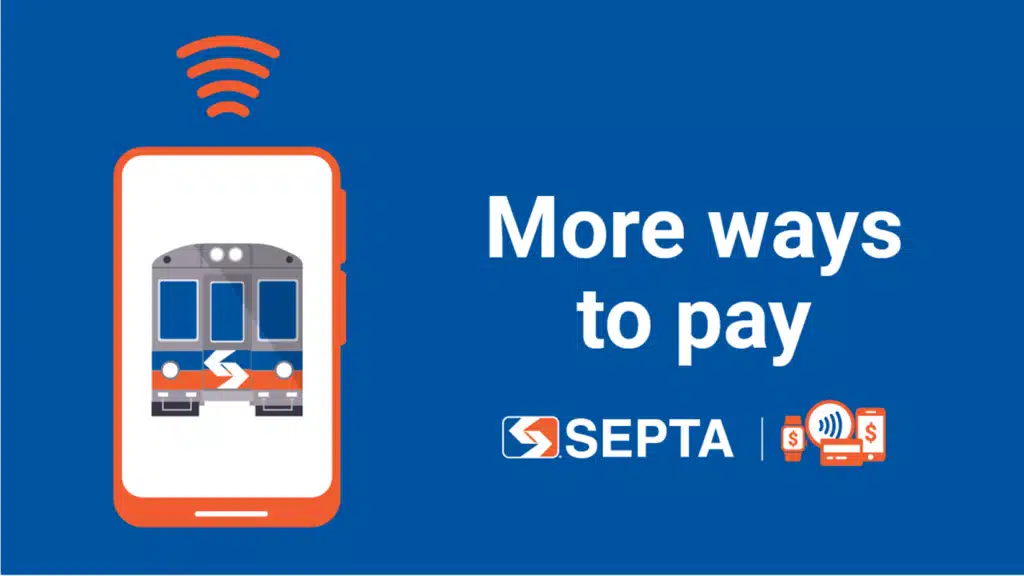
According to the agency, customers are able to easily tap on and tap off using any credit/debit card or mobile wallets (Apple Pay, Google Pay or Samsung Pay) at Regional Rail faregates and platform validators. Contactless payment has been available on SEPTA Bus and Metro services since September 2023.
Any validator with credit card icons displayed on the screen is ready to accept contactless payments. Before tapping, riders are encouraged to separate their credit/debit cards, Key card and mobile device to avoid the incorrect card or account getting charged.
More information is available here.
Tri-Rail
Tri-Rail trains continue to show signs of ridership growth in the first quarter of 2025, with a 2% increase in the first three months of the year, compared to the same period in 2024, back when the system reported having fully recovered its ridership, the agency reported on April 7. The system has averaged 385,000 passengers a month in 2025, with March just short of 400,000 rides.
The South Florida Regional Transportation Authority (SFRTA), operator of Tri-Rail, recently reported that the train system served more than 4.4 million riders in 2024, about 30,000 short of its highest ridership record year in 2019 of 4,495,039 riders.
Tri-Rail trains have been averaging 15,000 weekday daily riders since 2024 and reached 16,000 on several days in 2025. Weekend service remains strong with Saturdays topping 8,000 rides and Sundays 7,000, on a regular basis.
“As we continue to expand and enhance our services, it’s clear that South Floridians are increasingly recognizing the value and convenience of Tri-Rail,” said SFRTA Executive Director David Dech. “With more people relying on Tri-Rail for their daily commute and travel, we remain committed to improving service and ensuring a reliable transportation option so even more people come onboard.”
Train station ridership reports indicate that airport travel remains a major driver of Tri-Rail growth, with the Miami Airport and Fort Lauderdale Airport stations being #1 and #3 busiest stations for the system, respectively, according to the agency. Metrorail Transfer Station is the second busiest, where passengers can connect to Miami’s Metrorail system, and Tri-Rail trains provide service to MiamiCentral Station in downtown.
According to Tri-Rail, the system has also seen an increase in the express train service that was introduced in July 2024, with a weekday southbound morning train and a northbound evening train, providing limited stops and a one-seat ride between MiamiCentral and West Palm Beach. Ridership on the express service is averaging 450 round-trip passengers a day and often tops 500.
“We are grateful to have a dedicated ridership base that supports Tri-Rail and lets us know what we need to do to improve our services,” added Dech. “This continued growth in ridership demonstrates people are appreciating our efforts to make this a better system.”
With more passengers using Tri-Rail, SFRTA says it will be launching an educational campaign for passengers on the importance of purchasing tickets before boarding the train and avoid being removed from trains for not having valid fare. Train passes are sold at all Tri-Rail station ticket vending machines and on Tri-Rail’s mobile app, available on the iOS App Store and Google Play Store.
NYMTA/Metro-North
The New York MTA on April 9 announced an initiative to protect the Metro-North Hudson Line from the effects of climate change through investments that will fortify the line against future stormwater runoff, tidal floods, and other risks.
This effort, known as the Metro-North Hudson Line Climate Resilience Blueprint, will rebuild critical infrastructure—including culverts, drainage, retaining walls, slopes, shorelines, and track—with attention focused on a 20-mile stretch between Riverdale and Croton-Harmon that is vulnerable to the impacts of extreme weather.
The Blueprint will also outline design guidance and actions to protect the entirety of the Hudson Line from the effects of climate change, and “ensure a coordinated approach is taken for all future Hudson Line projects,” according to the agency. This includes target track elevations, standards for waterfront shoreline improvements, and performance criteria for drainage.
The agency will host the first in a series of Open House on the Blueprint on Wednesday, April 23, at the Hastings-on-Hudson Library from 5:30 p.m. to 7:00 p.m. The Open House will feature a brief presentation given by MTA Construction & Development (C&D) representatives about the Blueprint and the Capital Plan, with a Q&A session to follow. Members of the public are encouraged to learn more about the project and share their thoughts on why it’s important that the MTA make the Hudson Line resilient to climate change.
A flagship project in the MTA’s 2025-2029 Capital Plan (download below) that was a direct outgrowth of the findings in the MTA’s Climate Resilience Roadmap (download below), the Blueprint is one example of how the MTA is “taking a bold, future-looking approach to tackling the challenges of climate change,” the agency noted. The Blueprint, the agency says, builds on the MTA and C&D’s commitment to “better, faster, cheaper”—ensuring projects are completed on time and on budget by maximizing opportunities to bundle construction projects that address a state of good repair.
The Capital Plan is a $68.4 billion investment in the region’s subways, buses, railroads, bridges, and tunnels over the next five years that “ensures New Yorkers continue to have access to reliable, accessible, and sustainable transit.” It includes targeted investments to rebuild, improve, and expand the transit system, and will enable the MTA to continue to provide frequent and reliable service by putting the system on a path to a state of good repair, including investments in railcars, power, and signals, according to the agency.
The Plan, MTA says, will also improve the customer experience, with investments in accessibility, stations, and modern fare gates, and act on climate change, including resiliency and sustainability initiatives. The 2025-2029 Capital Plan builds on the most detailed system-wide evaluation the MTA has ever undertaken, the Twenty-Year Needs Assessment.
“Securing the next generation of great public transit along the Hudson Line means investing in infrastructure to protect Metro-North from climate change,” said MTA Construction and Development President Jamie Torres-Springer. “The Hudson Line Climate Resilience Blueprint will give us a clear path to make our service stronger and more reliable, and we’re excited to share our vision with the commuters who depend on it.”
“By the 2050s, 80 percent of the Hudson Line will be at increased risk of flooding due to rising sea levels and more frequent severe weather events,” said Metro-North President Justin Vonashek. “The Hudson Line is a key economic driver for the Hudson Valley and it’s important that we make these crucial investments to protect the future of not only the railroad, but the entire coastal area.”
WMSC/WMATA
WMSC, which oversees Metrorail on safety, says it “won’t allow WMATA to expand the use of automation to run trains until it sees a big drop in the number of automated trains overrunning platforms on the Red Line,” according to a 7News report.
According to the report, since WMATA began using Automatic Train Operation (ATO) on the Red Line on Dec.15 of last year, the WMSC said as of Monday, “trains had gone too far and overrun station platforms 221 times.” That, 7News reports, “is a dramatic increase and is much higher than the number of overruns on the entire Metrorail system in 2023, when 144 trains overran platforms.”
The WMSC, according to the report, considers the station platform overruns a safety issue for WMATA workers, as well as passengers.
“Failing to service the platform also could result in passengers being unable to disembark the train using all available doors on the train, which can lead to injuries or the inability to safely evacuate the train to the platform during an emergency,” said Paul Smith of the WMSC at an online meeting Tuesday afternoon, according to the 7News report.
“We have told Metro that they have to get to the bottom of this if they wish to have [us agree to allow them] to operate on other lines in ATO,” WMSC CEO David Mayer said at the meeting. WMATA officials previously said they want to expand the use of ATO to all Metrorail lines in the near future, according to the report.
According to the report, WMATA has a very different take on the station overruns. In a statement to 7News, the transit agency said that the Federal Transit Administration (FTA) “does not consider platform overruns a safety issue, but rather a reliability issue.”
“[Neither] our peers—nor the FTA—track overruns as a safety event but a reliability issue that we continue to monitor,” the statement from Metro said, according to the 7News report. “Within the last three months, we’ve delivered 99.97% reliability related to servicing customers at station platforms. Metro is prepared to move into ATO operations on the Green Line now and other lines by this summer.”
In its statement, WMATA also pointed out that “trains overrunning station platforms and trains overrunning red signals are two different things, and Red Line trains have never overrun a red signal since the return of ATO,” according to the report. Red signal violations are considered a safety issue.
According to the 7News report, WMATA said it will discuss ATO at a meeting of its board of directors coming up on Thursday of this week.
Prior to relaunching ATO on the Red Line late last year, WMATA had not used it on any line since a crash on the Red Line in 2009, in which nine people died. ATO was ultimately not found to be the cause of that crash, according to the 7News report.
LA Metro
LA Metro’s new faregates on the A Line at Lake Station in Pasadena and Firestone Station in Florence-Graham are off to a good start, the agency reported on April 9.
The faregates are part of the agency’s larger strategy to enhance public safety. Last year, LA Metro launched TAP-to-Exit, a program designed to control access to its rail system by ensuring that everyone on the platforms pays their fare. To date, TAP-to-Exit has been implemented at North Hollywood Station, Downtown Santa Monica Station, and Union Station, and the agency says it is very encouraged by the results: “fewer reported incidents, fewer complaints about cleanliness, and more paid entries.” The new faregates are also designed to enhance access control.
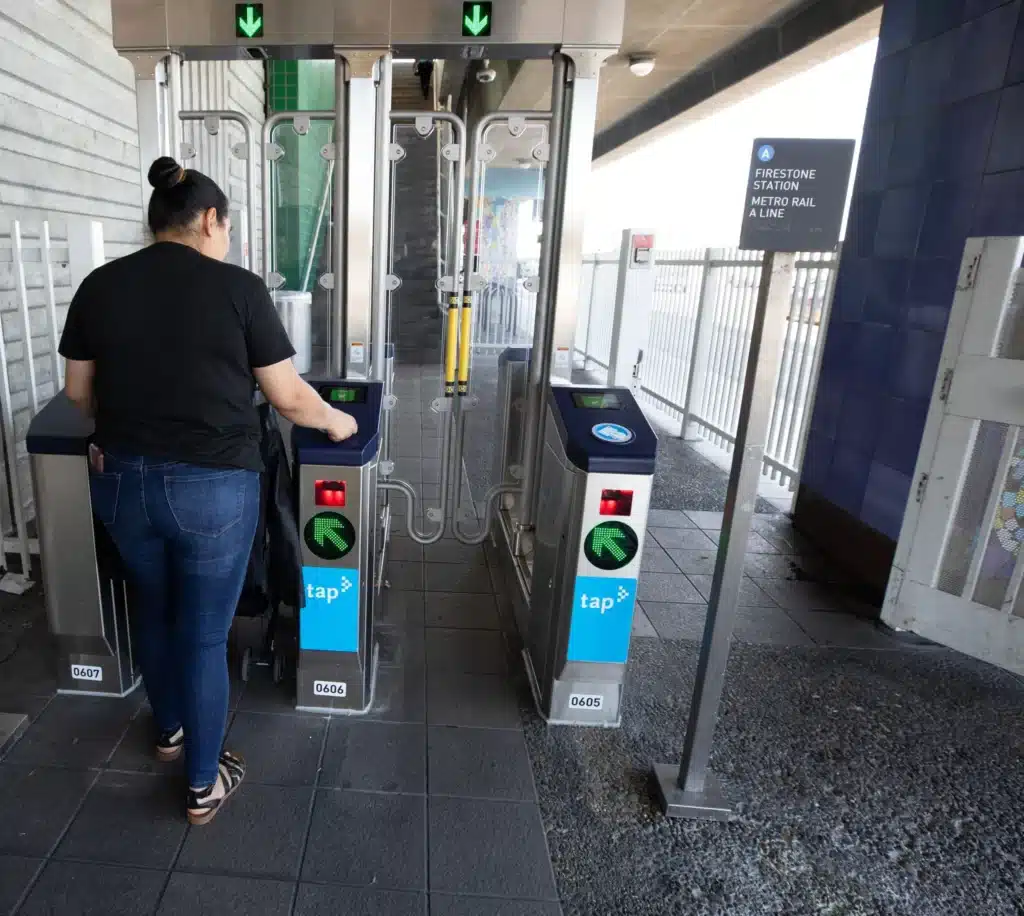
LA Metro says it chose to begin the gate installations at Lake and Firestone Stations because both stations “have shown high rates of fare evasion based on recent data.” For example, the agency measured the number of paid entries versus unpaid entries (calculated by counts of forced entries and emergency gate entries) between June and September 2024. The number of unpaid entries at Firestone Station “dwarfed the number of paid ones,” LA Metro noted.
Key features of the new faregates include:
- “They’re taller: Standing more than seven-feet-tall, it’s impossible for fare evaders to jump over the new gates. (The current faregates, by contrast, hover around three feet.)
- “They’re more precise: The new faregates are equipped with additional sensors that detect motion more precisely than their predecessors. This has been proven to reduce the potential for non-paying riders ‘piggybacking’ or ‘tailgating’ behind paying riders.
- “They’re sturdier: The new gates have special electromechanical locks, so determined fare evaders can’t force open the door by pushing them. The new gates still comply with fire and life safety requirements.
- “They’re more user-friendly: Instead of turnstile bars that like to get caught in your bike’s handlebars or the strap of your bag, the new faregates have paddle-style doors, making it easier to bring bicycles, luggage, and other belongings on the system.
- “They’re ‘smarter’: If a fare evader does manage to squeeze through the new gates, the sensors can record the incident, providing valuable data that will help LA Metro deploy our staff more effectively.”
The new faregates work the same way the gates work now. All passengers need to do is tap their TAP card and the gates will open as usual. In the future, LA Metro says it plans to implement the TAP-to-Exit program at all stations with the new faregates.
According to station data, the new gates are making a difference.
- “From Monday, March 3 through Wednesday, March 5, 2025, LA Metro saw an average of 512 paid entries at Lake Station. From Monday, March 31 through April 2, 2025, after the faregates were installed, LA Metro saw an average of 1,062 paid entries at Lake Station: a 107% increase.
- “From Monday, March 3 through Wednesday, March 5, 2025, LA Metro saw an average of 297 paid entries at Firestone Station. From Monday, March 31 through April 2, 2025, after the faregates were installed, LA Metro saw an average of 1033 paid entries at Firestone Station: a 248% increase.
- “From Monday, March 3 through Wednesday, March 5, 2025, LA Metro received 16 reported incidents at Lake and Firestone Stations on the Transit Watch App. From Monday, March 31 through April 2, 2025, LA Metro received only four reported incidents, marking a 75% reduction in reported incidents. Over this time period, the agency did not deploy any additional security personnel or fare inspectors to the stations, suggesting that the presence of these gates played the primary role in deterring fare evasion.”
Over the next few months, LA Metro says it plans to roll out the new faregates to the following stations:
- 7th Street / Metro Center (B/D A, E Lines)
- Westlake MacArthur Park (B/D Lines)
- North Hollywood (B Line)
- Pershing Square (B/D Lines)
- Willowbrook/Rosa Parks (A, C Lines)
- Wilshire/Vermont (B/D Lines)
- Vermont/Santa Monica (B Line)
- Hollywood/Western (D Line)
Beginning October 2025, LA Metro will begin installing the new faregates at the following stations:
- Aviation/LAX (C Line)
- Vermont/Athens
- Del Amo (A Line)
- Civic Center (B/D Lines)
- Compton (A Line)
- Harbor Freeway (C Line, J Line)
- Mariachi Plaza (E Line)
- Slauson (A Line)
- Expo/La Brea (E Line)
- Avalon (C Line)
- Lynwood (C Line)