
Transit Briefs: SEPTA, Santa Clara VTA, TriMet, Metra, NJ Transit, BART

SEPTA
SEPTA announced Nov. 14 that it has completed the point-by-point inspections of its Silverliner IV Regional Rail trains ahead of the deadline set by the FRA.
The FRA outlined 14 safety-related requirements in an Emergency Order issued on Oct. 1 in response to recent fires involving the Silverliner IV fleet.
SEPTA met almost all of the required actions by the FRA’s initial Oct. 31 deadline. The FRA granted SEPTA an extension to finish enhanced inspections of the 223 railcars and install new high-heat detectors.
SEPTA will meet the new deadline of Dec. 5 to install the thermal protection circuits on the Silverliner IV railcars. The circuits are a safety mechanism designed to interrupt the flow of electricity to an overheating device, providing an added layer of protection.
Now that the inspections are completed, SEPTA says, “Regional Rail reliability should gradually improve through the end of the year as more railcars are repaired and returned to service.”
SEPTA General Manager Scott A. Sauer spent the day thanking employees at the maintenance shops where crews have worked around the clock for weeks to conduct the complex inspections and address any needed repairs.
“I appreciate the hard work and dedication by our workforce to achieve this major milestone,” said Sauer. “I am confident that, through continued collaboration with the FRA, we can maintain safe Silverliner IV service for our customers.”
“We understand that the recent service disruptions on Regional Rail have wreaked havoc on the daily lives of our riders,” added Sauer. “We appreciate their patience as we work to mitigate the canceled trips, long delays, and crowded railcars.”
Meanwhile, SEPTA has signed an agreement with the Maryland Area Regional Commuter Rail (MARC) system to lease 10 rail coach cars, which will help provide some relief to customers in the coming weeks.
SEPTA will continue to share updates on the federally mandated safety actions.
Santa Clara VTA
The Santa Clara VTA recently announced more than $750,000 in grant funding to support projects that “improve access to public transit, strengthen community resilience, expand inclusive engagement, and celebrate community identity across Santa Clara County.”
These investments, going to 14 recipients in four different categories, “help cities and nonprofits advance equitable, transit-oriented communities (TOCs) that connect residents to opportunity while promoting cultural vibrancy and sustainability,” the agency noted. This is the second year VTA has awarded these grants to various organizations and cities in Santa Clara County.

The award categories:
Program Area A: Transit Access and Circulation Planning ($350,000)
- The City of San José will develop multimodal access and circulation strategies for the Santa Teresa, Cottle, and Blossom Hill stations to improve connectivity and safety in South San José.
- The City of Santa Clara will conduct an Access Gap Analysis for four stations—Old Ironsides, Great America, Lick Mill, and Great America Capital Corridor/ACE—to identify improvements for pedestrians, cyclists, and riders.
Program Area B: Community Resilience – Total Funding: $200,000
Funding strengthens emerging community development corporations to support small business resiliency and housing preservation.
- Latino Business Foundation Silicon Valley (LBFSV) will launch “Building Belonging: Preserving Small Businesses and Housing Near Transit,” helping stabilize small businesses, promoting “Shop Local, Go Local” campaigns, and expanding tenant protections.
- SV@Home will conduct a “Transit Oriented Preservation and Anti-Displacement Zones (TOPAZ)” feasibility study on Enhanced Infrastructure Financing Districts (EIFDs) to sustain affordable housing near transit.
- Enterprise Foundation will establish a Neighborhood Small Business Center near the Mountain View Transit Center to provide bilingual advising, training, and technical assistance.
Program Area C: Education and Engagement – Total Funding: $100,000
Funding strengthens community advocacy for TOC policies and inclusive engagement.
- Santa Clara City Library Foundation and Friends will implement “Project LiFT – Literacy for Transit,” offering free ESL workshops and family literacy events centered on public transit.
- The Audacity Performing Arts Project will launch “Digital Storytelling for Transit Equity,” empowering Title 1 students to create documentaries and podcasts on transportation access.
- Silicon Valley Youth Climate Action will lead a Youth Peer Transit Education program to increase youth ridership and reduce car trips.
- Nueva Vida Community will expand “Puentes Comunitarios,” to ensure that Spanish-speaking and underserved residents are not only informed but also actively shaping the future of their neighborhoods.
Program Area D: Placemaking and Cultural Activation – Total Funding: $100,000
Funding supports projects that reflect community vibrancy through arts and culture near transit.
- Poppy Jasper, Inc. will present “Poppy Jasper on the Line: Film & Culture in Transit-Connected Downtown,” activating downtown Gilroy and Morgan Hill with free film screenings and artist-led panels near VTA stations.
- School of Arts and Culture at the Mexican Heritage Plaza will host “Eastside Signature Events,” celebrating local heritage around the future 28th Street/Little Portugal BART Station through festivals like Avenida De Altares, Fiesta Navideña, Fiesta Del Mariachi, and Chile, Mole, Pozole.
- Our City will beautify the Eastridge Transit Center through the “Utility Box Community Art Project.”
- Opera San José will expand its “Opera on First” initiative, transforming South First Street into a live opera hub, pairing performances with VTA access to connect arts and transit.
Together, VTA says these projects “demonstrate a shared regional commitment to building equitable, connected, and culturally vibrant transit-oriented communities across Santa Clara County.”
TriMet
TriMet is using what it has learned from the community and its Service Priorities Survey to help inform changes to its transit service, as the agency works to resolve a $300 million annual budget gap.
More than 4,800 people across the Portland metro area shared their thoughts in the survey, which was open from Sept. 24 through Oct. 31. Responses, TriMet says, “reflected the community’s desire to preserve core aspects of our transit service, so those who rely on it most will continue to have safe, reliable options to connect with jobs, education, shopping, services and other needs.”
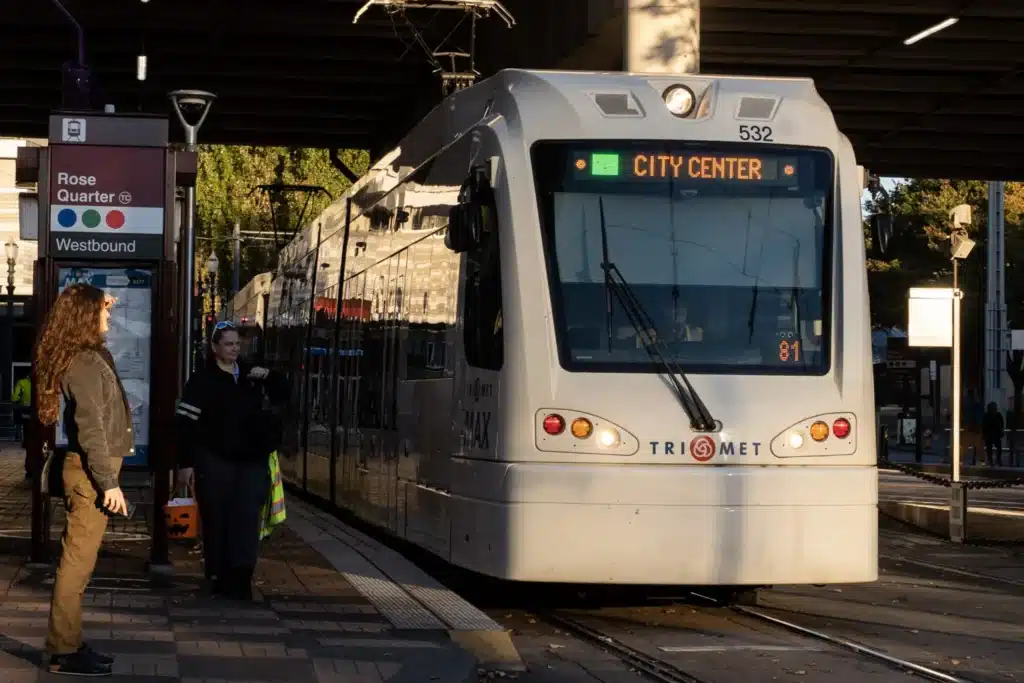
TriMet’s budget shortfall is the result of rising costs and inflation, less revenue from fares since the COVID-19 pandemic and the resulting rise in remote work, and funding uncertainty at the state and federal levels, the agency noted. “We announced in July plans to reduce spending to close the budget gap. We have started to make cuts internally, including reducing administrative expenses across our organization, but we must also bring our service in line with revenues,” TriMet said.
“Cutting service is a last resort and never what a transit agency wants to do, but by reducing spending now, we avoid more severe cuts down the road, which would affect many more riders. Also, by building a strong partnership with our community through engagement, we look forward to making these difficult decisions with their values and priorities at top of mind,” the agency added.
Survey respondents supported changes that improved operational efficiency, while preferring that TriMet preserve frequency and span of service. Comments showed strong empathy for riders who are transit dependent.
The three options with the largest number of “do this first” responses were:
- Reduce or eliminate service where lines are close together.
- Shorten the MAX Green Line to run between Clackamas Town Center and Gateway.
- Stop funding support to other transit agencies.
Participants, the agency says says, saw these as “common-sense measures” that would preserve TriMet’s core network of transit service. Some viewed them as less permanent, or options that could potentially be reversed in the future. Respondents preferred TriMet maintain frequency on high ridership routes and hours of service and preserve service to critical destinations such as medical care and colleges.
The options that earned the largest number of “do this last” responses were:
- Reduce how often MAX trains arrive.
- Reduce how often buses arrive on Frequent Service lines.
- Reduce or eliminate some bus service after 8 p.m.
- Reduce or eliminate some bus service on weekends.
Respondents prioritized late-night and weekend services, as well as TriMet’s Frequent Service, where buses and trains arrive every 15 minutes or better for most of the day, every day. Their comments expressed concern for shift workers and families, as well as late-night road safety. The responses also showed concern that cutting those types of services would affect reliability and discourage ridership.
TriMet says it is using the survey responses, along with ridership trends and other factors, to develop specific proposals for the service cuts. In January, the agency will share those proposals with the public and conduct another round of engagement. The feedback gathered will help TriMet finalize plans that will be presented to its Board of Directors for consideration in March and April 2026. The service changes will take effect later in 2026. TriMet will conduct additional outreach before making more cuts, likely in late 2027. TriMet says it aims to balance its budget by July 1, 2028.
More information is available here.
Metra
A Cook County jury has awarded Metra $19.3 million in a lawsuit against UP over “not walking through trains and collecting fares during the COVID-19 pandemic,” according to a Daily Herald report.
“We have said all along that our obligation is to protect our customers and taxpayers of the region, and on their behalf we are gratified by this verdict,” Metra Communications Director Michael Gillis said Thursday of the Wednesday verdict.
“While this is a disagreement between the parties, Metra and Union Pacific will continue to work together to provide service to our riders and the region.”
According to the Daily Herald report, UP indicated that it might appeal.
“Union Pacific took good faith steps to safeguard the health of our employees and the communities in which we operated during the pandemic. We are disappointed in the jury’s decision and are exploring our post-trial options,” officials said.
The verdict, the Daily Herald reports, “comes amid a prolonged and bitter dispute over how much Metra should pay to operate trains on UP’s tracks.”
“In 2019, UP announced that it no longer wished to operate commuter trains for Metra. Although the two railroads have essentially completed the transition, the finances are unresolved,” according to the report.
“Metra and its partners UP and BNSF suspended collecting fares during Illinois’ stay-at-home order in mid-March 2020. But in June when pandemic regulations were relaxed slightly, BNSF and Metra conductors resumed collecting fares and walking cars while UP held back,” according to the report.
The lawsuit cited the period between July 13, 2020, and May 31, 2021.
At the time, UP executive Benita Gibson said, “what we know about COVID-19 continues to change, and we have a responsibility to our employees and commuters to put their health and safety first.”
In the lawsuit, Metra stated numerous UP passengers had raised concerns about safety, “including complaints about the inability to locate trainmen to obtain assistance, the failure of trainmen to walk through the cars to encourage the wearing of protective masks, and the failure to open enough passenger cars to allow for social distancing,” according to the Daily Herald report.
NJ Transit
NJ Transit is continuing to advance an extension of the HBLR into Bergen County by issuing an RFP to hire a contractor to prepare the DEIS for the proposed 10-mile extension that would provide light rail service from the current terminus at Tonnelle Avenue in North Bergen up to a currently anticipated terminal at Englewood Hospital.
“NJ Transit remains committed to extending the Hudson-Bergen Light Rail into Bergen County,” said NJ Transit President and CEO Kris Kolluri. “This RFP is a concrete demonstration of that commitment. Providing mass transit options to all regions of New Jersey takes cars off the road, cleans the air we breathe and drives economic activity, sustainable housing and a multitude of other benefits.”
The Northern Branch project, as currently proposed, will extend the Hudson-Bergen Light Rail system by 10 miles and include seven new station stops in five municipalities. The electric light rail service would operate on West Side Avenue in North Bergen, and then on existing railroad right-of-way owned by CSX between 91st Street in North Bergen and the northern border of Englewood and would introduce new station stops in North Bergen, Ridgefield, Palisades Park, Leonia, and Englewood.
In 2023, the Federal Transit Administration (FTA) rescinded its Notice of Intent (NOI) to consider NJ Transit’s previously submitted environmental impact statement “citing changes in environmental conditions such as flood plains, storm water management and air quality which have occurred since 2007.” NJ Transit determined that that scope of work required to update the environmental impact statement would require a new contract. At that time, work began to assess and prepare the requirements included in the current RFP.
BART
BART ridership continued its steady recovery in October, posting the highest weekday average since the pandemic began, the agency recently reported.
Ridership was 10.7% higher than October 2024, with an average of nearly 200,000 weekday riders. In total, passengers took more than 5.3 million trips during the month. On Saturday, October 18, BART recorded 150,000 trips—the highest Saturday ridership since the pandemic.
Usage of the new Tap and Ride payment system continues to grow. Nearly 10% of all trips in October used Tap and Ride, which allows riders to pay directly at the fare gates with a contactless bank card. Tap and Ride is now the second most-used payment method after Clipper Adult, with usage up 23% from September.
Special fare programs are also expanding. Clipper START, which offers a 50% fare discount to qualifying low-income riders, saw a 40% increase in usage over last October. Meanwhile, usage of Clipper BayPass, the all-in-one Bay Area transit pass, rose 13.4% in October alone and 138% compared to a year ago.
BART says it has been investing in system improvements based on rider feedback, “prioritizing safety, cleanliness, and customer experience enhancements.” Earlier this year, BART completed installation of stronger, more secure fare gates at all 50 stations and became the first Tap and Ride agency—a system that will soon expand to other local transit agencies through the Next Generation Clipper program.
These enhancements, the agency says, are making a visible impact. Riders are noting cleaner trains and stations and an increased safety presence throughout the system.
Despite encouraging ridership gains, BART continues to face a $375 million budget deficit. To close that gap solely with fare revenue, current ridership would need to more than double, according to the agency. BART’s most recent budget forecast projects a 4% ridership increase in 2026.
BART says its gradual recovery is closely tied to work-from-home trends in the region. While more riders are returning to the system, they are generally taking fewer trips due to remote and hybrid work schedules, the agency noted.
More information is available here.




