

R-TRIP

The new R-TRIP hub will officially launch with events on Oct. 16-17, 2025. Housed in the University of Pennsylvania’s Institute for Urban Research, it is led by Penn IUR Faculty Fellows Leslie Richards—the former Secretary of the Pennsylvania Department of Transportation (PennDOT) and CEO of Southeastern Pennsylvania Transportation Authority and now Professor of Practice at the Stuart Weitzman School of Design—and Lead Faculty Advisor Megan Ryerson, UPS Foundation Professor and Chair of the Department of City and Regional Planning at the Weitzman School.
According to Penn IUR, R-TRIP is slated to address current challenges facing transportation today, including:
- Transportation safety and crash prevention.
- Expanded access to jobs, education, and essential services.
- Data-driven innovation and technology deployment.
- Infrastructure prepared for future demands and disruptions.
- Improved reliability and performance of complex systems.
“Whether reimagining how people move through regions or integrating emerging technologies like artificial intelligence and advanced analytics into decision-making, R-TRIP is focused on practical impact and measurable progress that can be deployed across cities, regions and states,” Penn IUR reported Sept. 25. “Projects will be co-developed with input from public agencies and private sponsors and guided by interdisciplinary teams of Penn faculty, students and transportation leaders.”
The Initiative’s Public Sector Advisory Committee includes CEOs from such transit agencies as Los Angeles County Transportation Authority, Washington Metropolitan Area Transit Authority, California State Transportation Agency, Georgia DOT, Dallas Area Rapid Transit, Utah DOT, Denver International Airport, Pittsburgh Regional Transit, and Philadelphia’s Department of Aviation, among others.
According to Penn IUR, R-TRIP anticipates launching a series of pilot projects in collaboration with public and private partners, with an emphasis on:
- “Leveraging AI and predictive analytics to improve safety and operational efficiency.
- “Exploring smart infrastructure that adapts to user behavior and demand.
- “Advancing mobility data platforms that support informed planning and investment.
- “Supporting infrastructure that is resilient and adaptable to future conditions.”
These efforts, it said, aim to produce “measurable public benefits, such as reduced congestion, increased safety, and broader access to opportunity, through solutions that can scale across diverse environments.”
R-TRIP’s founding sponsors include Google Public Sector, AtkinsRéalis, Bentley Systems, HNTB, INRIX, STV, WSP, 4M Analytics, and Slalom.
“The Richards Transportation Initiative is built on the idea that great research should move quickly into action,” said Leslie Richards, a Railway Age Women in Rail Award honoree in 2020. “We’re creating a platform where public agencies, private partners, and academic leaders can work together to develop and implement smart, scalable solutions that accelerate innovation across the transportation sector.”
“The Richards Transportation Initiative is exactly the kind of forward-looking collaboration our nation’s transportation systems need,” added Garrett Eucalitto, President of the American Association of State Highway and Transportation Officials (AASHTO) and Commissioner of the Connecticut Department of Transportation. “Initiatives like this strengthen the ability of agencies to work across functions to improve mobility, accelerate electrification, and think beyond standard practices to better serve their communities.”
“We constantly ask how we can make travel safer, faster, and more responsive across Pennsylvania and beyond,” said Michael B. Carroll, Secretary PennDOT. “The Initiative’s applied research model gives us a powerful new tool to inform real-world planning and investment.”
MTA LIRR

LIRR “shattered” its most recent post-pandemic ridership record on Wednesday, Sept. 24, with 301,440 riders, including approximately 20,000 golf fans traveling to and from the Ryder Cup 2025 in Bethpage, N.Y., via the commuter railroad’s Farmingdale station, according to LIRR.
“This follows a summer that saw the LIRR repeatedly break post-pandemic daily ridership records carrying 298,419 passengers on Wednesday, July 23 and 295,419 passengers on Tuesday, July 22,” LIRR reported Sept. 25. “Since the beginning of June, the railroad carried more than 290,000 riders in a day six times with average monthly ridership for June, July, and August in excess of 265,000.”
The ridership highs reflect an increasing customer satisfaction rate and record-breaking on-time performance statistics, according to the railroad. Through the first half of the year, 96.6% of trains reached their destination on time, the railroad’s best rate in its history outside of pandemic years, and nine-tenths of a percentage point above last year’s rate of 95.7%, covering the same period of the year. Overall customer satisfaction reached 81% in spring 2025, up five percentage points from the fall 2024, when it reached 76%, which was itself a six-point increase from spring 2024’s rate of 70%, according to LIRR.
LIRR saw its busiest seven-day period since the pandemic, with a total of 1.77 million passengers riding between Monday, Aug. 25, and Sunday, Aug. 31. The pre-pandemic 2019 average weekday ridership of 316,692 was the highest since 1949.
According to LIRR, it brought millions of riders to see Post Malone, The Lumineers, Blackpink and other concerts at Citi Field; Phish, Mumford & Sons and the Black Keys at Forest Hills Stadium; every Mets home game; the U.S. Open; and hundreds of Manhattan events this summer along with service to the Hamptons and all the other Long Island beaches.
Nine extra trains are part of expanded service to the Ryder Cup this week (week of Sept. 21), and seven more trains have added Farmingdale stops.
“People are coming back to the LIRR because of the exceptional service, as they know a fantastic customer experience is there for them,” LIRR President Rob Free said. “The highest on-time performance in the railroad’s long history and clean, safe, and comfortable trains that are the best way to travel to everything that Long Island has to offer.”
In related news, Gatekeeper recently announced a C$27 million Federal Railroad Administration transit video project with LIRR, and MTA Metro-North Railroad will launch “super-express” trains next month.
Metra

Metra will be putting into service this fall a prototype café car, rotating it across most of its busiest lines and stations and asking riders to take a survey about whether they like the concept and about what amenities and features they would like to see, according to the commuter railroad serving Chicagoland.
To make the prototype, Metra said it removed the second level on one half of a car, and installed counters, stools, booths, and tables. The interior has also been decorated “so it feels a bit different from the average Metra car,” it noted.

The car will make its debut on the Rock Island Line on Sept. 30, Oct. 1, and Oct. 2, and then will be parked at LaSalle Street Station on Oct. 6. Riders can view the car and offer their feedback in an onboard survey. Riders who complete the survey will receive free snacks and beverages, Metra said.
The car will be moved to the BNSF Line the week of Oct. 13, the Milwaukee District North Line the week of Oct. 20, the Milwaukee District West Line the week of Oct. 27, the Union Pacific North Line the week of Nov. 3, the Union Pacific Northwest Line the week of Nov. 10, and the Union Pacific West Line the week of Nov. 17. The specific schedule for each line will be posted at metra.com/CafeCar.
“We created this special car in an attempt to improve the riding experience and maybe attract new riders,” Metra CEO/Executive Director Jim Derwinski said. “This is your chance to check it out and tell us what you think. Would you use it? What amenities would you like to see? What other thoughts do you have?”
(Note from Railway Age Editor-in-Chief William C. Vantuono: “New Jersey Transit should do this!”)
Separately, earlier this month and just days after the Surface Transportation Board granted Metra’s application for terminal trackage rights to continue commuter rail service over three Union Pacific-owned lines in Chicagoland, UP filed a lawsuit in federal court seeking compensation from Metra. Also, the 87th St./Woodruff Station on the Metra Electric Line, which has been closed since December 2024 for a complete rehabilitation, will reopen on Oct. 6.
REM
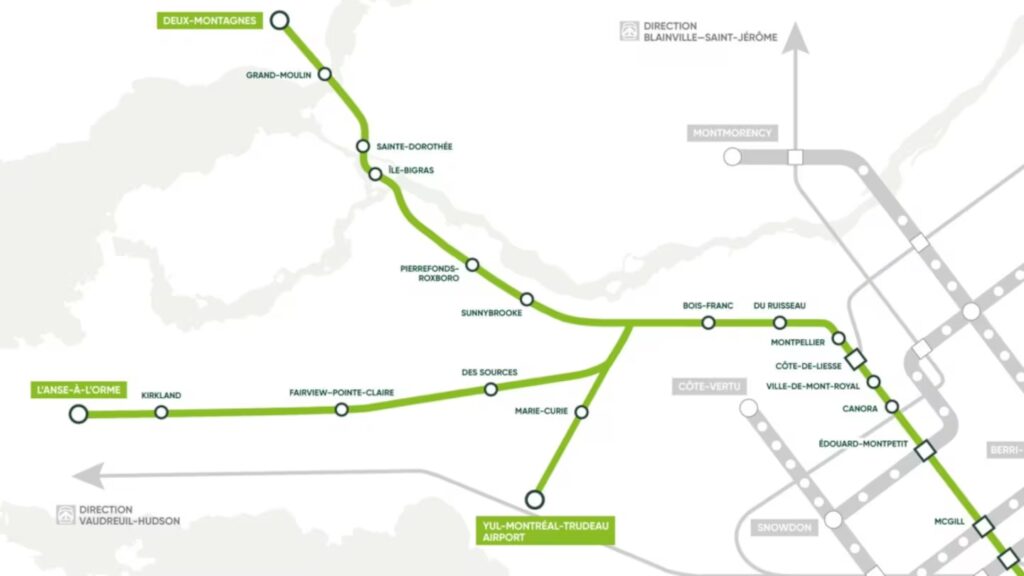
REM’s Deux-Montagnes branch will begin running in November and the Anse-à-l’Orme branch will open in spring 2026, The Canadian Press reported Sept. 25.
“The two branches [see map, top] were scheduled to enter service at the end of 2024, but that timeline was postponed to fall 2025 and management [at CDPQ Infra, the subsidiary of Quebec’s public pension fund manager that is developing the REM network] had been looking at an October start for several months,” according to the news agency.
REM’s first automated urban rail system segment linking the South Shore to downtown Montreal’s central station launched in July 2023, and The Canadian Press noted that the “project has faced criticism from passengers about its reliability, especially last winter when the trains suffered multiple stoppages.”

“When asked about the frustration of future passengers, CDPQ Infra president and CEO Jean-Marc Arbaud emphasized the scale of the project,” the news agency reported. “‘In seven years, no project in Canada has been completed on such a time frame on the same scale,’ Arbaud told a news conference. ‘I don’t reject the criticism,’ he added. ‘In the end, what I’m saying is that we did it, everyone who worked on the project did more than their best, and it’s a success.’”
According to Arbaud, the delays will not affect “the construction cost update,” according to the news agency, which noted that the project’s price tag is estimated at C$9.4 billion, “about [C]$2.4 billion more than the initial forecast in 2018.”
When the Airport segment opens—scheduled for 2027—the network will have 26 stations and span 41.6 miles (67 kilometers).
In related news, REM’s first segment recently reopened after a six-week summer shutdown to test the new extensions to Montreal’s North Shore and West Island.




