NYMTA
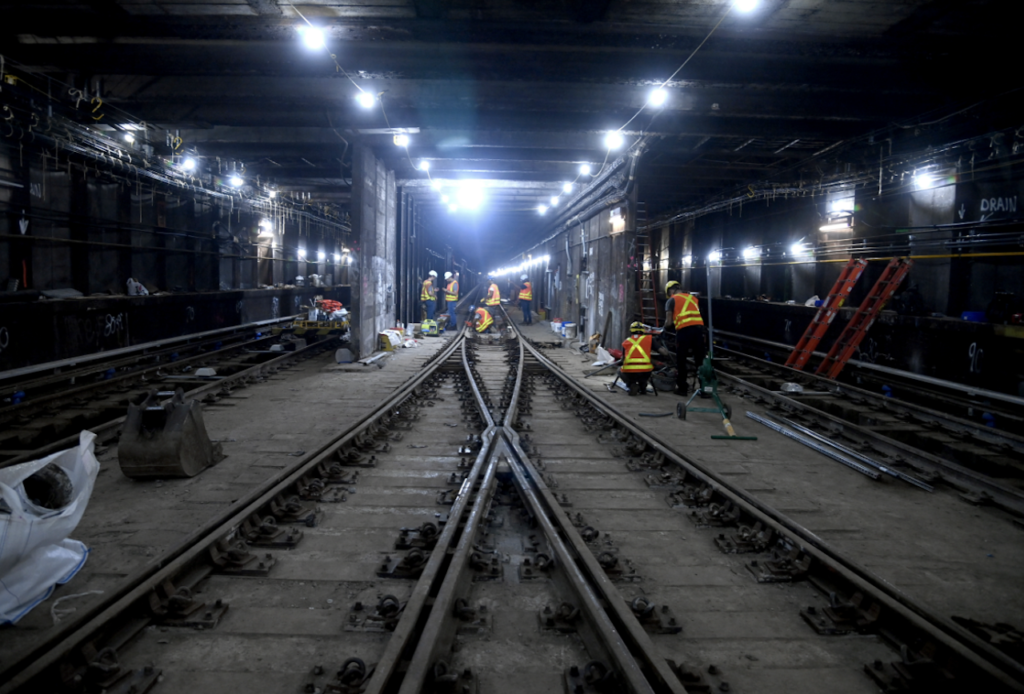
The New York MTA on Aug. 8 reminded customers that Phase 3 of the signal modernization work on the G Line will begin at 4 a.m. on Monday, Aug. 12, and continue through 5 a.m., on Tuesday, Sept. 3.
The G train’s signal system dates back to the 1930s and is now being modernized with communications-based train control (CBTC), which, the agency says, “will bring more reliable service to the 160,000 riders who take the G train every day.” Once the project is completed, the G train will be the third line in the subway system to be fully converted to CBTC, following the L and the 7.
In Phase 1 and 2, the project team has completed critical construction milestones, including the complete reconstruction of the train interlocking between 21st Street and Court Square. This infrastructure, MTA says, hadn’t received an upgrade in more than 30 years and had fallen in a state of disrepair. In comparison, the new interlocking includes 3,000 feet of new third rail and more than 50 miles of new cables to support a new fiber optic and wireless communications system. Construction crews also added a new track lubrication infrastructure to reduce train noise for a quieter and smoother ride, and all three phases implement modern composite railroad ties, which are much more resilient to water infiltration than the traditional wooden ones. Approximately 100 construction crew members per shift worked around the clock to complete the new interlocking in two weeks.
Phase 3 begins with curved track replacement between Bergen Street and Hoyt Street. This section of track requires G trains to make a very sharp turn, which causes a lot of wear and tear on the rail and train wheels.
At the start of the work, the MTA launched a comprehensive customer service campaign to support riders. Hugo Zamora was appointed as the “G Train Czar” to oversee real-time communication with G train customers. Zamora “ensures reliable alternative bus shuttle service is available and is empowered to make real-time adjustments to service to meet customers’ needs,” the agency noted.
SCVTA
Bay Area transit agencies are synching schedules in a whole new way with a focus on improving transfers between systems and making schedule changes at the same time, SCVTA recently announced.
According to the agency, “most Bay Area transit agencies are rolling out new schedules next week in coordination with each other and are working to align the timing of schedule changes twice each year, once in summer and once in winter.” There has been a 250% increase in the number of transit agencies changing their schedule concurrently twice each year, and six of seven major transit providers are syncing their schedule changes at least once a year, SCVTA noted.
Agencies convened a meeting in March 2024 to share planned changes for mid-August and to look for opportunities to improve transfers. Advancing schedule change alignment, SCVTA says, is a key priority for Bay Area transit general managers who meet on a weekly basis to make transit more rider-focused and efficient. The major agencies are already working on another iteration of a coordinated schedule change to go into effect in January 2025. These coordinated schedule changes will benefit current transit riders while attracting new riders, SCVTA noted.
Some key examples of improved coordination from the mid-August schedule changes:
- “In the North Bay, a series of coordinated changes between SMART, Golden Gate Transit, and Marin Transit will improve service and connections along the congested Highway 101 corridor.
- “The Napa Valley Transportation Authority is making changes to Route 29 from Redwood Park and Ride to the El Cerrito del Norte BART station to enhance the bus-to-train transfer timing. 71% of the trips will now have a 5- to 10-minute transfer time at El Cerrito del Norte, as opposed to 23% with the current schedule. The change will positively impact as many as 16,465 riders annually.
- “AC Transit and Golden Gate Transit have improved schedules to be more coordinated at El Cerrito del Norte Station and along Cutting Boulevard west of the BART station. This alignment enhances reliability for riders traveling between Marin and West Contra Costa counties via the Richmond-San Rafael Bridge.
- “In San Francisco, Muni is making changes to improve regional connections, specifically, the 28 19th Avenue bus schedule serving Daly City BART station is changing to ensure East Bay riders can catch the last BART train to Oakland late at night.
- “VTA is making changes to match upcoming BART and Caltrain schedule changes to ensure timed transfers are maintained at various locations across the South Bay and Peninsula.
- “SamTrans is improving several bus routes that serve BART stations. One noteworthy change is to bus route 292, serving both Millbrae and SFO BART stations, with frequency (the time between bus arrivals) to be every 20 minutes from 6am-6pm to match BART’s frequency.
- “Both BART and Caltrain will make changes to improve some of the rail transfers at Millbrae Station that will go into effect when Caltrain launches its electric service on September 21. With BART’s schedule change on August 12 and Caltrain’s schedule change on September 21, ~85% of all weekday trains will have a transfer between 5 and 19 minutes at Millbrae Station. On the weekend, ~90% of trains will have a transfer between 5 and 19 minutes, allowing for both systems to be off schedule a bit but still provide a reliable connection. If trains were scheduled with less than a 5-minute wait, delays would frequently break the transfer and result in a longer wait.”
While all transit agencies are working to improve transfer timing for Bay Area transit riders, several challenges continue to exist making transfer timing difficult:
- “A better transfer for one end of a route may create a worse transfer for other areas of the route.
- “Adding service to allow frequencies to match each system requires new funding at a time transit agencies are facing significant budget challenges.
- “Transfers between BART and Caltrain at Millbrae Station don’t always line up perfectly because Caltrain has four trains per peak hour and two trains per off-peak hour/weekends. BART has three trains per hour at all times. Both systems are also limited in flexibility due to key system timing points elsewhere.”
In addition to schedule coordination, SCVTA says Bay Area transit agencies are working together, along with the Metropolitan Transportation Commission, on significant regional projects that will “transform the rider experience,” such as unified transit maps and directional signs and fare integration and affordability programs such as the implementation of free and discounted transfers.
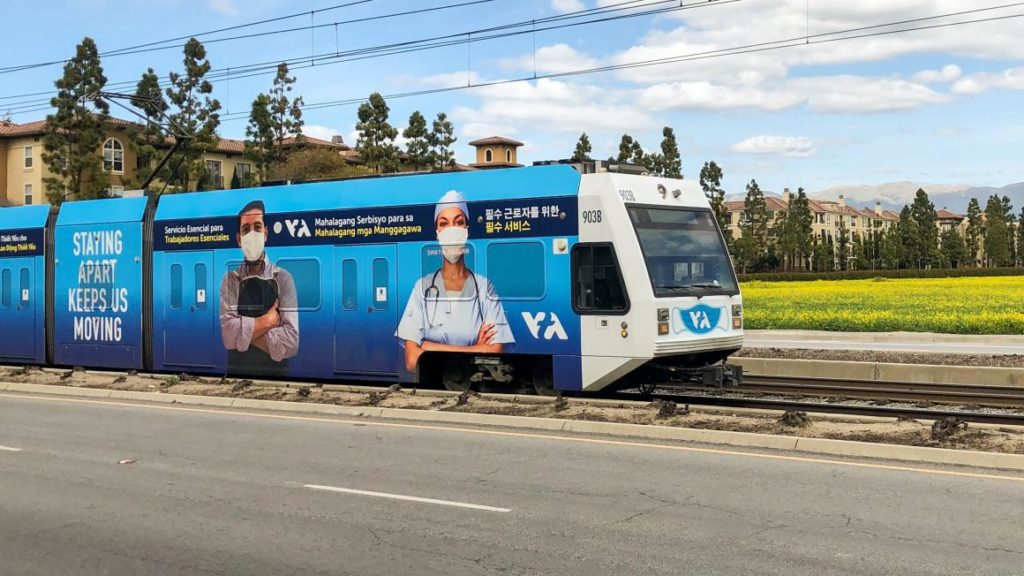
Separately, SCVTA has contracted Econolite Systems for the installation of equipment to detect TSP calls at at-grade light-rail intersections, according to an ITS International report.
According to the report, the installations are at non-gated intersections along four strategic and heavily travelled corridors—Tasman Drive (north corridor), East San Carlos (south corridor), North Capital Avenue (east corridor) and North 1st Street (west corridor).
Econolite’s field services team, ITS International reports, are responsible for pole-mounted antennas, cable in existing conduits, lightning suppression units, cable grounding kits, wiring of shelf-mount units and wiring of relay switches.
According to the report, VTA has three light rail lines that use an existing TSP system in active operations and are adding a fourth.
“The TSP for the light rail lines is based on embedded detection in the exclusive right-of-way to trigger service calls for TSP. TSP was operational on 97 signalized intersections within the cities of Milpitas, San Jose, Santa Clara and Sunnyvale, as well as the County of Santa Clara on light-rail lines with nearly 100 light-rail vehicles,” according to the report.
Econolite, ITS International reports, “is also in coordination with the cities of San Jose, Sunnyvale, Santa Clara and Milpitas, as well as the County of Santa Clara and Caltrans, for the installation of the intersection equipment along the four corridors.”
As part of VTA’s TSP detection upgrade project, “the new equipment will also provide wireless light-rail vehicle detection that can be used by other local agencies for emergency vehicle preemption,” according to the report.
VRE/MDOT MTA
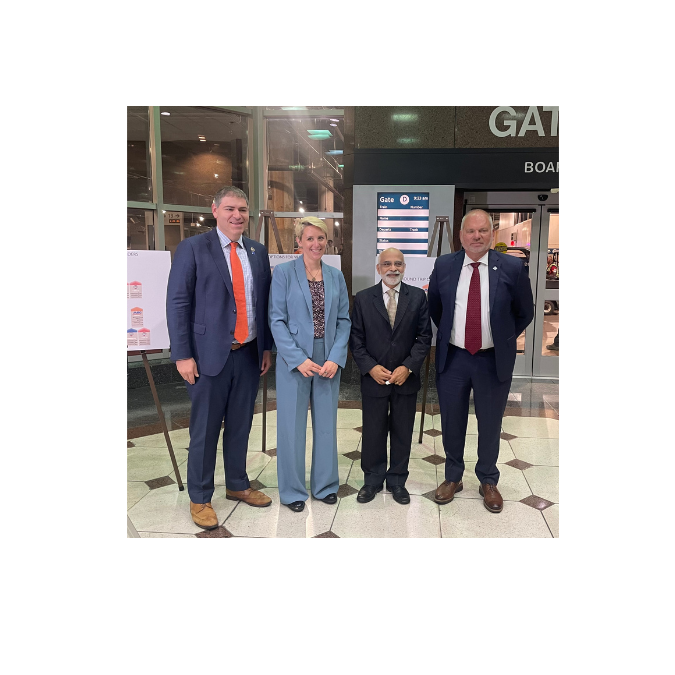
VRE and MDOT MTA on Aug. 8 celebrated a new collaborative agreement that will enhance commuter connectivity and efficiency across the region. Effective immediately, passengers with a weekly, monthly, or 10-trip ticket purchased on the MARC or VRE system to Union Station can utilize that ticket to transfer to the other system (MARC to VRE or VRE to MARC) to continue their trip at no additional cost.
“This agreement represents a significant step forward in regional transit integration,” said Maryland Transit Administrator Holly Arnold. “We are not only fostering a more connected and efficient transportation network across our states but fueling economic growth by facilitating easier movement of people, supporting tourism and attracting business to the National Capital Region.”
The agreement between Maryland and Virginia was announced Thursday at Union Station in Washington, D.C. The cross-honor program, the agencies say, “enables travelers to seamlessly transfer between MARC and VRE trains on one ticket, simplifying travel logistics and promoting greater accessibility and affordability for the region’s commuters. It also underscores the commitment of Virginia, Washington D.C. and Maryland to prioritize the needs of commuters and shape the future of regional mobility.”
“This agreement effectively expands the geographic footprint of commuter rail service in the region and provides passengers with an affordable two-seat ride across state lines,” said VRE CEO Rich Dalton. “It lays the groundwork for future efforts to better align MARC and VRE operations, which is consistent with our long-range plan to grow VRE from a peak-period, commuter-focused rail service to an all-day, bi-directional transit system that can better meet the transportation needs of a growing region.”
With this new program, the agencies say, “passengers will have easy access to connections between major urban centers, along with the unprecedented flexibility offered by the multiple transportation options available at Union Station.” MARC and VRE riders will have access to a wide range of employment centers, healthcare facilities, educational institutions, and tourism and cultural options throughout the region.
Amtrak
A transfer of locomotives from within the Amtrak network will restore complete service to the twice-daily corridor between Quincy, Ill., and Chicago, operated by Amtrak under a contract with the Illinois Department of Transportation (IDOT).
Effective this Saturday, Aug. 10, Amtrak Carl Sandburg Trains 381 & 382 will operate the full route. Amtrak had chartered buses along the route since last week. Sen. Dick Durbin had reached out to Amtrak to accelerate service restoration.
“While ensuring locomotives can receive proper, routine maintenance is essential, I’m relieved that Amtrak answered my call and is swiftly restoring full service for the Quincy-Chicago corridor,” said Durbin.
This temporary service suspension is the result of a shortage of available state-owned locomotives. Amtrak says it is working closely with IDOT and the manufacturer to “encourage streamlining of the process for making repairs to bring more of that fleet back into service.”
“We always appreciate the Senator’s strong interest in the performance of all our services in Illinois, said Amtrak CEO Stephen Gardner. “Amtrak will augment the locomotive pool for this service from our fleet to supplement the state-owned locomotives usually assigned to this route.”
Part of the Amtrak Midwest network, Train 381 is the morning departure from Chicago, and Train 382 is the evening departure from Quincy. Amtrak Illinois Zephyr Trains 380 & 383 continue to operate on this route and serve the same communities. Train 380 departs from Quincy in the morning, and Train 383 departs from Chicago in the evening.
In addition to Quincy and Chicago, other Illinois communities along this route are Macomb, Galesburg, Kewanee, Princeton, Mendota, Plano, Naperville and La Grange. Additional Amtrak trains serve Galesburg, Princeton, Mendota and Naperville.
LIRR
LIRR on Aug. 8 celebrated the 45th anniversary of the first-ever, women-only run train, according to a WABC report.
According to the report, on June 6, 1979, a train operated by only women pulled out of the Port Washington station on Long Island.
At the controls was Deirdre Hickey, the first qualified female conductor, along with Beverly Terrillion.
“It was exciting and groundbreaking,” said Terrillion, who was 24 years old at the time and working at a mortgage company but “making much less than her male counterparts.”
“The State Department of Labor was in the same building and the railroad,” Terillion said. “In order to get state funding, they had to hire women. This man literally knocked on all of doors on all the floors, asking only some if they wanted to start.”
According to the WABC report, “Terrillion signed up immediately, and was joined by Eileen Coleman a few months after.”
“I saw that there were other women doing this man’s job,” Coleman said. “I said, yeah, I want to be part of that.”
Coleman, Terrillion and the other woman from that day celebrated 20 years of women on the LIRR in 2000. They took a picture, and recreated it just last month.
“We lost three women to cancer and a couple others were coming down with cancer and I thought, before we lose anyone, I wanted to recreate it,” Terrillion said.
Both Terrillion and Coleman are now retired, but they are “very proud of what they’ve accomplished—paying the way for other women,” according to the report.