Transit Briefs: NYMTA, MARTA, Calgary Green Line LRT, Metrolinx, Amtrak

NYMTA
The New York MTA on Sept. 4 announced that the Grand Central Times Square 42nd Street Shuttle is now equipped with 5G wireless connectivity.
Through a public-private partnership agreement with Boldyn Network, major cell carriers including Verizon Wireless, AT&T and T-Mobile customers will now have full cell service in the tunnel between Grand Central 42nd Street and Times Square 42nd Street. The shuttle serves 12 million riders annually. The network is also designed to provide “seamless connectivity” for first responders, the agency noted. With bandwidth prioritization, the FirstNet Network will be available for the public safety community’s use.
According to the MTA, this is the first subway line to receive connectivity under a public-private agreement with Boldyn Network, formerly known as Transit Wireless. Boldyn Networks has deployed a high-capacity, low-latency network for all tier-1 mobile carriers to offer fully connected services to their customers. Even during peak commutes, riders will experience an enhanced connection on their mobile devices, the agency said.
Under the agreement, all 418 track miles of subway tunnel will receive cell coverage. WiFi service will also be expanded to all 191 above-ground subway stations and 21 Staten Island Railway stations. Installation of 5G infrastructure is happening in conjecture with MTA capital projects. The next tunnels to receive connectivity are:
- While the G train undergoes a major signal modernization, workers have been laying cables to support the fiber optic and wireless communications system throughout the entire line.
- Joralemon Street Tunnel. A 1.1-mile tunnel connecting the 4 and 5 between Manhattan and Brooklyn.
- 4, 5 and 6 Grand Central to as far north as 161st Street. As this phase of the project develops, five track miles of the 4, 5 and 6 will also be upgraded with 5G mobile infrastructure.
Boldyn Network, MTA says, will continue to build out the necessary infrastructure, leveraging the company’s existing infrastructure located throughout New York City. As the system is built out, the MTA will share in the revenues Boldyn Network receives from cell providers and other commercial customers, adding to the revenue from the station agreement. Overall, MTA says the project is expected to result in more than $1 billion in benefit for the agency and its customers over the life of the agreement in terms of service provided, additional revenue and cost savings.
“MTA has now developed a reputation as a first-class construction operation, getting our projects done on time and on budget: Third Track, Train, Times Square Shuttle, all that work on time and on budget. It’s not the old MTA. It’s the new MTA,” said MTA Chair and CEO Janno Lieber. “What we’re doing here is the most efficient way to bring cell connectivity: every time we go to do work in a tunnel, we’re going to say to our friends at Boldyn, come on in. Be ready, pull that cable. Install that infrastructure. Take advantage of the outage. It’s going take a few years, but we’re going to make the entire system fully connected in the most efficient way possible, which is during other construction outages.”
MARTA
Credit rating bureau Fitch Ratings has upgraded MARTA’s bond rating from AA to AA+. “This exceptional rating demonstrates MARTA’s strong financial position and is the second time Fitch has enhanced MARTA’s rating in the last two review cycles,” according to the agency. This higher rating, the agency adds, allows MARTA to “secure financing at more favorable interest rates, contributing positively to its financial stability, reliability, and overall success.”
The Issuer Default Rating (IDR) upgrade to AA+ reflects continued improvements in MARTA’s long-term liability burden, as well as implementation under Fitch’s new U.S. Public Finance Local Government Rating Criteria, the agency noted. “Growth in the personal income base and MARTA’s revenues have outpaced additional debt issuance, which positions the Authority to maintain ‘midrange’ liability metrics, even when considering additional issuances to fund MARTA’s robust capital needs,” according to the agency.
“Further underscoring its strong fiscal management,” MARTA has also earned perfect AAA ratings from both Standard & Poor’s (S&P) and Kroll Bond Rating Agency, “illustrating the Authority’s creditworthiness and ability to easily meet its financial commitments with the lowest risk of default.”
“This second rating increase in as many review cycles reflects MARTA’s financial stability and strong long-term revenue growth outlook,” said MARTA General Manager and CEO Collie Greenwood. “Bottom line, MARTA remains a good steward of taxpayer money and is well-positioned to increase our competitiveness for federal funding and meet the expansion commitments made to our jurisdictional partners.”
“These outstanding bond ratings place MARTA in the top tier of national transit agencies in terms of financial health and speak volumes about the strength of MARTA’s financial management and planning, and reassures our customers, investors, and partner jurisdictions that we can and will make good on our promises,” said MARTA Board of Director Chair Katie Powers.
Calgary Green Line LRT
Calgary Mayor Jyoti Gondek says the city “can no longer afford its long-sought Green Line light rail transit project” after the Alberta government announced its pulling funding from the plan in its current form, according to a report by The Canadian Press.
According to the report, Gondek says the province’s “push to change the scope of the project, and the delay that would come with a third-party review ordered by the province, will increase costs.”
Her comment comes after Alberta Transportation Minister Devin Dreeshen sent a letter to Gondek on Sept. 3 saying the Green Line is becoming a “multi-billion-dollar boondoggle” that will serve few Calgarians, according to The Canadian Press report.
According to the report, Dreeshen says the province “can’t support the city’s latest, scaled back plan with the $1.53 billion it had pledged.”
Council voted in July to “shorten the first phase of the line, and its budget has increased by about $700 million to [more than] $6.2 billion,” The Canadian Press reports.
Dreeshen says even though hundreds of millions of dollars have been spent on things like utility work, “throwing good money after bad is not an option.”
Metrolinx
The Ontario government announced Sept. 4 that it has officially broken ground on King-Bathurst, Queen-Spadina and Moss Park Stations, “marking another milestone in the province’s plan to build the Ontario Line and create a reliable and continuous transit line that connects communities throughout the Greater Toronto Area (GTA).”
Construction at the three sites includes work to remove soil and bedrock to create 30- to 40-meter-deep (98- to 130-feet-deep) stations with elevators and escalators that will ultimately connect the subways to the street. This work, the Ontario government says, will also prepare for future tunnel boring machines to create the tunnels that will connect all the underground stations through the downtown segment of the Ontario Line.
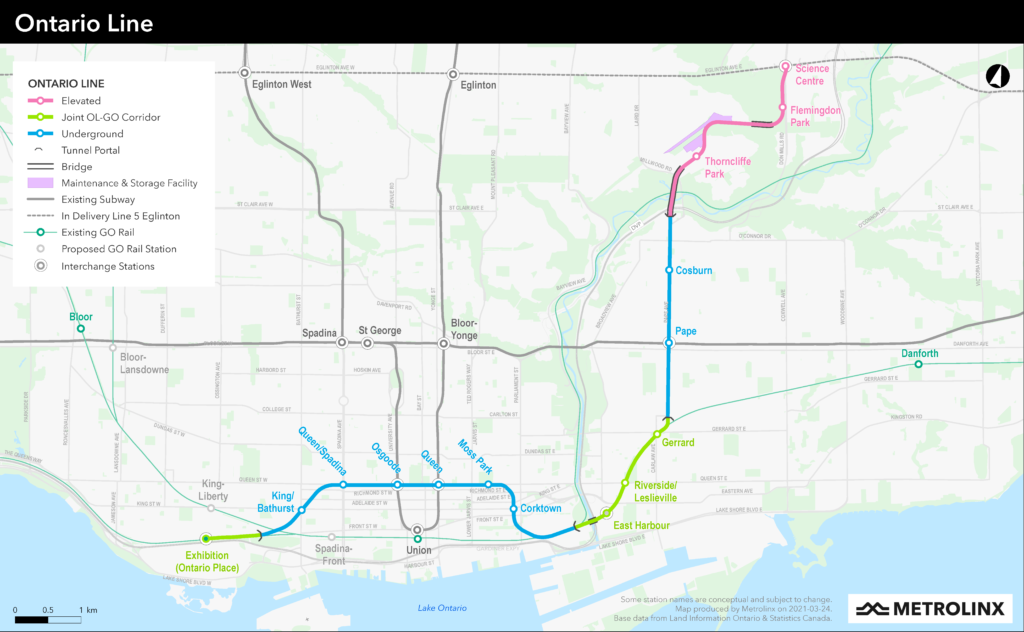
According to the Ontario government, the King-Bathurst Station will serve more than 5,000 commuters during the morning rush hour, creating “crucial connections” between the Ontario Line and popular streetcar routes like 504 King and 511 Bathurst. The Queen-Spadina and Moss Park stations are expected to serve more than 7,000 commuters each and facilitate more than 5,000 transfers during the morning rush hour. The Ontario Line project, the Ontario government adds, will help reduce crowding on Line 1 (Yonge-University) by 15% and at Union Station by 14%.

Once complete, Metrolinx’s 15.6-kilometer (9.7-mile) Ontario Line will have 15 stations, running from Exhibition Place through the downtown core and connecting to the Eglinton Crosstown LRT. The line will offer more than 40 connections to other subway, bus, streetcar and regional train services, bringing 227,500 more people within walking distance of transit and reducing daily car trips by at least 28,000.
“Under the leadership of Premier Ford, our government is one step closer to delivering a world-class transit system for the GTA,” said Minister of Transportation Prabmeet Sarkaria. “The stations we’re breaking ground on today will help tackle gridlock, reduce commute times and connect tens of thousands of commuters to homes and good-paying jobs each and every day.”
“A strong public transit system will help folks in Toronto get where they need to go faster, and reliably. That’s why, in 2021 we announced over $4 billion in support for the Ontario Line,” said Minister of Housing, Infrastructure and Communities Sean Fraser. “With the launch of Canada Public Transit Fund in July, we are investing nearly $30 billion over the next 10 years for transit projects across the country. The ground-breaking of the King-Bathurst, Queen-Spadina and Moss Park stations is an important milestone in our work to build a stronger public transportation system across the Greater Toronto Area.”
Amtrak
Amtrak will begin resuming its northern service line between Albany and Montreal, according to a NEWS10 report.
The line, which was suspended in May for 40 miles of track repairs, will resume on Monday, Sept. 9.
According to the NEWS10 report, New York State is paying for the track repairs as part of the 2008 federal Passenger Rail Investment and Improvement Act.