MTC
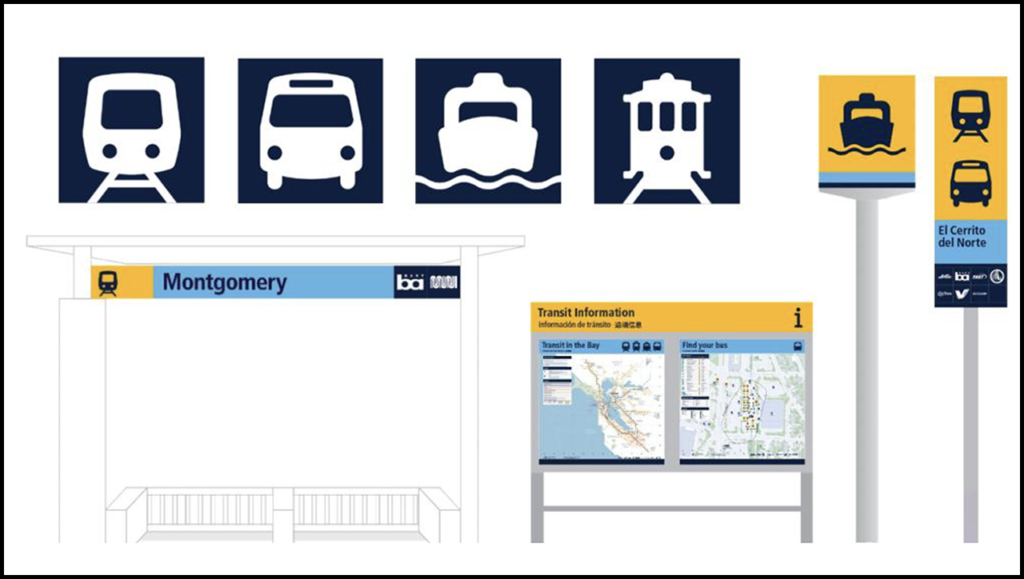
The Regional Network Management (RNM) Council on Feb. 23 approved the first set of transit wayfinding design guides to help Bay Area transit agencies establish a uniform look for signs and maps used everywhere from individual bus stops across the region to major hubs where multiple systems connect (see above). “These design guides are intended to make it easier for riders to identify information and use transit by delivering information that is clear, predictable and consistent across service areas and county lines,” according to the Council, which comprises the Executive Director of MTC, the regional transportation planning, financing and coordinating agency for the nine-county Bay Area; and General Manager-level representatives of such transit agencies as San Francisco Bay Area Rapid Transit District (BART), San Francisco Municipal Transportation Agency (SFMTA), Alameda-Contra Costa Transit District (AC Transit), Santa Clara Valley Transportation Authority (VTA), Caltrain, Golden Gate Bridge, Highway & Transportation District, and San Mateo County Transit District (SamTrans).
The approval finalizes the region’s new transit network identity and offers transit stop sign guidelines that MTC and agencies can use in the near-term while guidance for all transit stops and stations is refined and finalized, the RNM Council said.
The Regional Network Identity Design Guide is said to define a consistent “look and feel” for the Bay Area transit network, finalizing designs first introduced in January 2024 and used throughout the test locations at El Cerrito del Norte BART station (see photograph, top) and the Santa Rosa Transit Mall and Santa Rosa downtown SMART station. According to the Council, the Network Identity Design Guide includes specifications for the colors and symbols that should be used, as well as the hierarchy of how information should be presented, across all transit wayfinding materials.
The Transit Stop Signage Design Guide provides guidance for designing, installing, and maintaining transit stops—typically bus stops—using a new regional design that works across rural, suburban, and urban environments while accommodating stops with many routes, special services, or multiple transit agencies, the Council reported. Consistent signage at the Bay Area’s approximately 21,000 transit stops, it noted, is expected to improve legibility for riders and is intended to reduce long-term design, fabrication, and maintenance costs for transit agencies.
According to the RNM Council, MTC will use these two design guides for future pilot locations around the region. It noted that SFMTA already used the designs to make signage improvements at the Castro Muni Metro station, and other agencies with time-sensitive sign replacement projects are also considering using the new guidelines in the near term, with assistance from MTC as needed. These prospective projects include:
- BART: installing bus bay numbers at transit hubs.
- County Connection with WestCAT and Tri Delta Transit: testing new sign designs at three-agency shared stops in Martinez.
- SolTrans and WestCAT: installing new signage for 2026 service restructures.
An update to the comprehensive regional transit connections map, which is said to enable riders “to discover key destinations” they can reach on the Bay Area’s extensive rail, bus, and ferry network, was also released, according to the RNM Council.
“The Regional Mapping and Wayfinding Project is a standout example of regional cooperation,” said Bob Powers, RNM Council Chair and BART General Manager. “Putting customers’ interests first is the cornerstone of our Transit Transformation Action Plan to increase ridership by making transit faster, cleaner, more comfortable, more convenient and easier to navigate.”
Further Reading:
- First Look: Design Prototypes for Common Set of Bay Area Transit Signs (part of Transit Briefs)
- MTC Launches Regional Mapping and Wayfinding Project
DART

“Plano leaders have decided to call off the election to potentially withdraw from Dallas Area Rapid Transit after reaching a deal with the agency,” KERA News reported Feb. 23.
The May 2 election would have allowed voters to “decide to stay in or leave DART,” according to the media outlet. The Plano City Council, it said, also “voted to repeal an earlier resolution supporting capping DART’s tax revenue collections.”
KERA News reported that the Plano City Council decision “follows months of negotiations between DART and several member cities that have pushed for changes in DART’s funding and governance.” Plano, it said, is one of six cities—Addison, Farmers Branch, Highland Park, Irving, Plano, and University Park—“that called withdrawal elections that would end bus and train service within their city limits.”
DART operates light rail, Trinity Railway Express, regional rail, bus routes, GoLink on-demand service, and paratransit, moving more than 171,000 riders daily across a 700-square-mile, 13-city region including Addison, Carrollton, Cockrell Hill, Dallas, Farmers Branch, Garland, Glenn Heights, Highland Park, Irving, Richardson, Rowlett, Plano, and University Park. On Feb. 20, it approved a General Mobility Plan and inter-local agreement compromise that it said answers “cities’ concerns and provides a path forward for the agency, member cities, and regional partners.” If adopted by the city councils of all 13 member cities, the plan would provide requested funding from DART to the cities. The funding model proposed by DART relies on a mixture of DART funding, Regional Transportation Council funding, and looks for future funding initiatives. Under this agreement, DART said it would send part of its 1% sales tax revenue that currently funds the agency to member cities. In year one, each participating city would receive 5%, increasing by 0.5% annually to 7.5% in year six (see below).
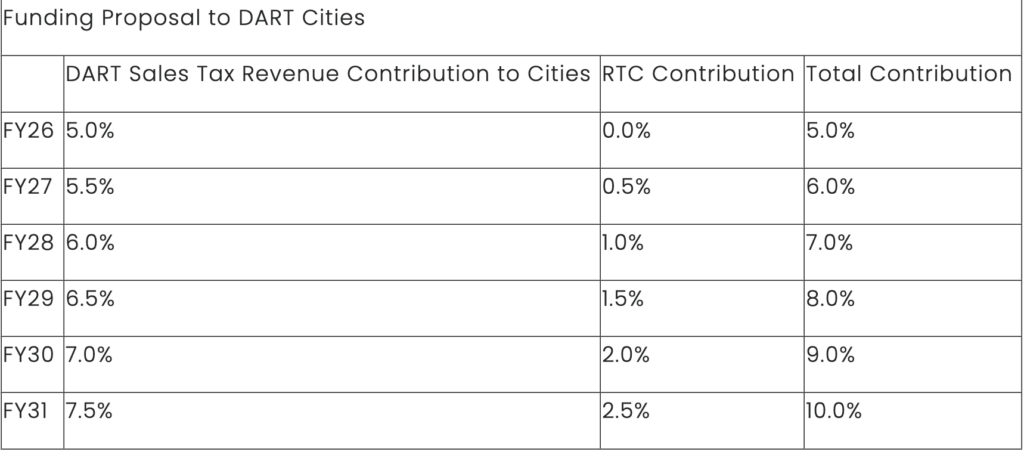
Earlier this month, the Regional Transportation Council of the North Central Texas Council of Governments approved $75 million to fund transportation-related projects in DART member cities, according to DART. Combined with DART’s contribution, the total guaranteed city funding would be 10% in year six.
DART reported that the agreement also creates a list of funding priorities that DART, member cities, and regional partners would work to advance at the state level. These items would include the governance structure along with: finding additional non-tax-based funding and transferring management of commuter rail (Trinity Railway Express and Silver Line) to a regional transportation authority, and finding additional non-tax-based funding.
KERA News reported that “[a]s part of the new deal, DART will give $360 million back to all of its member cities over six years. It also plans to restructure its board of directors so each city has a representative, expanding the board and reducing voting power for the city of Dallas. Plano City Council members passed a resolution Monday [Feb. 23] expressing support for the reform and ‘requesting state legislative action to implement a new governance structure.’”
DART CEO Nadine Lee “told KERA the agency will need to find other revenue streams to keep operations running,” according to the media outlet.
Lee also said: “There’s nobody who wants to improve services more than more than DART and we will endeavor to do that. If we can do that in partnership with the cities and if the cities are working with us in good faith we think that can be accomplished.”
KERA News reported that the Plano City Council, as part of the deal, “agreed to cease legislative efforts to defund DART. The city will receive more than $61 million over the next several years.”
At least three other cities—Addison, Farmers Branch, and Irving—are “considering calling off DART withdrawal elections,” according to KERA News. Cities have until March 18 to rescind the elections. DART is hosting a series of community education meetings leading up to a public hearing on March 24. A public hearing is required by law for any major service changes. If voters in any city elect to withdraw from DART, services in that city would cease immediately after the election is canvassed.