Metrolinx
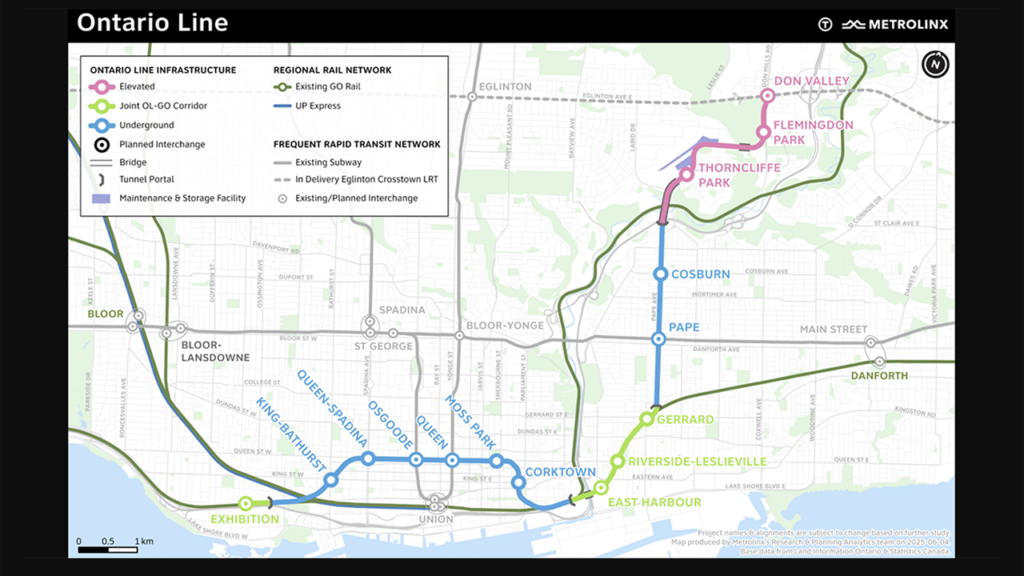
Construction is now under way along the entire Ontario Line, which when complete will be a 9.7-mile (15.6-kilometer), 15-station stand-alone subway, the Ontario government reported Feb. 18. Ground has been officially broken for the 1.8 miles (3 kilometers) of elevated guideway and four stations (Don Valley, Flemingdon Park, Thorncliffe Park, and Cosburn) in Toronto’s east end (see map, top). This section will carry Ontario Line trains up to 15 yards (14 meters) above street level, starting at the west end of Overlea Boulevard in Thorncliffe Park and running north to Don Valley Station at Don Mills Road and Eglinton Avenue East. The Cosburn Station will connect riders across the city to Toronto’s Pape Village neighborhood for the first time.
The Ontario Line is being delivered through several procurement contracts:
- Rolling Stock, Systems, Operations and Maintenance (RSSOM)
- Southern Civil, Stations and Tunnel
- Pape Tunnel and Underground Stations
- Elevated Guideway and Stations
Ground was broken in October 2024 on two bridges over the Don Valley and in July 2024 on the Pape Station. (For more project details, download report below.)
The Ontario Line will offer connections to more than 40 other transit services, such as TTC’s Line 1 and Line 2, three GO Transit rail lines, and the Eglinton Crosstown LRT. It will support almost 390,000 daily boardings and reduce travel times from Thorncliffe Park to downtown Toronto from 40 minutes today to 25 minutes, according to the government, and during peak periods like the morning rush hour, it will reduce crowding by up to 15% on the busiest stretch of TTC’s Line 1 between Bloor-Yonge and Wellesley.
“Advancing construction of the Ontario Line’s elevated guideway and four new stations means we are another step closer to enhancing connection and productivity in our nation’s largest city,” said Julie Dabrusin, Minister of the Environment, Climate Change and Nature and Member of Parliament for Toronto-Danforth, on behalf of Gregor Robertson, Minister of Housing and Infrastructure and Minister responsible for Pacific Economic Development Canada.
“With partners selected to deliver on all the project’s contracts and work under way across all parts of the Ontario Line, we are making significant progress in bringing more transit options to commuters,” Metrolinx President and CEO Phil Verster said. “From end to end, the Ontario Line will cut transit journey times by more than half, going from 70 minutes to less than 30 minutes.”
HART
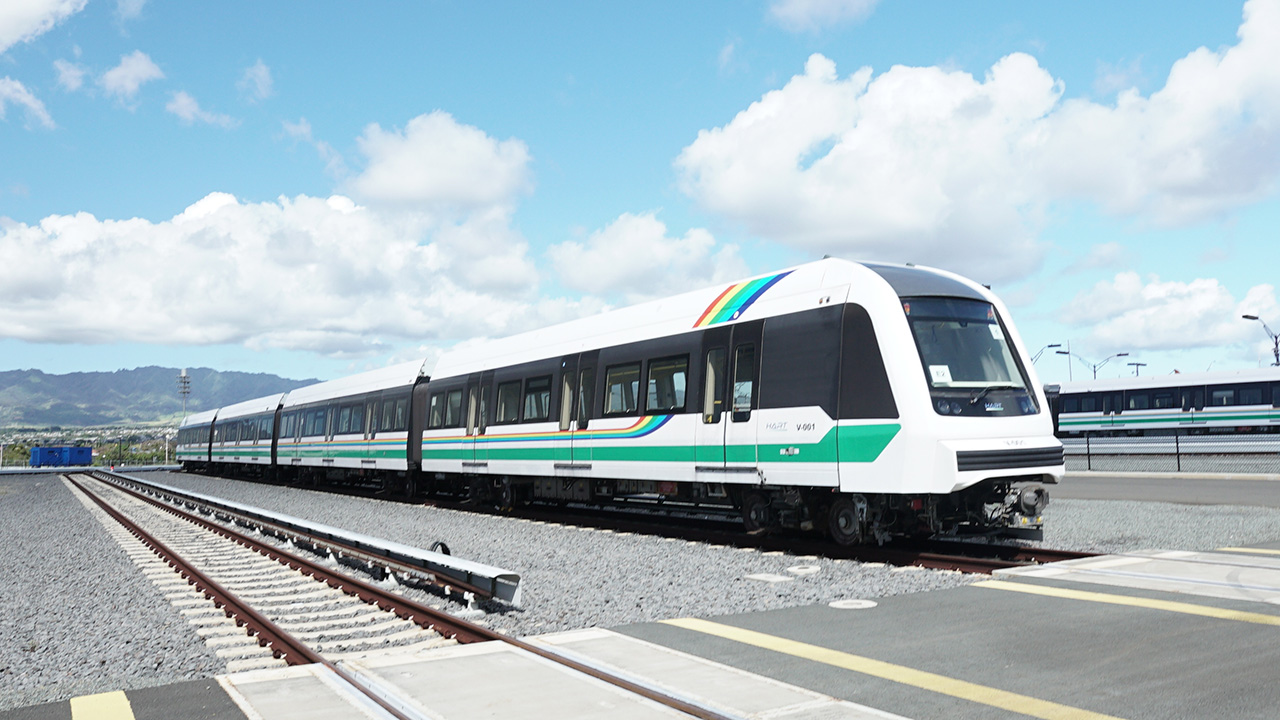
“The Honolulu City Council voted Wednesday [Feb. 18] to move forward with studies examining potential future expansions of the city’s rail system, including a route that could eventually reach the University of Hawaii at Manoa,” Hawaii News Now reported. “Council members approved Bill 60 on an 8–1 vote, directing the Honolulu Authority for Rapid Transportation to begin preliminary engineering and feasibility work on possible extensions of Skyline.”
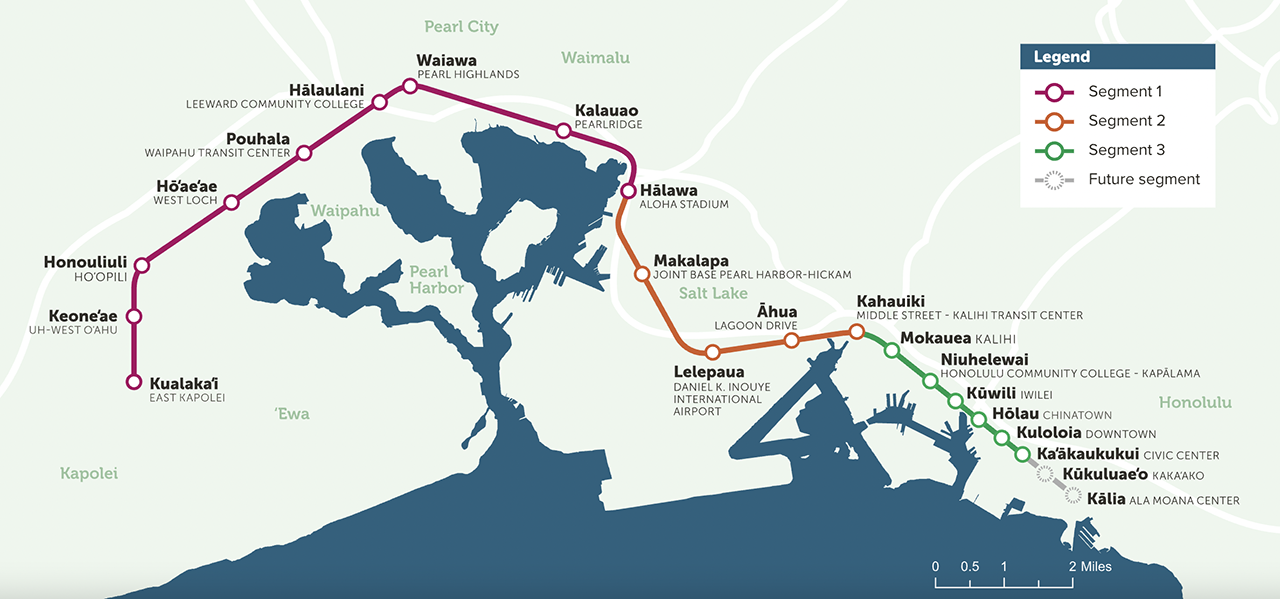
According to the media outlet, the studies will explore stops west of the current alignment (see map below) and a “branch from Kakaako to UH Manoa, as well as other destinations including Waikiki.” It noted that neither construction funding nor a timeline was approved.
HART told Nexstar Media Group’s KHON 2 that “as part of the planning process, private partnerships to help build future extensions will likely be explored.”
Skyline’s first segment opened in June 2023. It included nine stations and 10.75 miles of guideway. Segment 2 opened in October 2025. Segment 3 is expected to wrap up in 2030.
LACMTA
The Foothill Gold Line Construction Authority (Construction Authority) on Feb. 18 released a report prepared by Kleinhenz Economics, detailing the economic benefits that are expected to result from the upcoming construction and operation of the 2.3-mile Claremont extension of the Metro A Line. (See report above; see map with extension between Pomona and Claremont below). The report quantifies the economic impact within Los Angeles County from the initial capital investment to build the light rail extension, including jobs created, economic output, labor income, and tax revenues at the county, state, and federal levels, as well as the ongoing economic benefits to the county once revenue service begins.

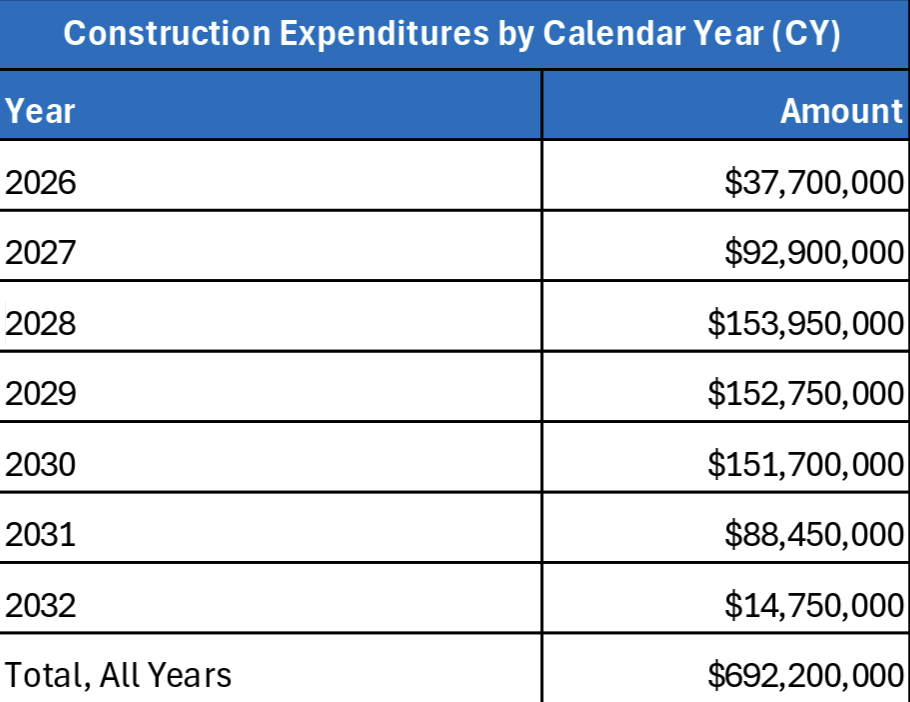
“As highlighted in the report, during the seven-year design and construction phase alone (2026 to 2032), the project will generate more than $1.13 billion in economic output, support more than 4,700 jobs and produce more than $481 million in labor income,” the Construction Authority said. “Workers will see an average annual income of $101,000. Furthermore, construction activity is estimated to generate more than $154 million in tax revenues, including more than $20 million in revenues for Los Angeles County. In short, for every $1 million spent during the next seven years of final design and construction, the project will generate $1.6 million in total economic output for the region.”
Once revenue service begins, the ongoing operations will continue to generate return on investment for the county, according to the Construction Authority. “The report found that for every $1 million spent operating the extension, the project will generate $7.6 million in total economic output for Los Angeles County, driven by effects across the supply chain and from household spending,” it said.
“Under an 8-minute headway scenario during the first three years of operations (2032 to 2034) alone, the project is estimated to generate nearly $460 million in economic output, support nearly 1,200 annual jobs and produce more than $490 million in labor income,” the Construction Authority continued. “The average annual wage for supported jobs is estimated at $137,000, which, like the average annual wage during construction, is significantly higher than the county’s median earnings. More than $123 million in total tax revenues will be generated in the first three years of operations, with Los Angeles County receiving approximately $22 million of that total. A 5-minute headway scenario studied in the report saw an even greater return on investment across the same measurements.”
Construction Authority CEO Habib F. Balian commented: “The study confirms what we have always seen throughout the various extensions of the Metro A Line from Los Angeles through the San Gabriel Valley—that the return on investment from the project is significant. The long-term economic effect of the Claremont Extension will go far beyond what is included in this report; it will change where families decide to set down roots, where businesses locate and invest and how and where jobs are created.”
The Construction Authority noted that the report does not capture Metro A Line riders spending around the stations, the project serving as a catalyst for transit-oriented development near the rail line, the economic activity generated by residents and businesses at these new developments, and the environmental and public health benefits from reduced traffic congestion and vehicle emissions.
Separately, Parsons Transportation Group last month landed a design and engineering services contract for the Claremont Extension.
Service on the Metro A Line’s Glendora-to-Pomona extension began last fall.
SEPTA
In January 2026, SEPTA’s system-wide ridership—including regional rail, buses, trolleys, subways and high-speed line—was up 1% or 8,627 unlinked trips from January 2025, the transit agency reported Feb. 18.
Average daily ridership was 714,475 unlinked passenger trips across all modes, it said. This was up 3% from December 2025, which saw average daily ridership of 693,261 unlinked passenger trips across all modes; November and October saw 756,672 and 779,701 unlinked passenger trips across all modes, respectively.
According to SEPTA, January’s ridership gains were driven by bus. Bus ridership increased by 4% or 13,378 unlinked trips per weekday compared to this time last year, it noted. Saturday and Sunday ridership declined in January due to winter weather including accumulating snowfall during the weekend of Jan. 17-18 and Jan. 24-25.
Metro ridership declined by approximately 1% or 2,010 trips per day relative to this time last year, according to SEPTA. This is primarily driven by a decline in trolley ridership because of service interruptions on both the T and D. Trolley ridership is down 16% or 8,825 trips per weekday relative to this time last year, it noted, but ridership on the B and L is up by 4% or 6,815 average weekday trips.
Regional Rail ridership declined by 4% or 2,840 trips per day relative to this time last year due to the Silverliner IV car shortage, the winter storm, and extreme cold temperatures, according to SEPTA.