

MDOT
MDOT on Sept. 2 released its Draft Consolidated Transportation Program (CTP) for Fiscal Years 2026 to 2031, outlining a $21.5 billion balanced plan “to further enhance safety, keep the system in working order and support the state’s economy.”
“Thanks to Governor Moore’s budget and the approximately $400 million in additional annual revenues passed by the General Assembly, the Department was able to use state dollars as a match to acquire additional federal funding in the previous Final CTP for Fiscal Years 2025-2030. That continued effort to match federal funding has resulted in an increase in this year’s draft program of nearly $300 million total compared to the Final CTP,” MDOT noted.
“This capital budget focuses on our priorities of enhancing safety, maintaining our system and driving economic growth,” said Acting MDOT Secretary Samantha J. Biddle. “Thanks to Governor Moore’s leadership and the General Assembly’s commitment to transportation funding, the additional revenues allow us to continue to advance projects that achieve these goals.”
The Draft Fiscal Year 2026-2031 CTP (download below) shows that MDOT “is strategically using available resources and focusing on data-driven investments to advance Maryland’s goals.” The $21.5 billion program includes key investments across all transportation modes, including significant reinvestment in the Maryland Transit Administration’s (MTA) core service, such as rehabilitation and modernization of the central light rail line.
The six-year Draft CTP outlines capital investments in each mode funded by the Transportation Trust Fund: Maryland Aviation Administration, Maryland Port Administration, MTA, Motor Vehicle Administration, State Highway Administration and The Secretary’s Office, as well as Maryland’s investment in the Washington Metropolitan Area Transit Authority (WMATA). The MTA’s toll facilities are financed, constructed, operated and maintained with toll revenues paid by customers using those facilities and represent an additional $5 billion investment in the State’s transportation system in fiscal years 2026-2031, according to MDOT.
BART
From Antioch to Millbrae, the Transbay Tube to the Dublin hills, BART fans can now see the system like never before as the agency releases a new series of videos showcasing the entire system from the point of view of a train operator. The BART Cab Cam series is the first time this footage will be available to view on YouTube.
BART released the first video—a ride on the Red Line from end to end—on Monday, Sept. 1, to kick off Transit Month. A total of 12 videos will be released of all five BART lines and the Oakland Airport Connector in both directions.
The videos will be published on YouTube weekly over the next 12 weeks, with the final video debuting on Nov. 3.
Produced in-house by the BART Communications and Marketing teams, the videos were filmed throughout 2025 and showcase BART’s diverse service area in stunning 4K.
Denver RTD
Denver RTD is using virtual reality technology to augment its training program for Transit Police officers to learn how to safely assess a multitude of situations and address threats, the agency recently reported.
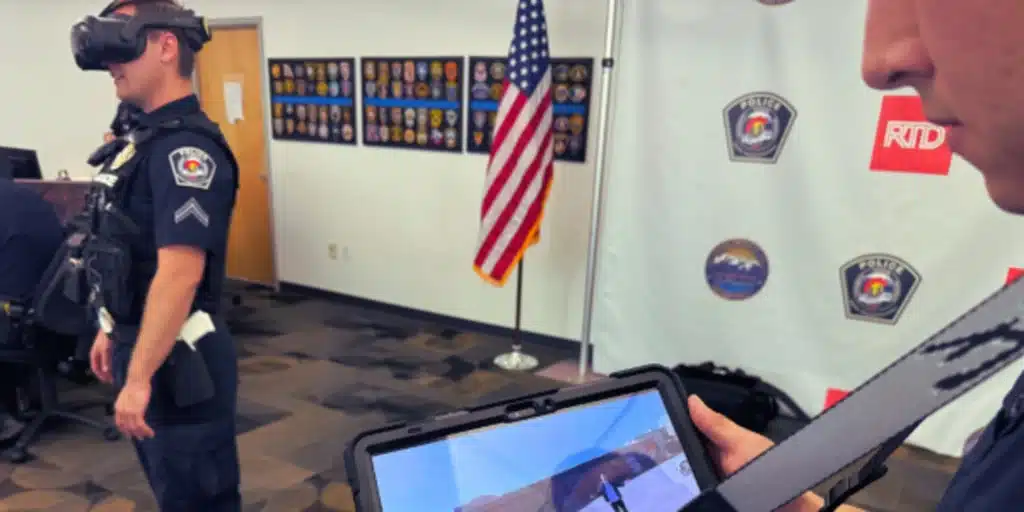
The virtual reality technology offers reality-based training scenarios for officers to safely hone skills and supports certification in using TASERs. Almost half of the 100 sworn officers in the Transit Police Department (RTD-PD) have completed the reality-based training since the program was implemented in June. The program is taught by two of RTD-PD’s certified Master Taser instructors, Corporal Jacob Schubert and Corporal Chance Fitzgerald.
Through the technology, officers see and hear a simulated environment requiring them to take the best course of action and safely use TASERs. The technology manufacturer and service provider, Axon, currently provides 12 scenarios and continues to add more for officers to build upon their technical skills and refine in-the-moment decision-making. The technology, RTD says, “enables officers to progressively build skills, even accounting for factors such as the physical and mental state of the individual in the scenario, whether they’re standing, sitting or partially obscured––right down to the details of the clothing a person may be wearing and how that would impact the use of TASERs.”
The RTD-PD elected to implement the technology for a variety of benefits, including the ability to safely train officers without the use of live rounds from TASERs, RTD noted. The system’s headset and tablet device are portable, enabling training to be conducted in many locations. Transit Police brings the virtual reality training to almost every in-service training to maximize the ability of officers to use the technology.
With AI advancements, it is anticipated the training modules will evolve and benefit the program with future modules allowing for two-way communication with virtual suspects to better prepare officers for real world scenarios, according to RTD. The training’s virtual reality technology is built to represent the identical size, weight and capabilities of real-life TASER counterparts.
The virtual reality program costs RTD-PD approximately $170,000 a year for six headsets and tablets to directly view an officer’s actions in the simulated environment, and it provides access to performance metrics. Program costs are offset by the ability to provide a safe and versatile training environment for officers, as well as being able to keep officers on patrol while offering periodic bursts of training in about 20-minute intervals, the agency noted. “This reduced time for training means tens of thousands of dollars are saved on training field days and the associated costs for equipment and staff time.”
More information is available here.
Caltrain

Caltrain has installed new digital displays at its Capitol, Blossom Hill, Morgan Hill, San Martin and Gilroy stations to improve the South Santa Clara County riding experience. These displays, the agency says, will help keep riders informed, offering real-time train schedules, service alerts and announcements.
Each display also includes text-to-speech functionality—at the push of a button, riders can hear important information read aloud, making it easier for all riders to stay updated.
This brings Caltrain’s live train updates and real time notifications to South County stations for the first time.
The digital displays are provided by Papercast. A pilot version was installed at San Carlos Station earlier this year.
LIRR
Gatekeeper Systems Inc. (Gatekeeper), a leader in video and data solutions for protecting people in transit, on Sept. 2 announced that its wholly owned subsidiary, Gatekeeper Systems USA Inc., has entered contracts valued at approximately $19.55 million (approximately C$27 million) with the LIRR for the commuter rail’s Audio-Visual Recording Monitoring System Upgrade
The project, Gatekeeper says, relates to the replacement of LIRR’s audio-visual recording monitoring system on its railcar fleet in compliance with the FRA mandate, which requires that “all passenger train lead locomotives providing scheduled intercity rail passenger or commuter service be equipped with crashworthy memory modules and image recording devices prior to Oct. 12, 2027.”




