
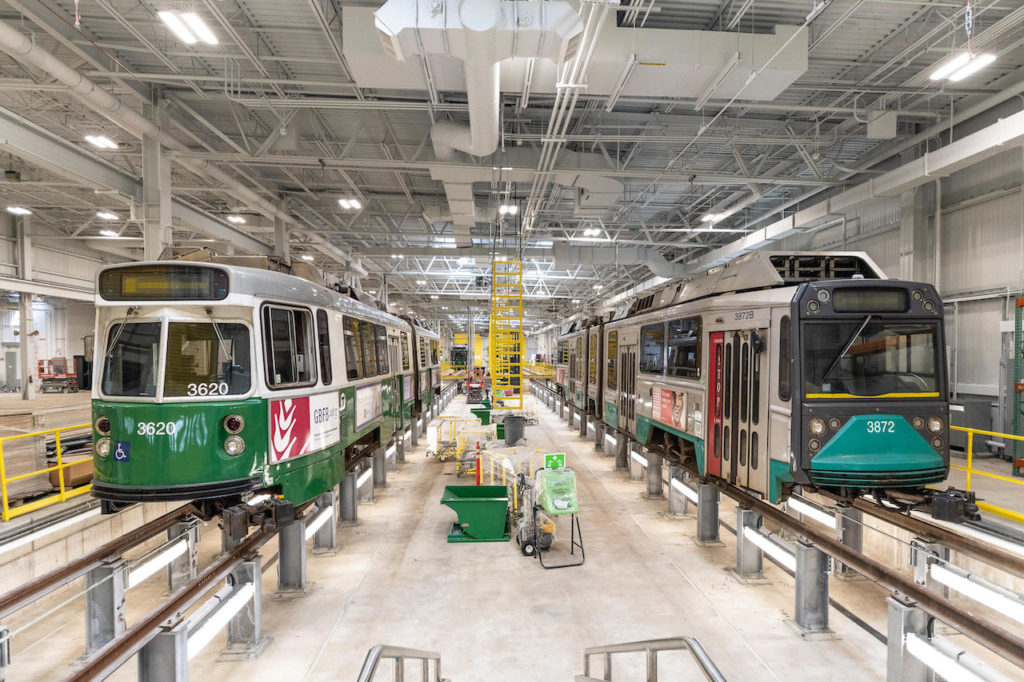
MBTA
MBTA on July 3 reported reaching a “landmark achievement” by negotiating agreements with all 28 of its affiliated labor unions, representing 16 collective bargaining agreements. It was realized within 18 months of Massachusetts’ Healey-Driscoll Administration taking office and under the leadership of MBTA General Manager Phillip Eng “to address long-standing labor concerns” and in an aim “to stabilize and expand the MBTA workforce,” the transit authority said.
According to MBTA, all agreements were finalized within one year of negotiations, “a significant improvement from previous multi-year processes”; all 16 contracts are for four-year terms, “ensuring the longest period of labor stability since the 1980s”; contracts include improved wages and incentives “to boost recruitment and retention efforts”; and the contracts were built upon the “historic pension agreement with the Carmen’s Union (March 2023) and similar agreement with the Transit Police Association (Fall 2023).”
The final agreement was ratified with the MBTA Plumbers in June 2024.
“The success of the MBTA depends on a well-trained, motivated and empowered workforce,” Massachusetts Gov. Maura Healey said. “That’s why, from Day One, our administration has been committed to partnering with labor to efficiently secure agreements that ensure workers receive competitive wages and benefits and strengthen our efforts to recruit and retain the best talent. I’m grateful to General Manager Eng and his team for their leadership, to our labor unions for their partnership, and to the men and women who keep the T moving forward for their hard work.”
“This is a significant step forward in creating the infrastructure and support that is needed for our workforce to implement the current and future work of the MBTA,” said Transportation Secretary and CEO Monica Tibbits-Nutt. “I am deeply grateful to everyone who worked to make this a reality and to ensure that our frontline workers have everything they need to provide quality services to residents and travelers.”
“The Healey-Driscoll Administration understood from the beginning that rebuilding our workforce was paramount to restoring the reliability of safe public transit,” said MBTA General Manager and CEO Phillip Eng. “I’m thankful for the efforts across our organization that negotiated and settled these contracts with our labor partners in record time. These contracts provide a level of stability we haven’t seen in decades. Union workers and the new hires we’re eager to bring on are on the frontline of providing reliable safe service for many communities. I’m so proud to stand side by side with the MBTA workforce.”
“It’s awesome to hear that all the union contracts at the MBTA are under agreement,” commented MBTA Board Director Robert Butler, who is also President of the Northeast Regional Council of the International Association of Sheet Metal, Air, Rail and Transportation Workers (SMART). “It is a historical accomplishment and emphasizes how progress can be made when labor and management work together. We are very thankful for the Governor and her team.”
“Making these frontline MBTA jobs competitive like was done in the recent Local 589 contract and others that followed is important not just because many of these jobs can provide a pathway to the middle class, but because the system absolutely needs to attract and retain experienced frontline workers in order to improve,” Carmen’s Union Local 589 President Jim Evers said. “We give the administration and the General Manager credit for engaging with the frontline workforce through collective bargaining in a manner that is positive, productive, and respectful.”
“Under the new General Manager and the Healey-Driscoll Administration, a lot of trust has been restored among the workforce and we absolutely give them credit for making essential investments in the frontline workforce through a professional and respectful collective bargaining approach,” said Mike Vartabedian, IAM District 15 Assistant Directing Business Representative and Chairperson of the MBTA Coalition of Unions.
“We appreciate that the Healey-Driscoll Administration understands the critical role that public transportation plays in the lives of working people, and how important it is to respect and listen to the hardworking union members who make our public transportation system run,” Massachusetts AFL-CIO President Chrissy Lynch said.
In related news, MBTA on July 1 announced that it had completed critical track work on the Orange Line while service was suspended between North Station and Oak Grove during the weekend of June 22-23 and between North Station and Wellington June 24-30, and in June released a Request for Qualifications for the Transit-Oriented Development (TOD) site in Attleboro.
SEPTA
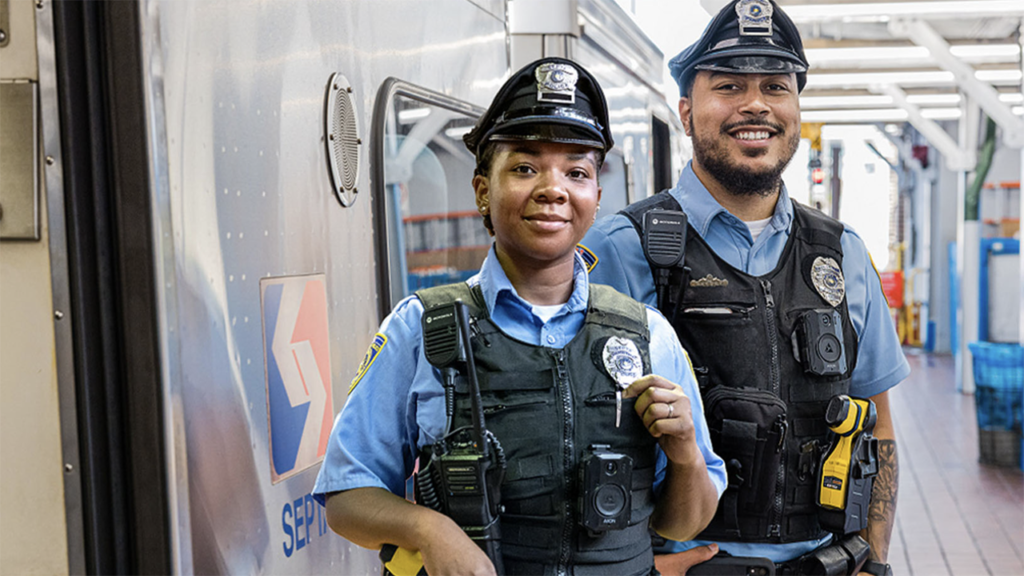
SEPTA in first-half 2024 saw a 37% decrease in serious crimes on the system compared with the same period last year, the transit authority reported July 3.
According to new data released by the SEPTA Transit Police Department, the most violent crimes, including aggravated assaults and robberies, fell by 47% with aggravated assaults dropping from 71 to 50, and robberies dropping from 146 to 63. SEPTA said it has not seen an increase in any crime category this year compared to this time last year.
The report comes after SEPTA announced the return of an enforcement program for quality-of-life violations as part of an effort “to discourage incidents, focus on repeat offenders and enhance the customer experience”; SEPTA Transit Police on July 1 began issuing Code Violation Notices (CVNs) for some of those low-level crimes, including alcohol consumption, public urination, smoking, littering, and other offenses.
According to the transit authority, the CVN policy adds to a number of recent changes aimed at improving system safety and security, including: the continued increase of visible patrols by SEPTA Transit Police, with more officers strategically deployed at stations and on trains, trolleys, and buses, and the assistance of a new Virtual Patrol Unit, which uses SEPTA’s surveillance camera system to help dispatch officers to where they are needed most.
“The safety and security of our customers and employees is SEPTA’s top priority, and these results confirm that our enhanced hiring and enforcement efforts are having a positive impact,” SEPTA CEO and General Manager Leslie S. Richards said. “The budget approved by the SEPTA Board last month includes important safety and security initiatives that will build on that momentum, and we are hopeful that the state will enact a new transit funding plan to support these critical priorities.”
“We want everyone to feel safe when they are riding SEPTA, and I am pleased that incidents of violent crime continue to decrease as a result of our efforts,” SEPTA Transit Police Chief Charles Lawson said. “The addition of new Transit Police Officers is allowing us to have a more visible presence in our stations and vehicles, and new deployment strategies and enforcement tools are helping to mitigate violations that lead to more serious crime.”
SEPTA reported that 14 cadets graduated last month from the Municipal Police Academy at Delaware County Community College, and another 17 recruits are expected to start police academy during the week of July 7.
Separately, the SEPTA Board recently approved a wayfinding signage contract.
DEN
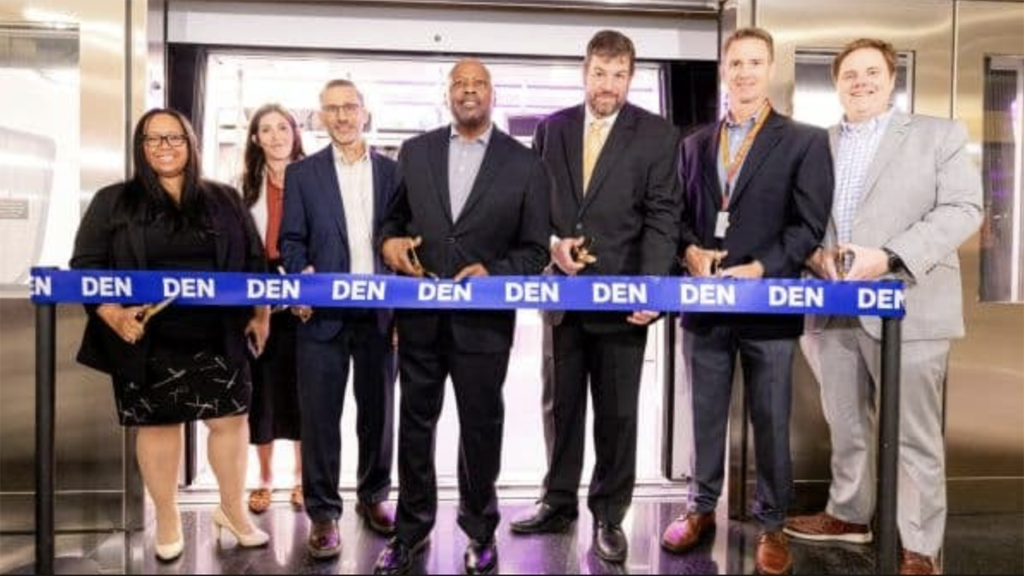
The first of 26 new vehicles has entered service on DEN’s automated people mover system, according to a July 4 report by International Railway Journal, a Railway Age sister publication. Alstom is supplying a total of 26 Innovia 300R rubber-tired vehicles, 16 of which will replace the oldest vehicles in the airport’s existing fleet. When all the new trains are in service, the fleet will have grown to 41 cars, IRJ reported.
Alstom built the aluminum-bodied vehicles at its Pittsburgh, Pa., plant, and according to IRJ, they are “the first of their kind to be deployed in the U.S. and will increase capacity on the 2-kilometer [1.24-mile] automated people mover system, with up to eight four-car trains in service at one time.”
DEN is the third busiest airport in the U.S., and sixth busiest airport in the world. It currently handles 77.8 million passengers per year, a figure set increase to 100 million passengers by 2030.
“Over the next 15-18 months, we will replace more than half of our entire fleet and look to expand the number of train cars that are running at any given time to better meet current and future demand,” said DEN CEO Phil Washington, who previously served as CEO of both Los Angeles County Metropolitan Transportation Authority and Denver Regional Transportation District.




