MBTA
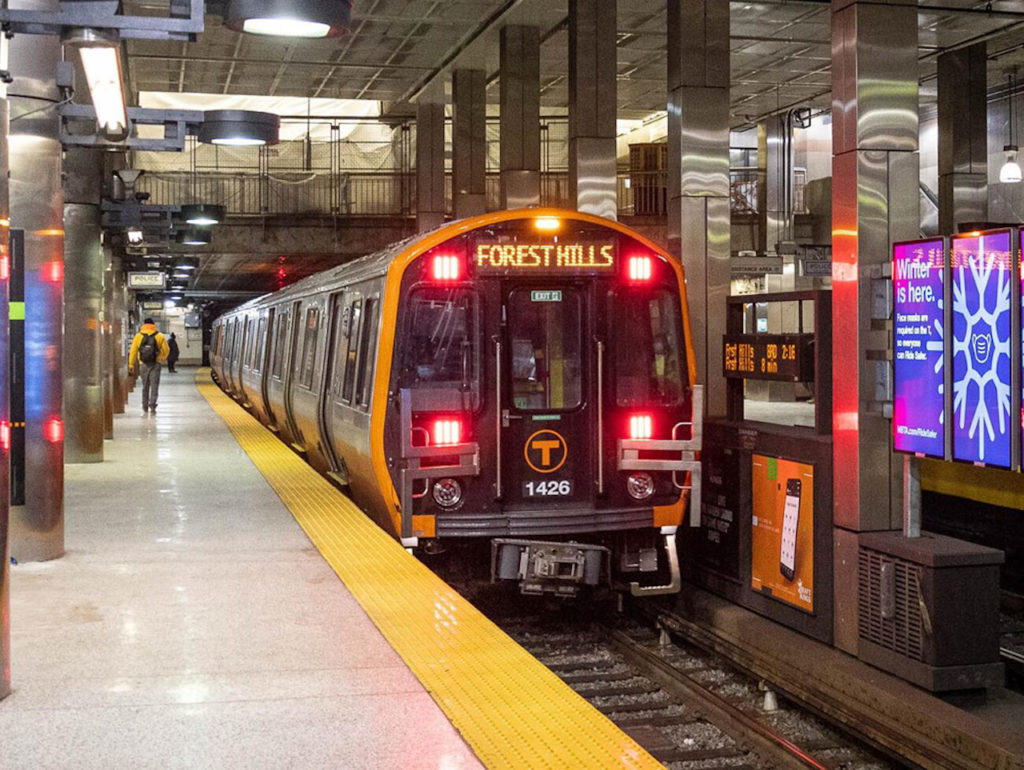
MBTA on July 25 announced performance progress since last year across its subway, bus and RIDE paratransit services, including more scheduled service, less time between trains, and “excellent” on-time performance of RIDE vehicles.
“Due to higher availability of subway operators, the addition of new Orange Line cars, and steady improvements to track infrastructure, the number of weekday trips delivered each day on the Red, Orange, and Blue … subway lines has increased significantly over the last year,” MBTA said. “Additionally, the time between trains has decreased during morning and evening peak rush hours, meaning less time for riders to wait between trains.”
As of June 2024, the agency said the Red Line operated about 300 trips per weekday (vs. 249 in June 2023). The time between trains improved on the Ashmont and Braintree branches to about 14.5 minutes (vs. 18.5 minutes in June 2023) and to about seven minutes on the Red Line trunk between Alewife and JFK/UMass (vs. about nine minutes in June 2023). The Orange Line operated 284 trips per weekday (vs. 200 in June 2023), with the time between trains improving to approximately eight minutes (vs. 11.6 minutes in June 2023). The Blue Line ran 357 trips per weekday (vs. 295 in June 2023), with the time between trains improving by over half a minute to about five minutes (vs. nearly six minutes in June 2023). According to MBTA, these results reflect weekdays without service suspensions.
On the bus side, MBTA reported reducing the number of “dropped” trips—scheduled bus trips that did not operate due to service disruptions, disabled buses, not enough bus operators to run stated bus schedules and other factors. These trips fell from more than 8.3% in June 2023 to about 1.8% in June 2024. “Through major hiring and training efforts and record labor agreements reached this year, MBTA continues to boost its ranks of bus operators to improve service for riders,” the transit agency said. “This improvement is also due in large part to the coordination, planning, and analysis work by MBTA’s Service Planning, Bus Operations, and Operations Analytics teams to accurately predict resource needs and make data-driven decisions in advance and in the moment.”
For RIDE paratransit, on-time performance in June 2024 reached 94%, exceeding MBTA’s overall goal of 90% and well above its lowest average over the past 12 months of 85% in September 2023, according to the transit agency. Additionally, RIDE’s dispatching and scheduling reduced its average call wait times from 13 minutes 22 seconds in April 2023 to 19 seconds in June 2024, also beating the goal of a two-minute wait time, MBTA said. These improvements are in large part due to worker wage increases, according to the agency, which noted that as a result, RIDE complaints declined to a record low in June 2024 of 1.87 per 1,000 trips.
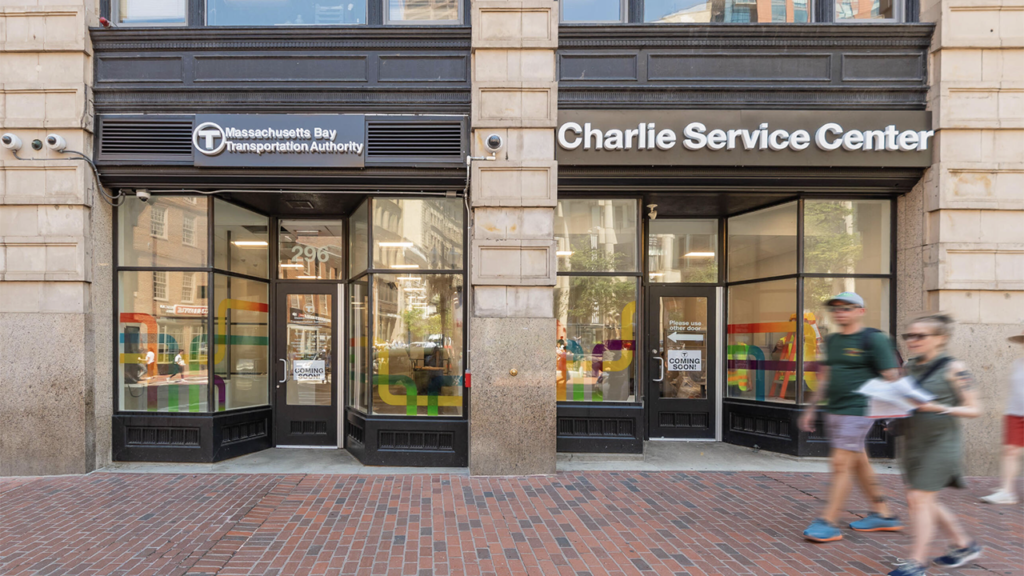
Meanwhile, MBTA on July 29 will open a new fully accessible street-level Charlie Service Center to the public at 296 Washington Street, between Milk Street and Water Street in downtown Boston. Located near State and Downtown Crossing stations, this customer service facility replaces the CharlieCard Store previously located within the Downtown Crossing concourse.
The facility will allow riders to buy passes for any mode; replace a damaged or expired CharlieCard for fare payment; request a Senior CharlieCard, Transportation Access Pass (TAP), or Blind Access Pass; process a name change on a Senior CharlieCard, TAP or Blind Access Pass with a valid ID; use cash to make deposits for RIDE accounts; and receive support in different languages on-site.
Starting Aug. 1, as part of the launch of Tap to Ride on the MBTA system, the Charlie Digital Assistant will become available for reduced fare riders to connect their reduced fare entitlement with this new way to pay, according to MBTA. The Charlie Service Center will offer in-person support for riders using the Charlie Digital Assistant. MBTA noted that using Tap to Ride is optional and only recommended for riders who pay as they go.
In addition to the new Charlie Service Center, MBTA reported that it is bringing its Customer Service Call Center back in-house to improve customer support. Led by its Customer and Employee Experience Division, the Call Center handles approximately 19,000 calls and 3,000 web inquiries per month.
“The Customer Service Call Center plays an important role in improving our rider communications efforts, ensuring a streamlined, consistent approach to addressing rider inquiries,” MBTA Chief of Customer and Employee Experience Danny Levy said. “I’m also excited that the Charlie Service Center is now relocated and able to provide a better customer experience for our riders and workplace for our employees.”
Separately, the MBTA Board of Directors on July 25 approved a $54 million plan to bring BEMU (battery-electric multiple-unit) train service to the Fairmount Commuter Rail Line, which, the agency says, “will ultimately result on more frequent service and lower emissions in surrounding communities.” Also, the Massachusetts Department of Transportation Board earlier this month approved the Fiscal Year 2025-29 five-year Capital Investment Plan, which includes $16.7 billion in planned transportation investments.
MTA
Starting this upcoming 2024-25 school year, New York City students will receive Student OMNY contactless fare payment cards to make it easier and more affordable for them to get to and from school and after-school activities, according to MTA.
Unlike the MetroCards that have been distributed to students citywide since 1997, the new Student OMNY cards will be valid 24 hours a day, 7 days a week, 365 days a year, with up to four free rides per day. “These changes will significantly expand flexibility for student travel, as students were previously limited to only three free rides each day from only 5:30 a.m. to 8:30 p.m., and the cards could only be used on days when the student’s school was open for class,” MTA reported July 25.
Student OMNY cards will be valid on MTA’s subway lines; on local, limited and Select buses; on the Staten Island Railway; on the Roosevelt Island Tram; and on Hudson Rail Link. They will include free transfers from one mode to another. Students will also now keep the same card for the entire year, through the summer.
According to MTA, the cards will be distributed to students at the start of the school year by each individual school across the five boroughs. Students will also receive promotional flyers outlining the benefits of the improved program. MTA and New York City Public Schools will work together to evaluate and promote card usage across school districts, according to the transit agency.
New York State contributes funding for the Student OMNY cards in the form of a $25 million appropriation from the New York State Department of Transportation. Future increases to this amount are subject to appropriation, according to MTA. New York City Public Schools will increase their lump-sum contribution for the OMNY cards, from $45 million to $50.5 million, MTA added; future lump-sum increases will align with MTA base fare increases.
“The Student OMNY card program makes it even more convenient for kids to use the public transit system, teaching them how indispensable it is to New York City,” MTA Chair and CEO Janno Lieber said during the July 25 announcement (scroll to top to watch video).
“These expanded student OMNY cards are a game-changer for families across New York City, particularly for working-class families that need just a little more help to afford our city—families where older siblings pick their younger brothers and sisters up from school or where kids have after-school and summer jobs to help make ends meet,” New York City Mayor Eric Adams said. “This builds on the work we’ve done to make our city more accessible, particularly for young people and low-income New Yorkers.”
“I’m thrilled about the launch of student OMNY cards because expanding access to public transit means more and more students will have opportunities to explore our city and experience all that New York has to offer,” New York City Public Schools Chancellor David A. Banks said. “I’m grateful to our partners at the MTA and across the city for making this possible for our students.”
According to MTA, OMNY pilots have been launched for select paratransit riders, pre-tax commuter benefit riders, and Fair Fares riders, with a wide rollout to those customer bases expected by the end of 2024. Reduced-Fare riders can make the switch to OMNY online with the OMNY digital assistant, MTA noted. All existing Reduced-Fare MetroCard riders, totaling more than 1.5 million, will receive an OMNY card mailed to them by the end of 2024.
MTA reported that transit riders have used OMNY to tap into the transit system nearly 1.7 billion times. OMNY market share accounts for more than 50% of New York City Transit riders, with full-fare subway rides rising to 78% since the MTA updated its fare-capping feature in August 2023. MTA launched a fare-capping pilot in 2022.
In other MTA news, the agency recently celebrated a “massive” decrease in subway crime and replaced the first segment of Metro-North Railroad’s Park Avenue Viaduct.
TransLink
TransLink on July 25 issued new report (above) detailing potential future transit service cuts that it said would be necessary at the end of 2025 if a new transit funding model is not established.
“TransLink is facing a funding gap of approximately $600 million each year—a shortfall in the budget to operate current transit service levels throughout the region,” the Metro Vancouver-based transit agency said. “Without funding, TransLink faces the prospect of cutting transit services to balance its budget. TransLink recently announced C$90 million in corporate cost-efficiency and revenue measures to help reduce the funding gap.”
The report, prepared at the request of the Mayors’ Council, said that the $600 million annual operating budget shortfall would result in “significant cuts to all transit services.”
“These cuts would be devastating to the region, and we’re doing everything we can to stop them from happening,” TransLink CEO Kevin Quinn said during the report’s release. “Unfortunately, this is a window into our reality if a solution to our outdated funding model is not implemented. We need all levels of government to come together to protect and expand transit service to meet the needs of Metro Vancouver’s growing population.”
Relief funding from the Government of British Columbia has been “pivotal in protecting service levels since the pandemic,” according to TransLink, but it noted that relief funding is coming to an end in 2025, and a new solution is required to address this gap.
If a solution is not found next year, the agency said, potential cuts to transit services could include:
- Cutting bus service in half, including canceling up to 145 bus routes and all NightBus services.
- Reducing SkyTrain automated rapid transit and SeaBus services by up to 30%.
- Eliminating West Coast Express commuter rail service.
- Reducing HandyDART by 35%.
- Eliminating the Local Government Funding Program, which invests in road maintenance and local infrastructure upgrades.
According to TransLink, these substantial reductions to transit service would significantly impact the entire Metro Vancouver region:
- “More than half a million people will no longer be living within walking distance of a transit stop, disproportionately impacting those who are low-income, visible minorities, shift workers, youth, and seniors.
- “There would be almost no transit services operating in Langley, White Rock, South Delta, Port Coquitlam, Maple Ridge, Pitt Meadows, and much of the North Shore.
- “Tens of thousands of more cars would be added to the already-congested streets and bridges, with congestion worsening by 20%.
- “Employers in health care, childcare, hospitality, construction, and major industries would face the prospect of employees who can no longer make it to work.”
Once service is cut, it would take at least a decade to return transit services and ridership back to current levels, even if investments return, TransLink said.
“Our region is growing at a record pace at the same time as facing an affordability crisis, both of which require more, and not less, transit,” Chair of the Mayors’ Council Brad West said. “The mayors are ready to do their part, but we need the next provincial government, as well as the federal government, to work with us to ensure these cuts to transit services never happen and begin expanding our system rapidly in line with growing needs.”
TransLink reported that it is seeking approximately $600 million in annual operating funding to avoid transit service cuts, but that it also requires new funding to expand transit services through the Access for Everyone plan. This plan includes doubling bus service and adding projects such as the UBC SkyTrain extension, a new rapid transit link to the North Shore, the Burnaby Mountain Gondola, and new Bus Rapid Transit routes, it noted.
“TransLink is asking all levels of government to develop a sustainable funding model that would allow transit services to keep up with the region’s growing population,” the agency reported. It said there are several issues with TransLink’s current funding model, including:
- “Decline in revenue from fuel taxes: The regional shift toward electric and hybrid vehicles is causing a decline in fuel tax revenue; in 2023 alone, TransLink collected $34 million less revenue from the fuel tax than in 2022, with the losses projected to grow over the next decade.
- “Fare increases below inflation: Costs of construction, labor, fuel, maintenance, and new vehicles have been increasing at unprecedented rates; additional operating costs for expanding bus service and for new expansion projects like the Broadway Subway Project and Surrey–Langley SkyTrain which will require significant funding to operate once complete.
- “Increasing costs and expansion: Due to the pandemic, the 2020 fare increase was canceled and held at levels below inflation in 2021-24; with no fare increase in 2020 and 2.3% increases in all subsequent years, TransLink’s costs have risen faster than fare prices have increased.”
TransLink said that the agency and the Mayors’ Council “continue to work with all levels of government to find a new sustainable funding model to avoid any potential service cuts.”