MBTA
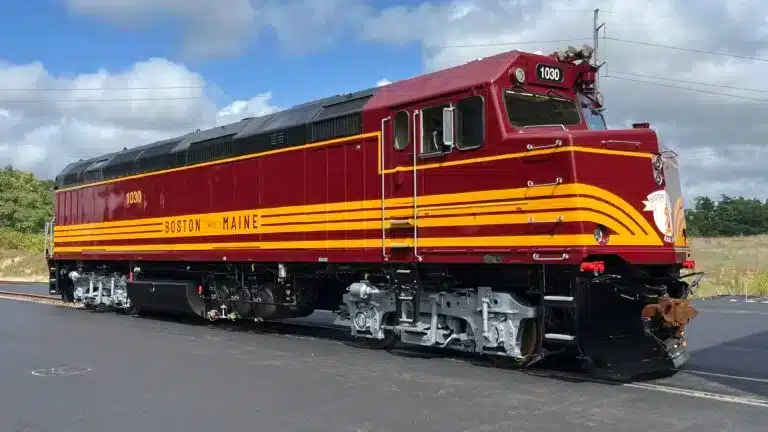
The MBTA is refurbishing some Commuter Rail trains with the Boston and Maine Railroad’s emblem of a minuteman and the company’s maroon and yellow design to honor the railroad company that emerged as a leader in the region over an approximately 150-year history, according to a Boston.com report. The Boston and Maine trains will begin service this week.
According to the report, “the Boston and Maine train is one of three with special designs to honor historic passenger train companies. By the end of the year, two additional trains honoring the New Haven Railroad and New York Central Railroad will hit the rails,” the MBTA said.
Rick Kfoury, the president of the Boston and Maine Railroad Historical Society, said the new design “serves as a daily reminder to the general public of the Boston and Maine’s massive contributions to New England sociology, economy, and culture since the 1830s.”
At its peak, the Boston and Maine Railroad covered more than 2,300 miles of tracks from its hub in Boston, linking hundreds of cities all around New England, according to the society and as reported by Boston.com. Its principal shops were in North Billerica and Concord, N.H.
“Seeing the Minuteman emblem appear once again in revenue service on the former Boston and Maine System helps to introduce the story of the B&M to new generations,” Kfoury said in a statement. “It is wonderful to see an accurate historical tribute paid by the modern-day stewards of the Route of the Minuteman.”
The designs honor “the passenger railroads that laid the foundation for today’s Commuter Rail network,” the MBTA said in a statement.
According to the report, “the three specially painted trains are the last three of 37 locomotives to reenter service following an overhaul,” the MBTA spokesperson said. “Beginning in 2019, F40 trains, originally put into service between 1987 and 1991, were refurbished to ‘like-new’ condition, according to Commuter Rail operator Keolis.”
“The refurbished trains also got additional upgrades, including remote monitoring and diagnostics, forward-facing and cab cameras, and modern brake and control systems,” the MBTA said.
“The New Haven train may be orange or red, and the New York Central car could be navy blue, according to images of the historic trains and reproductions,” Boston.com reported.
CTA
The CTA on Sept. 9 launched two new challenge statements as part of its Innovation Studio, “an initiative designed to allow businesses and organizations to pilot solutions and new technologies to overcome some of the agency’s biggest challenges.” These two challenge statements, CTA says, “focus on improving the customer experience for non-English speaking riders and providing enhances simulation technology to support rail operations training.”

“Innovation Studio continues to expand its portfolio of innovative solutions, delivering diverse pilot projects ranging from improved wayfinding at bus stops to detecting and alerting intrusions on CTA’s track ‘right of way’,” said CTA Acting President Nora Leerhsen. “This latest round of challenge statements seeks to eliminate language barriers and help make the system navigable for our riders while another pilot will seek to find more ways to enhance ongoing rail operations training with a new, modern training tool.”

The first new challenge CTA seeks solutions for will address the following statement: “How can CTA provide rail station attendants with tools to welcome and assist riders with limited English proficiency?”
According to the agency, more than 13% of the people who live in CTA’s service area have limited English proficiency. CTA riders, who primarily speak a language other than English, can face unique challenges accessing and navigating transit services. This can include difficulty determining which train platform to board at a rail station, navigating from the station to their destination, interacting with fare machines and receiving timely notices when there are disruptions to service. Though CTA Customer Service Representatives/Assistants (CSR/As), who staff rail stations, are responsible for assisting riders with navigation and fare payment, they do not currently have tools at their disposal to support riders who speak a different language.
While the top languages spoken in the service area are Spanish, Polish, Chinese, Arabic, Cantonese, and Tagalog, CTA also serves customers visiting from a variety of domestic and international locations who may be unfamiliar with the transit system and need assistance with navigation.
The challenge statement, CTA says, seeks to pilot solutions that can enable CSR/As to engage riders through interpretation and/or translation devices, with the goal of allowing CTA staff to better communicate with riders speaking various languages. Proposals must be integrated into a stationary interactive display in stations to adhere with existing CTA policies. Translation and interpretation assistance are the main features requested, but innovators may propose other features that can enhance the customer experience.

The second new challenge CTA is seeking solutions for will address the following statement: “How can CTA provide simulated training opportunities for rail operators to gain additional hands-on experience?”
CTA is seeking a lightweight solution that “simulates the rail operating environment to improve training available for rail operators who have completed their initial training period, to receive feedback and build skills for safe and efficient operation.” Training opportunities, outside of real-life, on-the-job experience, are limited.
A rail simulator complementing CTA’s existing operator cab simulator would provide a cost effective, safe, and efficient way for operators to continue to improve confidence and skills, leading to a more skilled workforce to navigate the complexities of CTA’s rail system, the agency noted.
CTA says it would prefer proposals from interested companies that can “reasonably model rail cabs while maintaining portability and providing scenarios in a variety of weather and time of day conditions.” However, simulators that utilize existing PCs or tablets will also be considered. The proposed solutions would be available to operators at a fixed location in at least one CTA training center and should have the ability for CTA to relocate them to other facilities as needed.
According to the CTA, there will be an opportunity for interested companies to learn more about the challenges and how to apply in an information session at a place and time in late September to be determined. Interested vendors will be able to ask questions and get a better understanding of what is required.
Applications for both challenge statements are due by Oct 21.
Last year, CTA launched three challenge statements during the inaugural year of the Innovation Studio program, and CTA has launched one other challenge so far this year. The agency is partnering with private sector entities to explore leading-edge ideas to improve rail system safety, to develop a new solution for bus stop asset management, to expand the availability of real-time information displays to bus riders, and to mitigate the impact of secondhand smoke for riders on bus and rail vehicles.
There are currently four pilots in progress from the 2024 challenges. These include two pilots to install digital bus stops signs at up to 20 stops to provide real-time arrival information and system alerts, and two to automatically detect intrusion on the rail right-of-way. CTA will provide more updates as these, and other in-development pilots move forward.
More information is available here.
NYMTA
The New York MTA on Sept. 9 announced that, as summer draws to a close, New York City’s congestion relief program “has continued to successfully reduce traffic and improve travel times throughout the region.”
According to the agency, August saw nearly 2.7 million fewer vehicles than baseline enter the congestion relief zone, a 14% reduction. August was level with June for the largest vehicle reduction seen so far in 2025. Congestion pricing, MTA says, continues to generate revenue to fund transit improvements across the region, including new rail cars, accessibility improvements, and enabling the advancement of the Second Avenue Subway Phase 2.
“In less than a year, New Yorkers are seeing massive benefits from congestion relief, including new rail cars, dozens of ADA elevators and signal modernization,” said MTA Chair and CEO Janno Lieber. “This initiative has demonstrated that government can do big things that deliver results—less traffic, safer streets, and improved quality of life for transit users, drivers and pedestrians alike.”
According to the MTA, congestion pricing has shown continued success in reducing traffic, speeding up the flow of traffic, and cutting down delays, not just in the congestion relief zone but throughout the New York metropolitan region. The number of vehicles entering the zone is down by 12% since congestion pricing started. Every day, 87,000 fewer vehicles enter the zone, and since the program started, 17.6 million fewer vehicles have entered the zone compared to last year.
Additionally, transit ridership across all modes has increased from January to August 2025 when compared to the same period last year. In July, the MTA achieved its best summer subway ridership week since 2019, hitting four million subway riders three days in a row in a summer season—a first since the start of the pandemic. The Long Island Rail Road (LIRR) shattered its post-pandemic daily ridership record twice in July, carrying 298,419 passengers on Wednesday, July 23, and 295,419 passengers on Tuesday, July 22.
Transit service has also improved across-the-board in 2025 to near-record heights. In August, subway weekday On-Time Performance was 85.2%, the best for that month in 10 years, according to the MTA. Overall summer On-Time Performance on the subway was 84.3%, up from both 2024 and 2023.
LIRR and Metro-North On-Time Performance have consistently been at or near 97% in 2025.
Earlier this week, the congestion relief program was recognized by the International Bridge, Tunnel and Turnpike Association (IBTTA) with its Social Responsibility award, calling it an “historic first by reducing gridlock and advancing access—cutting congestion, improving travel times, generating critic no al transit funding, and creating new discount and exemption plans for drivers.” On June 11, the Intelligent Transportation Society of New York awarded the Central Business District Tolling Program with its Intelligent Transport Systems Project of the Year.