MBTA
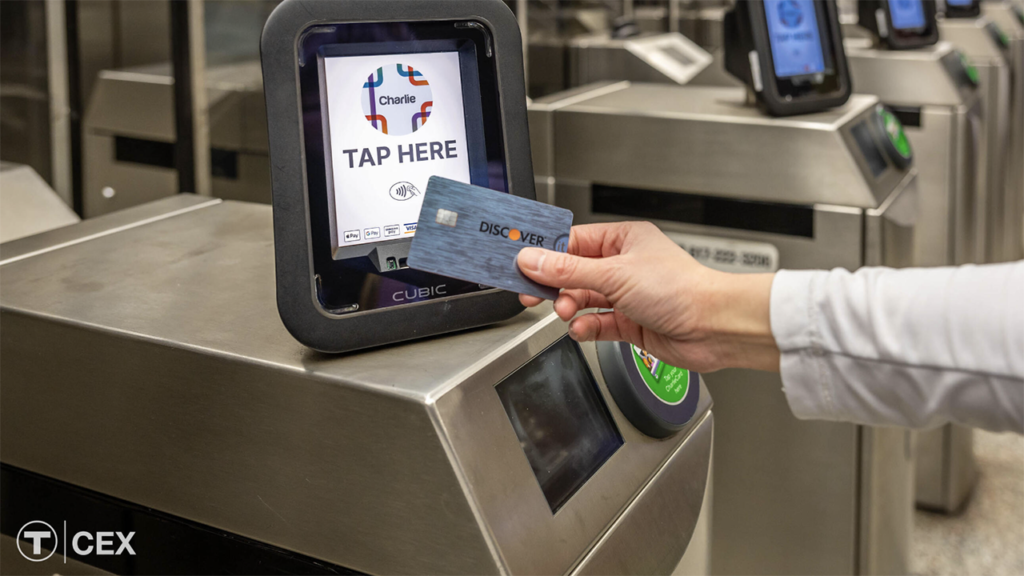
MBTA will begin accepting contactless payments onboard Green Line and Mattapan Line trolleys as well as buses, and at all gated subway stations beginning Aug. 1.
Contactless payment will allow riders to pay by tapping a contactless credit/debit card, phone with a mobile wallet, or watch on fare readers, MBTA reported July 9. This one-step option for “pay-as-you-go travel” will replace purchasing and reloading a CharlieCard. “Riders can look for the contactless symbol, tap their card or device on the reader at the fare gate or the reader at the vehicle door, wait for the green checkmark, then ride,” according to the transit authority, which noted that riders with weekly or monthly passes or those who would like to continue to use their CharlieCards will not be impacted by the change. The current ways to pay will remain the same.
Riders in reduced fare programs—such as Senior, Student, and TAP—will have the option to link their benefits to their contactless card, phone or watch, but can continue using their current payment method. Contactless payment options will operate in accordance with the MBTA’s privacy policy.
According to MBTA, riders will be able to manage their contactless cards, phone, and/or the watch they use for travel through an online Charlie account or by calling the Customer Support Center. Registration is optional.
“I’ve seen directly at other transit properties and heard firsthand from many riders about the importance of contactless payment and how it would greatly enhance the experience of using mass transit,” said MBTA General Manager and CEO Phillip Eng, who previously led MTA Long Island Rail Road. “Last year this project needed a course correction and I’m proud of the progress made to deliver this important amenity for our riders, bringing our payment system for our bus and subway system into the 21st century. This lays the groundwork for the fare payment system of the future, incorporating our fare structure including the recently approved Income-Eligible Reduced Fares. The MBTA team’s steadfast dedication to bring this initiative to fruition along with our partner Cubic, worked collaboratively, solving challenges to demonstrate our commitment to the public. I thank our riders for their patience as we continue to build a system that they can rely on and be proud of.”
“Cubic Transportation Systems has been a proud partner of the MBTA for several years, and we thank the MBTA for their collaboration throughout this project,” Cubic Transportation Systems (CTS) President Peter Torrellas said.
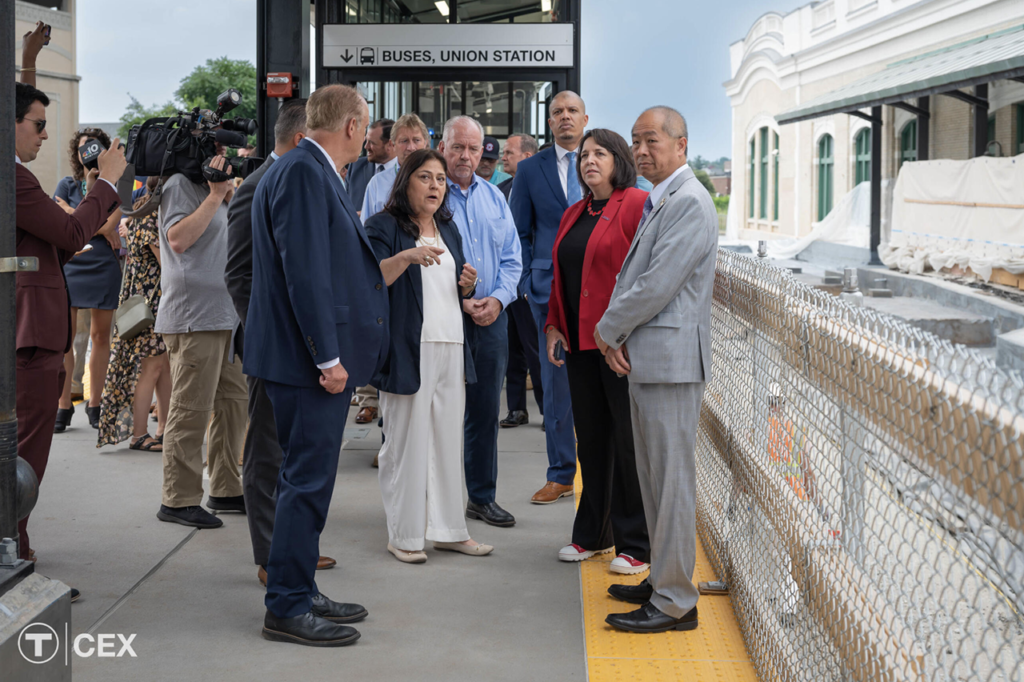
Meanwhile, MBTA on July 10 celebrated the recent opening of a center-island platform at Worcester Union Commuter Rail station on the Framingham/Worcester Line. The new fully-accessible, high-level platform became available to riders on July 1, replacing the previous single-side platform. The aim: to reduce train dwell times, improve operational flexibility, and ease congestion along the Worcester Line.
According to MBTA, the platform and associated stairs and station canopies accommodate and provide flexibility for additional MBTA Commuter Rail and Amtrak intercity passenger rail services, including expanded West-East Rail service. Two new station access points were also constructed: a new pedestrian tunnel/concourse from the platform under the tracks to the historic station building and a new pedestrian bridge at the opposing end of the station to an expanded and modernized parking lot. Three new elevators, stairways, security, and accessibility improvements to the commuter parking area have also been accomplished.
Demolition of the old platform, tracks and signals will continue until the end of this year, according to MBTA.
The total budget for the project was approximately $74 million, with funding from various federal, MBTA, and city sources.
Worcester’s Union station was built by the New York Central Railroad along the Boston & Albany Railroad main line and opened in 1911. The Worcester Redevelopment Authority began renovating it in 1994. The station re-opened to riders in July 2000, providing MBTA Commuter Rail, Amtrak and local bus service/connections.
“We are committed to rebuilding our infrastructure making our stations more welcoming and fully accessible for all,” Phillip Eng said. “Union station is a critical transportation hub for the Worcester community. The upgrades will ensure safe and more reliable service that allows two trains to serve the platform, which is a significant improvement to prior service that was limited to only one train at Union station. The reopening of this platform is another step forward toward improving service to the Worcester area.”
Separately, MBTA recently secured contracts with all 28 unions.
BART
BART on July 9 issued its 2024 Role in the Region Report (see above) to “inform a regional conversation about the future of BART” by describing its contributions to California’s Bay Area. It also provides predictions for how the Bay Area—its economic viability, “traffic-choked” roadways, cultural institutions, and more—would look without BART. Due to a decreased farebox recovery, the transit agency is expecting a budget deficit beginning in 2026 when state and federal emergency assistance runs out (scroll down to read more about the budget).
“The Bay Area and our regional transportation network have undergone significant changes since BART last conducted a Role in the Region study in 2016,” BART General Manager Bob Powers said. “The 2024 Role in the Region Report arrives at a crucial crossroads for BART and the region, and the data, analyses, and stories within will serve as an important educational resource for the pivotal years ahead.”
The report offers insights on changes in travel patterns and funding; BART’s holistic benefits to the Bay Area; and BART’s future.
Here is a snapshot of some of the report’s findings:
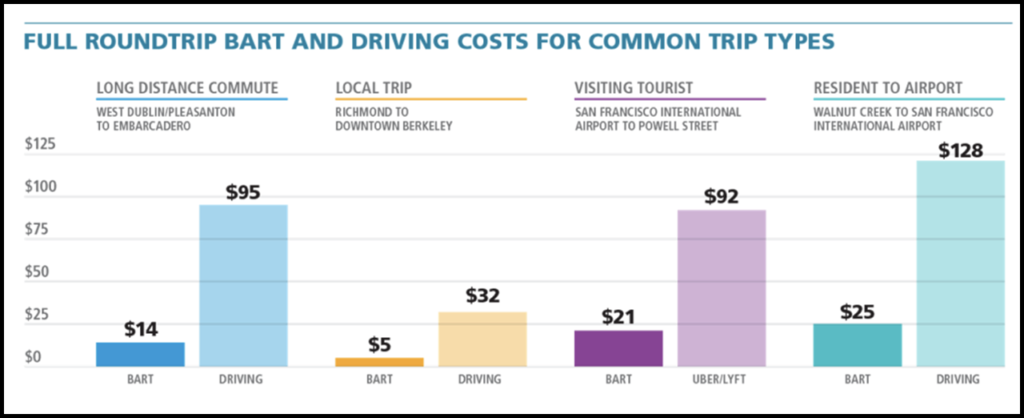
The report outlines the following BART benefits:
- “BART is significantly more affordable than driving (see Figure 1, above). Example: Taking BART from West Dublin/Pleasanton Station to Embarcadero Station roundtrip costs $14. Driving the same route costs $95 when accounting for gas, tolls, parking, insurance, and maintenance.
- “BART is integral to a connected regional transit network. Within a 15-minute walk of BART and one transfer to a connecting agency transit stop, you can reach 67% of the nine-county Bay Area region’s jobs, 61% of the region’s residents, and 60% of schools, parks, and libraries.
- “In 2023, BART contributed $1.2 billion to the economy through more than 5,000 jobs when accounting for BART’s direct payroll expenditures, local vendor spending, and employee expenditures. Between 2019 and 2023, BART infused the local economy with more than $3.7 billion in construction spending and $1.7 billion in construction labor income.”
According to BART, if it did not exist:
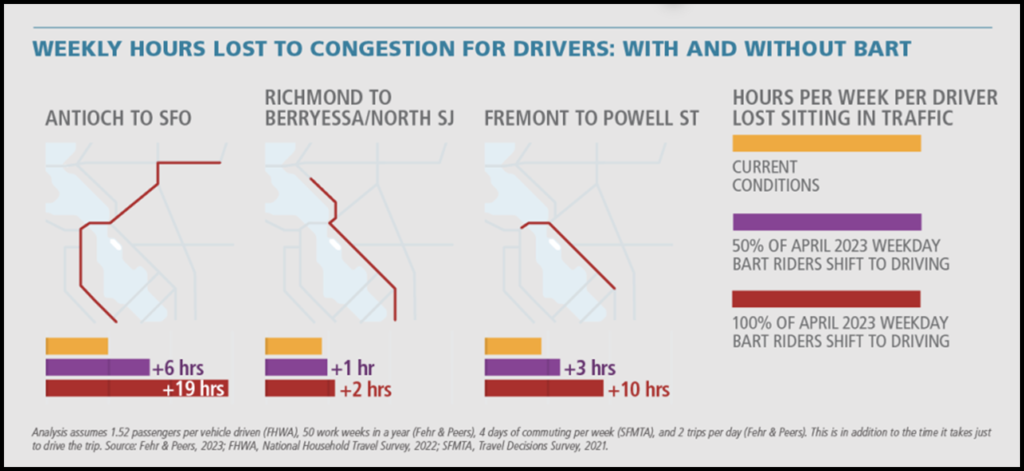
- “Regional traffic congestion would worsen. Example: Drivers could experience up to an additional 19 hours lost to congestion weekly (see Figure 2, above).
- “Traffic could increase by 73% on the Bay Bridge and 22% in the Caldecott Tunnel during morning peak commute hours.
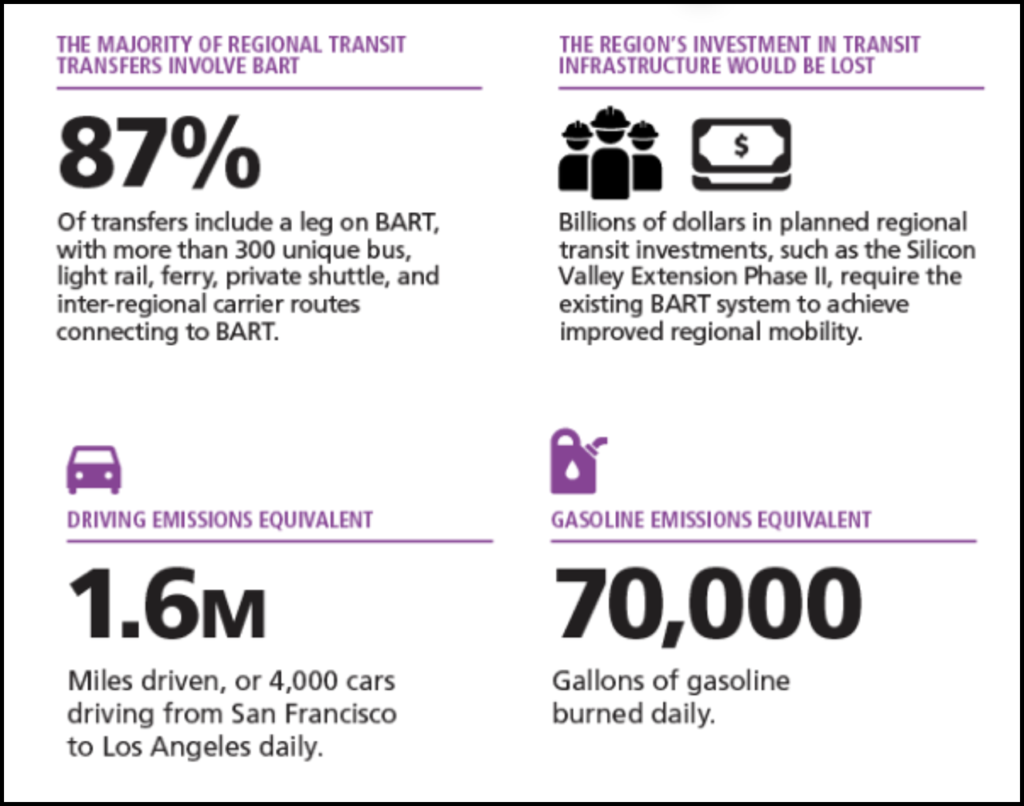
- “The regional transit network would fail to function, and there would be cascading effects across the 300 bus, light rail, ferry, private shuttle, and inter-regional routes that connect to BART (see Figure 3, above).”
BART provided the following information on changing regional travel trends:
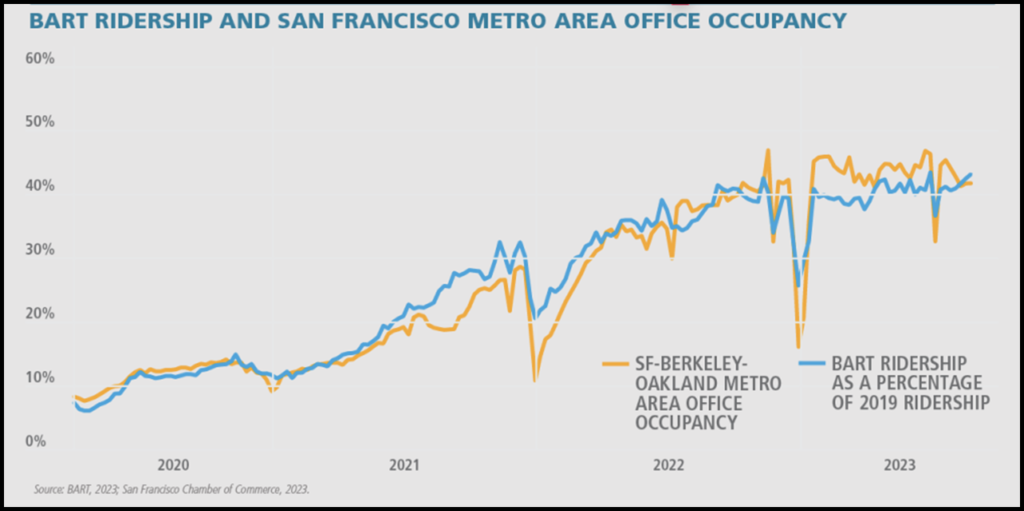
- “BART ridership is closely linked to regional office occupancy rates; both have recovered to approximately 43% of pre-pandemic levels (see Figure 4, above).
- “Because of BART’s decreased farebox recovery, BART expects a budget deficit beginning in 2026 when state and federal emergency assistance runs out.”
The BART Board of Directors on June 13 voted to approve a new two-year budget. While the FY25 operating budget is balanced, the FY26 operating budget faces a $35 million dollar deficit, according to BART. Measures, the agency said, are being taken to reduce the projected deficit, such as containing discretionary expenses. A 5.5% inflation-based fare increase on Jan. 1, 2025, combined with an identical fare increase this past New Year’s Day, is estimated to generate an additional $20 million over the two-year budget term. BART will also defer some operating budget allocations to capital projects.
“We have a number of options still available to address the FY26 operating deficit,” said BART Assistant General Manager for Performance & Budget Pamela Herhold. “We’ll be working with the Board throughout the coming year to chart the best course of action.”
The outlook after FY26 “changes dramatically” as BART is expected to exhaust the remaining emergency federal and state funding. One-time federal emergency assistance of $1.6 billion has allowed BART to sustain operations since 2020, but the last of this funding will be spent in FY25. SB 125 state and regional assistance of $352 million, to be allocated in 2024 and 2025, will also be used to offset operating deficits over the FY25 & FY26 budget period.
In FY27, BART’s first fiscal year without emergency assistance, the deficit is projected to be $385 million, according to the agency. “Since BART’s outdated model of relying on passenger fares to pay most operating costs is no longer feasible, the agency must modernize its funding sources to better match other transit systems throughout the country that receive larger amounts of public funding,” the agency said. “BART needs a more reliable long-term source of operating funding and continues to advocate at the federal, state, and regional levels for the permanent funding needed to sustainably provide the quality transit service the Bay Area needs.”