MBTA
MBTA on Dec. 18 reported that three shortlisted teams have received initial Request for Proposals (RFP) for managing, operating, and maintaining the Commuter Rail system; the current contract with Keolis Commuter Services expires June 30, 2027. MBTA offers 14 commuter lines serving the Greater Boston region and Rhode Island; nearly 90,000 passengers rider on weekday.
The three shortlisted qualified teams are (in alphabetical order):
- Keolis – Alstom JV Partners: a joint venture of Keolis America Inc. and Alstom Transport USA Inc.
- Mass Regional Rail: a consortium of Alternate Concepts Inc., TransitAmerica Services Inc. and RATP Développement S.A.
- A consortium of Transdev North America, Inc. and Transport UK Holdings Limited.
The Commuter Rail system “has achieved many significant milestones following the COVID-19 pandemic,” MBTA said. “Embracing a new and bold approach, schedules across the network were rewritten, shifting to consistent all-day service. The flexibility offered by these new schedules has led to ridership recovery unmatched by most Commuter Rail systems across the country.” The transit agency noted that it is “advancing work to continue to improve service frequency,” including 30-minute headways on the Framingham/Worcester Line; that reliability “continues to be improved” through projects like the upcoming upgrades at North Station; and that safety “continues to be the number one priority,” including through safety enhancements at nearly 300 at-grade crossings across the network.
According to MBTA, the objective is for the next operating partner “to build upon these successes, upgrading the legacy Commuter Rail system to a modernized, high-frequency Regional Rail service.” The contract scope also includes parking operations, as well as delivering and operating Fairmount Line decarbonized battery-electric multiple unit (BEMU) service. “A wide range of redeveloped performance indicators will incentivize excellence in performance, customer service, fare collection, and capital investment while driving continuous improvement,” MBTA added. “The current procurement process is aimed at identifying a partner who can collaborate with the MBTA on delivering this vision.”
MBTA is conducting a two-step procurement process to select the next operator for its Regional Rail Operating Contract. The process began with a Request for Qualifications issued on July 18, 2025. Statements of Qualification were received on Oct. 3, 2025. The second step of this process was issuing the RFP, which was done Dec. 17.
Beginning this month, MBTA said it will engage with each shortlisted team “as part of a competitive dialogue process, ensuring that the final contract will elicit competitive bids and provide value to the Commonwealth.” The bidders, it noted, will also spend this nine-month period conducting due diligence. Final Proposals will be submitted in fall 2026 and MBTA said it aims to select the Preferred Proposer by the end of next year “to allow sufficient time for the new operator to mobilize before taking over responsibility for the service.”
Keolis Commuter Rail has operated the Commuter Rail system since 2014.
Further Reading:
Alto
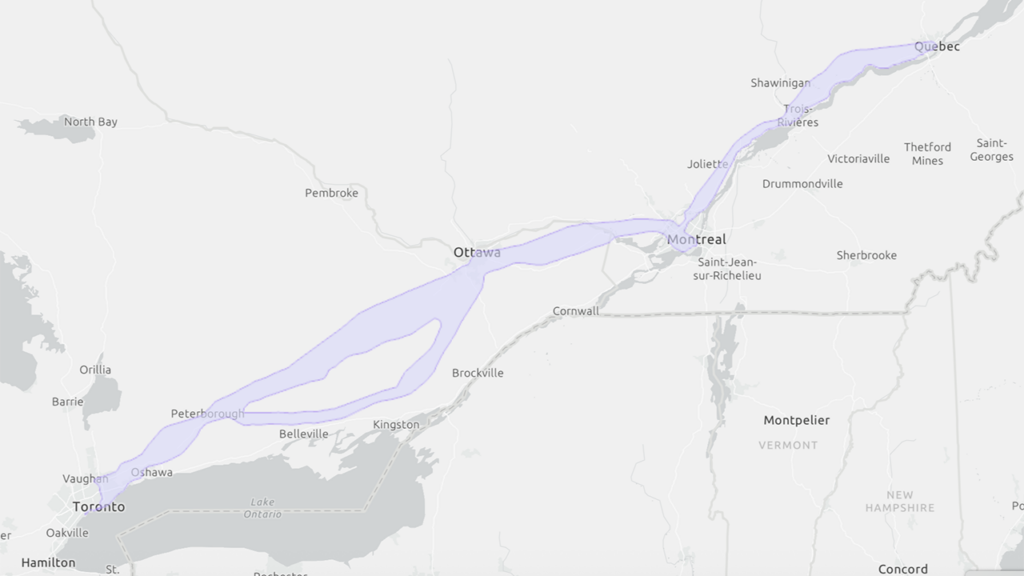
If built, Alto, the planned 621-mile (1,000-kilometer) Toronto-Québec City HSR line, could add 72 trains per day to “Canada’s most densely populated region,” The Canadian Press reported Dec. 19.
The number comes from “[d]raft versions of a 2023 technical briefing” that Canada’s national news agency said it obtained through an access-to-information request. “An Alto spokesperson confirmed the [Crown] corporation still believes 72 trains per day is a ‘reasonable estimate,’” according to The Canadian Press.
“Benoit Bourdeau said Alto’s goal is to have 20 to 30 trains a day in each direction between Toronto and Montreal, compared to roughly eight in each direction currently offered by VIA Rail,” The Canadian Press reported. “He said some will be express trains that will not stop at every station.”
Bourdeau explained that “Current planning aims for frequent departures, generally hourly, with the potential for departure every 30 minutes during peak periods, depending on routes,” and “he cautioned that the 2023 figures are working assumptions, not ‘final service decisions,’” according to The Canadian Press.
“Though many figures are redacted, Alto released portions of the briefing drafts that indicate 72 trains could travel the Quebec City–Toronto corridor each day by 2039,” The Canadian Press reported. VIA Rail, on average, it noted, runs 39 trains per day “along the various legs of the Quebec City–Toronto corridor.”
“A briefing for the prime minister’s office, obtained through a separate access-to-information request, forecasts that there would be 26.5 million annual trips on a high-speed system by 2059,” according to The Canadian Press.
Alto and its private-developer partner Cadence announced in November that they would soon begin outreach to the steel industry in support of the HSR project, whose first segment the government announced earlier this month will run between Ottawa and Montreal.
NYMTA

“With two weeks left in 2025, subway crime is at the lowest level in 16 years: overall major crime in the transit system is down 5.2% from 2024 and 14.4% from 2019,” New York MTA reported Dec. 18. “Accounting for increases in ridership, there have been 1.65 major crimes per million riders in 2025, down roughly 30% from 2021 and comparable to pre-pandemic lows.” The agency noted that 2025 “is on pace to be the second safest non-pandemic year in the subway system in recorded history, eclipsed only by 2009.”
Additionally, felony assaults have decreased in second-half 2025, according to New York MTA; the rate of assault incidents are down 16% from 2024, and in November, assaults were down 25% compared with the same month last year.
At the same time, New York MTA pointed out, subway ridership continues to climb. On Thursday, Dec. 11, the subway broke its post-pandemic ridership record for the third time in two weeks, with 4.654 million riders. So far this year, ridership is up nearly 8%, with more 1.2 billion rides taken to date.
The agency also reported that New York Gov. Kathy Hochul is committing further safety investments in 2026, including an additional $77 million for ”enhanced” New York Police Department subway patrols.
“New Yorkers aren’t just safer on our subways now than they’ve been in years—they’re feeling safer, too,” NYPD Commissioner Jessica Tisch said. “This isn’t by accident, it is the result of our transit safety plan—the precision deployment of cops to the platforms and trains where the majority of crime actually occurs, and the men and women of the NYPD who effectively execute this plan. Major crime is down across the subways, and the last five months combined have been the safest in recorded history on the subway outside of the pandemic years. None of this happens without the support of Gov. Hochul and [New York City] Mayor [Eric] Adams, and this new investment will allow us to continue driving down crime in our transit system.”
“This has been the most consequential year in the history of the MTA for many reasons—surging ridership and customer satisfaction and our historic capital plan, but nothing is more important than safety,” MTA Chair and CEO Janno Lieber said.
Further Reading:
- Watch: NYMTA Launches Railcar Acceptance, Testing Facility
- Kawasaki to Supply 378 More ‘B’ Division Cars to NYCT
- MTA 2025–2029 Capital Plan Gets Greenlight
- MTA: Ridership Up, Fare Evasion Down
CTA

CTA has teamed with the Chicago Police Department (CPD) to develop a new “security surge” plan, the transit agency reported Dec. 18. CPD is increasing the number of sworn law enforcement officers participating in its Voluntary Special Employment Program (VSEP), who are deployed to patrol CTA’s system, from an average of 77 sworn law enforcement officers per day to 120 officers, according to CTA, which operates rapid transit “L” service over approximately 224.1 miles of track, as well as bus service over 127 routes.
Under VSEP, CPD police officers sign up to patrol the CTA on their days off; it is a supplement to CPD’s Public Transportation Section and District police officers. CTA also has VSEP programs for additional police resources with the suburbs of Forest Park, Oak Park, and Evanston.
Private security canine (K-9) staffing will also increase, CTA said, from an average of 172 canine security guards per day to 188 guards.
CTA and CPD will “strategically deploy the added resources based on combined crime data and CTA system information,” which CTA said is “in line with the agencies’ longstanding partnership and daily communication.”
The “security surge” plan is made possible by funding from the CTA’s FY2026 budget.
“CPD and CTA work closely together every day to keep CTA riders safe, and this surge is an extension of that effort,” CPD Superintendent Larry Snelling said. “This initiative builds upon the work that our agencies have done together, like our updated Public Transportation Section Strategic Decision Support Center, which opened earlier this year with CPD Robbery Task Force Detectives embedded inside the room for more streamlined and efficient investigations.”
“CPD officers are at the core of CTA’s multilayered security strategy, and I value our partnership with Superintendent Snelling and his staff as we continue our longstanding commitment to keep our riders safe,” CTA Acting President Nora Leerhsen said. “We expect the additional police and K-9 presence on our system to further increase security visibility.”
Crimes on CTA’s system in November were down 19% from the prior-year period, according to CTA, citing CPD statistics; year-to-date, they are down 3%.
Further Reading:
NJT

NJT, in partnership with the Jon Bon Jovi Soul Foundation, Collaborative Support Programs of New Jersey, and Volunteers of America Delaware Valley, is encouraging riders to give this holiday season through their joint “Chance For Change” program.
Giving is conducted digitally, accessible online and through QR codes available on digital advertising screens, on social media, and on the NJT mobile app. The secure platform, NJT said, allows riders to donate “to a coalition of partners that provide direct assistance to people experiencing homelessness, substance use disorders or with other social service needs.”
The program was launched in summer 2024.
“The holidays are a time when many want to help others, and ‘Chance For Change’ provides NJT customers with a trusted way to contribute right from their phones,” NJT President and CEO Kris Kolluri said. “We’re proud to partner with organizations like the Jon Bon Jovi Soul Foundation, CSPNJ, and Volunteers of America Delaware Valley to make giving more accessible to those riding with us every day.”