LACMTA

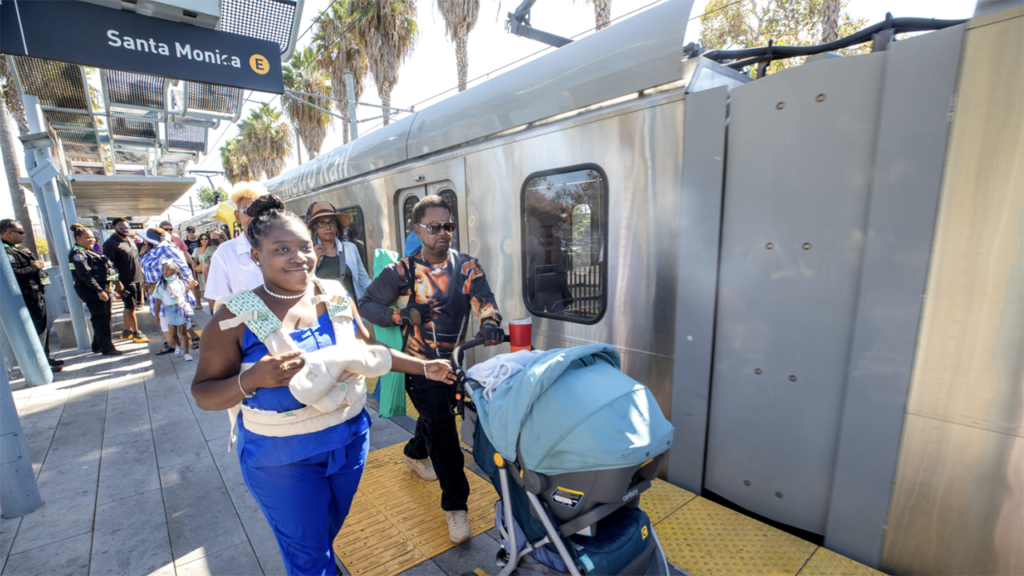
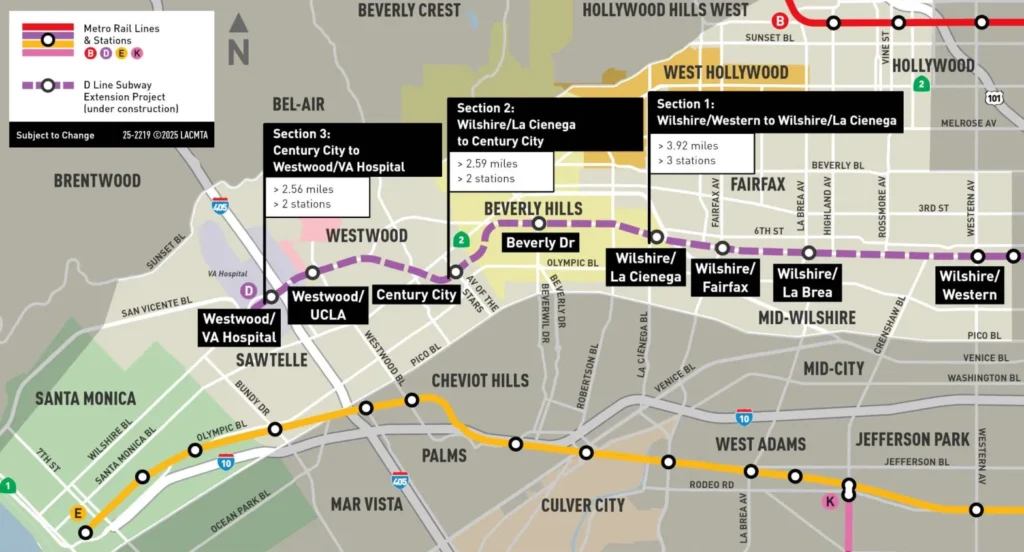
The first section of the D (Purple) Line Extension will open May 8, LACMTA announced Feb. 26 (see map below). Service along the 3.9-mile Section 1 corridor includes three new stations: Wilshire/La Brea and Wilshire/Fairfax—which bookend Los Angeles’ Miracle Mile—and Wilshire/La Cienega in Beverly Hills. Each station will have a landscaped plaza at street level, elevators and escalators, and wide platforms, and are fully ADA accessible, according to the transit authority. There will be bike parking and connections to local bus lines, it noted.
LACMTA added that safety was key to the D Line Extension project. It said the three new stations and the plaza will have “enhanced lighting and have been designed with clear sight lines”; the stations will be staffed by its Metro Ambassadors and Transit Security Officers, and contract law enforcement and Care-Based Division members will also be present; cell phone service will be available in each of the new stations; and the stations will have taller faregates that improve fare compliance.
“With the Santa Monica Freeway and other Westside roads chronically congested, the debut of Section 1 provides immediate benefits to commuters,” LACMTA said. Travel times between Wilshire/La Cienega and Union Station in downtown L.A. will be about 20 minutes with no transfers required. That same trip today typically takes double that time on the bus and D Line, according to the transit authority. Many other transit trips in the D Line corridor will see similar time savings.
While the D Line Extension delivers immediate benefits to current riders, LACMTA noted, it will also make it easier for future riders and visitors to get around, including those coming to Southern California to see the World Cup in 2026, the Super Bowl in 2027, and the Olympic and Paralympic Games in 2028.
According to LACMTA, Sections 2 and 3 of the D Line Extension are currently forecast to launch next year. Section 2 will bring the subway to downtown Beverly Hills and Century City, while Section 3 extends the subway to a station serving Westwood Village (with access to UCLA) and a station next to the West Los Angeles VA Medical Center.
The original D Line opened to Wilshire/Western Station in 1996. Plans to continue the line further west were scuttled due to two big hurdles: the challenge of tunneling through a methane gas zone and bans on local and federal funding due largely to concerns about the agency’s ability to safely build the project, according to LACMTA.
Momentum shifted in the early 2000s, the transit agency noted. First, LACMTA convened tunneling safety experts who determined advances in tunneling made it safe to excavate subway stations and tunnels. Then, in 2008, more than two-thirds of L.A. County voters approved the Measure R sales tax measure to provide local funding for the project. In 2016, 71% of county voters approved the Measure M sales tax measure to accelerate Section 3 of the D Line Extension.
Local funds, in turn, were used to attract $1.25 billion in a New Starts grant from the Federal Transit Administration, $66.4 million in supplemental New Starts funds, and a $749.3 million loan from the federal TIFIA program in 2014.
Separately, the LACMTA Board last month selected rapid transit for the Sepulveda Transit Corridor Project.
SEPTA
SEPTA on Feb. 26 awarded a contract to Korman Communities, Inc. and Benchmark Real Estate, LLC for the long-term ground lease of the 3.4-acre parking lot at Ambler Station along the Lansdale/Doylestown Regional Rail Line.
Under this agreement, the developer will pay SEPTA $402,500 per year with annual increases of 3% for a total contract value estimated to be $236 million over a term of 99 years.
The Korman and Benchmark proposal includes ground floor commercial; high quality open space and stormwater management; commuter and development parking; and multi-family housing with an affordable component (see rendering, top).
The developer will be responsible for all aspects of financing, zoning, permitting, design, construction, and maintenance of the project, and redevelopment of the parking lot is subject to SEPTA’s approval, according to the transit authority.
SEPTA said it is ”building on the success of its Transit Oriented Communities (TOC) Program by pursuing joint development opportunities to secure better returns on its real estate assets.” Dedicated revenue from ground leases and new ridership revenue is projected to grow to $10 million annually within the next decade, it noted.
“SEPTA is committed to strict fiscal discipline and finding innovative ways to generate new revenue streams beyond the farebox,” SEPTA General Manager Scott A. Sauer said. “Building housing and commercial space near our stations will boost ridership and bring economic activity to the communities that SEPTA serves.”
Other SEPTA projects under way are at the Conshohocken, Germantown and Langhorne stations.
In other news, SEPTA on Feb. 24 rolled out its newest CBTC digital signaling system upgrade on the Media–Sharon Hill Line, according to Hitachi Rail, which provided the system that will help modernize one of the last remaining interurban trolley systems in the United States.
Sound Transit
The Sound Transit Board on Feb. 26 formally adopted the 2026–2030 Sustainability Plan (see above). According to Sound Transit, the plan outlines how it “integrates sustainability into every stage of planning, designing, building, and operating,” and the adopted motion “further strengthens these commitments by sunsetting the purchase of fossil fuel-powered revenue vehicles and equipment by 2030.”
The new plan establishes objectives and implementation strategies in the following areas:
- “Advancing equity. Expanding civil rights, equity, and inclusion trainings for employees; increasing fare affordability and access; and providing support and resources for small and disadvantaged businesses.
- “Building sustainable infrastructure and operating resiliently. Building agency resilience to climate change and other natural hazards, ensuring safe and reliable service during power outages, and reducing the environmental impacts and GHG emissions associated with material use and construction.
- “Continuously improving agency governance and business practices. Attracting, developing, and retaining talented employees and contractors; improving safety compliance and reducing the environmental impacts of agency procurements; and strengthening the agency’s sustainability funding portfolio to support long-term goals.
- “Growing ridership and strengthening communities. Advancing community development, strengthening, and formalizing community engagement vision and priorities, and expanding multimodal access to Sound Transit stations.
- “Protecting and restoring the environment. Protecting native habitats and wildlife, reducing environmental impacts from agency facilities, and minimizing surface water impacts on agency-owned and maintained properties.
- “Reducing air pollution and GHG emissions. Reducing emissions across operations, transitioning key fleets to zero-emission technologies by 2030, and achieving zero-emission fleets and facilities by 2050.”
According to Sound Transit, the plan establishes “clear, time-bound, and enforceable climate goals and embeds sustainability across every stage of project delivery and operations.” Additionally, it advances decarbonization by committing the agency to greenhouse gas neutrality for rail and facilities by 2030 and zero-emission operations by 2050, while grounding fleet and infrastructure decisions in cost, reliability, and service performance.
Plan implementation will be overseen by agency leadership and tracked through annual reporting to the Board. Clear performance metrics will measure progress toward agency targets, while ensuring transparency for riders and regional partners, according to Sound Transit.
“The 2026–2030 Sustainability Plan—implemented through our nationally and internationally recognized sustainability program—reflects that vision by defining how we embed sustainability into every aspect of our work as we design, construct, and operate our regional transit system,” wrote Sound Transit CEO Dow Constantine in a letter introducing the plan. “As our system grows to connect more people, it is also shaping how people live, work, and move around the region, and our 2026–2030 Sustainability Plan ensures we will support that progress for generations to come.”
Further Reading:
- Sound Transit Readies for ‘Crosslake Connection’
- Meet Seattle Mayor Katie Wilson, Transit Advocate
- Sound Transit Launches Federal Way LRT Extension
WMATA
The WMATA Board on Feb. 26 voted to approve a major expansion and modernization of the University Pass (U-Pass) program, which is described as an initiative “designed to give more college students affordable, unlimited access to transit while supporting ridership growth and institutional partnerships.”
Approved as part of WMATA’s Strategic Transformation Plan, the expanded program introduces new pricing and participation options that make it easier for colleges and universities to join and for more students, such as part-time, community college, and graduate students, to benefit from accessible transportation.
Since launching as a pilot in 2016 with American University, U-Pass has grown into a regional mobility program serving more than 35,000 students and generating roughly 4.6 million trips in fiscal year 2025.
Regionwide, 43 colleges and universities are eligible to participate, representing a potential reach of about 360,000 students across the National Capital region. The new program changes will be implemented during the fall 2026-2027 school year.
“U-Pass is a win for students, universities and the entire region and another example of continuous improvements for our customers,” WMATA General Manager and CEO Randy Clarke said. “By expanding the program and introducing flexible options, we’re opening the door for more institutions to participate, giving more students affordable, reliable access to transit every day.”
“As the largest non-Federal employers serving over 300,000 students in the region, I am glad that WMATA continues to evolve their U-Pass program to allow more of our universities to participate,” said Andrew Flagel, President and CEO of the Consortium of Universities of the Washington Metropolitan Area.
Separately, WMATA and Kawasaki Rail Car, Inc. earlier this month resolved their 7000-Series railcars disputes.