Transit Briefs: LACMTA, NYMTA, BART, Denver RTD, SEPTA, Alstom
LACMTA
The LACMTA Board on March 26 “unanimously approved a plan that will reshape how residents get around the city,” according to KTLA 5 in Los Angeles, Calif.
The Board selected the San Vicente–Fairfax alignment as the Locally Preferred Alternative (LPA) for the K Line Northern Extension, a 10-mile, 10-station underground extension of the K Line that will run from the E Line north to Hollywood (see map, top). The new rail service will connect with LACMTA’s B, C, D, and E lines, serving six of LA’s busiest bus corridors and improving access to jobs, healthcare, and entertainment (download Fact Sheet below).
“Supporters said the extension will provide direct rail connections to major destinations, including LAX, the Kia Forum and SoFi Stadium,” the media outlet reported. “However, there was some pushback from homeowners concerned about tunneling beneath their neighborhoods.”
LACMTA “has tunneled in a variety of projects throughout Los Angeles County, and many homeowners participated in a tour throughout Los Angeles County of all of the work that Metro has done,” L.A. County Supervisor Lindsey Horvath said, according to KTLA 5. “They continue to do safety studies and additional technical analysis to address the concerns that community members have raised. And, as I said, they will continue to do so in order to address the concerns that the community members have.”
According to the media outlet, construction is slated to begin in 2041, with service starting in the late 2040s.
NYMTA
The New York MTA on March 25 launched an update of its mobile app exclusively for New York City subway and bus riders. With a single tap, the agency said, users can now find real-time subway and bus arrivals close to them and view the real-time position of a train or bus and its estimated time of arrival at all its future destinations, allowing riders to fully plan their trips from start to finish. The new MTA App also features 24/7 live in-app customer support to answer rider questions, as well as direct customers to other MTA services.
Customers can download or update the existing MTA App through the Apple App Store (iOS) or Google Play Store (Android). The app is available in English and Spanish.
According to MTA, the app was developed by an in-house team at a “minimal cost.” The app can be updated and improved regularly, without having to rely on third parties, it added. New features are expected later this year, including OMNY account management ride history.
MTA Chair and CEO Janno Lieber said, “The new app for subway and bus customers is making a play to be another five-star download, just like TrainTime before it. This is what happens when you invest in and empower in-house talent—best-in-class innovation without the Big Tech price tag.”
The new MTA App is said to retain “popular features that frequent users currently rely on, including favorited lines, routes and stops, per-station arrival times for specific trains and buses, improved user location accuracy, and an in-app trip planner.” It will also continue to allow users to book and manage Access-A-Ride trips. The app will not store any user data, including location, according to MTA. It added that MTA Metro-North Railroad and Long Island Rail Road customers will continue to benefit from the TrainTime App where they can buy and use tickets, plan their trips, and track their trains.
Following is a detailed breakdown of the new features in the MTA App:
- Subway Experience. “Access to key information, including real-time subway arrival data, station wayfinding, and transfers have been improved in several ways, delivering an overall faster and easier experience navigating the subway system,” MTA said. “The app features more accurate, higher-frequency updates to subway arrival times and locations; a clearer representation of stations with multiple levels and subway lines; information about service changes affecting individual subway lines at a specific station; markers showing riders where to stand on the platform for boarding as well as exiting; improved labels for subway directions; improved service alert iconography, and live arrival times for subway-to-subway and subway-to-bus transfers.”
- Bus Experience. “The new MTA App strengthens and enhances real-time bus service information, making it the go-to tool for bus riders,” MTA reported. “Features include more accurate, higher-frequency updates to bus arrivals and locations; trip-level views for favorited bus routes; real-time bus location markers; arrival times for all bus routes at a specific stop; improved bus stop iconography for easier navigation, and live arrival times for bus-to-bus and bus-to-subway transfers.”
- Accessibility. “The updated MTA App is focused on providing fast, easy to find accessibility information for both subway and bus riders,” MTA said. “Upgraded features include a new accessibility mode: a version of the subway map that highlights accessible stations, easier-to-find elevator and escalator status, support for screen readers and font scaling, and continued integration with Access-A-Ride, allowing customers to book and manage trips.”
- Planned Service Changes. “The MTA App makes it easy to look up current and future subway and bus service changes for the lines you care about most,” MTA reported. “Customers can select now, tonight, tomorrow or this weekend to look up planned work that may affect their travel.”
- MTA Lost and Found. “The new MTA App has a direct link to the official MTA Lost and Found page, providing subway, bus and commuter rail customers with a quick and efficient way to file a claim for lost property,” MTA noted.
BART
BART on March 25 reported carrying more than a million riders during Super Bowl LX week (Feb. 2-8), the highest ridership week for the transit agency since the pandemic. Thursday, Feb. 5, was also the highest ridership day since the pandemic with 225,832 trips, per BART’s February Ridership Snapshot.
“Preliminary ridership numbers for March are strong,” BART reported. “Over February and into March, Saturday ridership reached 85% of pre-pandemic levels, and March to date is 14% higher compared to the same period a year ago. Tuesday, March 24, is now the third-highest post-pandemic ridership day with more than 221,000 trips.”
According to BART, the February ridership boost was driven largely by fans and visitors traveling to destinations across San Francisco for Super Bowl-related events and celebrations. The strong performance, the agency noted, highlights its “ability to move large crowds quickly and efficiently, connecting the region during moments of peak demand.”
February ridership highlights:
- Total trips: 4.5 million (+13% year-over-year).
- Average weekday ridership: 191,099 (+11% year-over-year).
- Average Saturday: 129,183 (+27% year-over-year).
- Average Sunday: 77,296 (+15% year-over-year).
BART reported that Saturdays “saw particularly impressive growth, reflecting increased demand for events, entertainment, and weekend travel across the region.”
In February, more than 685,000 trips were taken using Tap and Ride, up 7% compared with the previous month, which BART said reflected “continued adoption of contactless payment options that speed up station entry and improve the rider experience.”
BART ridership was also up in January.
Even with continued growth, fare revenue has not returned to pre-pandemic levels and is not enough on its own to fully fund operations, according to BART. “Like transit agencies nationwide, BART faces a structural budget deficit as remote and hybrid work patterns reduce traditional commute trips,” it noted. Read more about BART’s funding deficit here.
Find comprehensive BART ridership reports here and daily ridership numbers here.
Further Reading:
- BART Adopts Alternative Service Plan Outlining Budget-Balancing Details (part of Transit Briefs)
- For Bay Area Transit, a $590MM ‘Fiscal Bridge’
Denver RTD
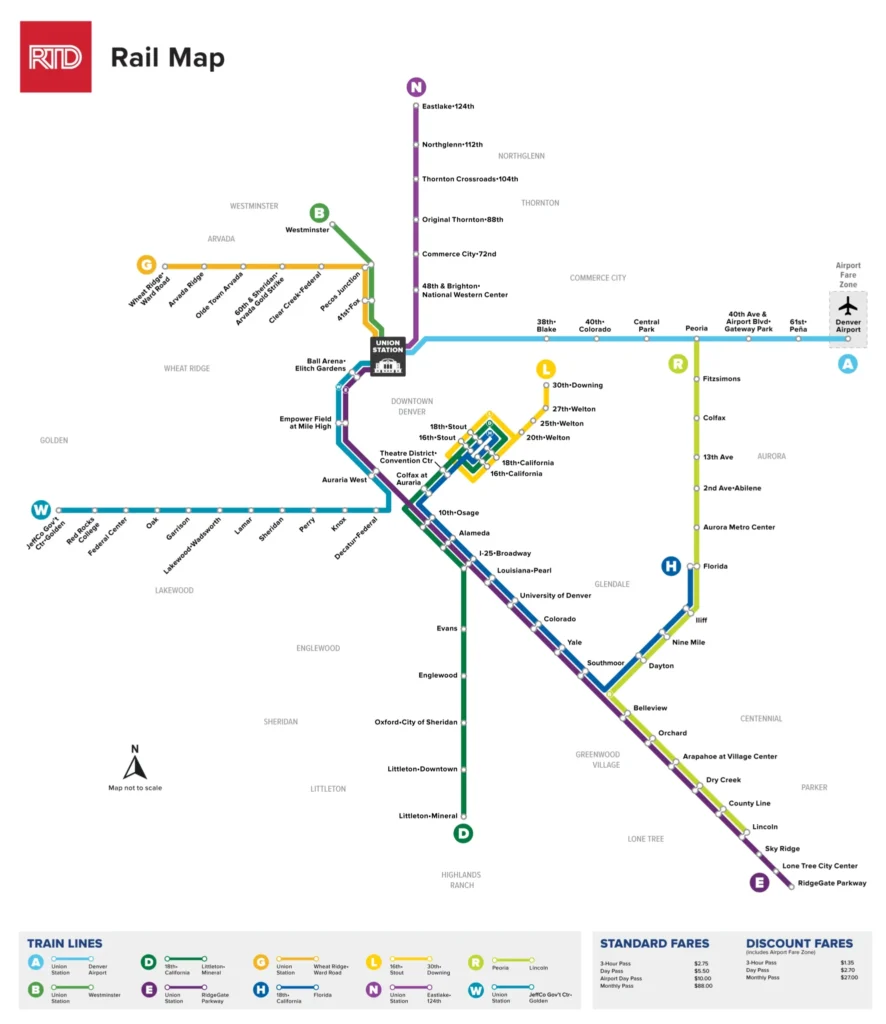
RTD’s preliminary, unaudited 2025 financial results “indicate a 17% year-over-year revenue growth, totaling $1.3 billion revenue,” the agency reported March 26. “RTD’s financial position is strengthened by investment income and continued grant performance contributing to financial progress and disciplined management across the organization.”
Customer boardings “remain stable though reduced from 2019 levels due to enduring fully remote and hybrid work schedules which began in 2020 that impact total boardings and fare revenue,” according to RTD, which provides bus, commuter and light rail, shuttles, ADA paratransit, demand responsive, special event, vanpool, and many other services. However, RTD said its sales and use tax revenue mitigates reliance on fares solely for overall revenue. While RTD said it is “operating at a deficit during a multi-year adjustment cycle,” the agency is “focused on long-term sustainability as a provider of critical transit resources across the service area.”
Chief Financial Officer Kelly Mackey said, “Under the leadership of General Manager and CEO Debra A. Johnson, in partnership with the Board of Directors, staff is addressing the deficit head-on and preparing for the 2027 budget cycle; transparency will remain central to that work.”
RTD’s sales and use tax revenue grew 1.3% to $869 million though $34 million below budget (-4%) due to projected construction starts and permitting that did not materialize for use tax, according to the agency. RTD fare revenue of $61 million decreased 4% year-over-year and was $4 million favorable to budget (7%), it said.
The agency reported a preliminary net position decrease of $227 million, which was a 20% year-over-year improvement and $163 million (42%) better than budget. RTD boardings declined by 0.3% in 2025 compared with the prior year but increased by 4.3% in the second half of 2025 compared with the same timeframe in 2024 “due in part to an update in the A Line ridership counting method,” RTD said.
“Notably, 2025 working capital declined as pandemic-era federal funding was utilized—not only for RTD, but transit agencies nationwide—while operating costs continued to increase,” RTD reported. “Even so, liquidity remains well above pre‑pandemic levels, supporting stability and debt‑service capacity.”
RTD also reported that S&P Global Ratings on March 13 affirmed its “financial strength,” with the agency maintaining its AA+ long-term rating and underlying rating (SPUR) on certificates of participation (COPs) outstanding. “S&P affirmed RTD’s stable outlook, recognizing the agency’s healthy liquidity and manageable debt profile, while highlighting the importance of continued progress in addressing the structural deficit as the agency prepares for the 2027 budget cycle,” RTD said.
On Jan. 15, Fitch Ratings reported that RTD maintained its AA+ rating on RTD’s FasTracks revenue bonds and AA on COPs with stable outlooks across all categories, according to RTD. Similarly, it said, on Dec. 17, 2025, Moody’s affirmed that RTD maintained its ratings of Aa2 on FasTracks revenue bonds and A1 on COPs with a stable outlook.
“The credit rating agencies recognize RTD’s proactive and conservative financial management and policies and RTD’s support from voter-approved sales and use taxes that enable the agency to provide transit services for 3.1 million customers across its 2,345 square-mile service area,” RTD said. “The ratings reflect confidence in RTD’s proactive financial management and recognize the need for its essential role as a transit provider across the Denver metro area.”
Further Reading:
- Denver RTD Launches Comprehensive Operational Analysis (part of Transit Briefs)
- Denver RTD Releases 3Q Financial Results (part of Transit Briefs)
- Denver RTD Increases Rail System Fare Checks (part of Transit Briefs)
- Denver RTD Earns ‘Stable Outlook’ From Three Credit Agencies (part of Transit Briefs)
- Denver RTD Tabs Tran as CPO
- For Denver RTD, FY26 Budget Tops $1.5B
SEPTA
SEPTA is launching a pilot program to deploy digital real-time arrival displays at selected trolley and bus stops, according to the transit agency. The first 10 devices will be installed later this spring.
“The screens, which are solar-powered and use e-paper technology, are unique because they are small enough to be mounted on a bus stop sign pole,” SEPTA said. “Knowing when the next vehicle will arrive was a top priority for many of the 20,000 riders who participated in the comprehensive community engagement efforts for SEPTA’s New Bus Network initiative.” Each device will be equipped with a text-to-speech button, enabling blind and low-vision riders to access the same real-time service information.
The timing of the pilot aligns with the anticipated surge in visitors expected this summer when Philadelphia hosts FIFA World Cup matches, the MLB All-Star Game, and America’s 250th birthday celebration, SEPTA reported.
Pilot locations will be selected based on two key criteria: overall customer impact and geographic equity, ensuring that the benefits of improved real-time information reach riders across all parts of SEPTA’s service area, according to the agency. Bus stops, as well as T, G, D and M Metro stations, will be considered for device locations.
“We are committed to leveraging state-of-the-art, secure technology to modernize the rider experience,” SEPTA Assistant General Manager of Information Technology Elisa Cunningham said. “We will evaluate the results of the pilot to determine future phases of deployment across the network.”
“Every improvement we make to our network starts with listening to our riders,” added SEPTA Chief Officer of Customer Experience and Communications Administration Lex Powers. “This program is one more way that SEPTA is investing in the people who depend on us—today and into the future.”
SEPTA is encouraging riders to share feedback about where they would like to see these devices installed.
Alstom
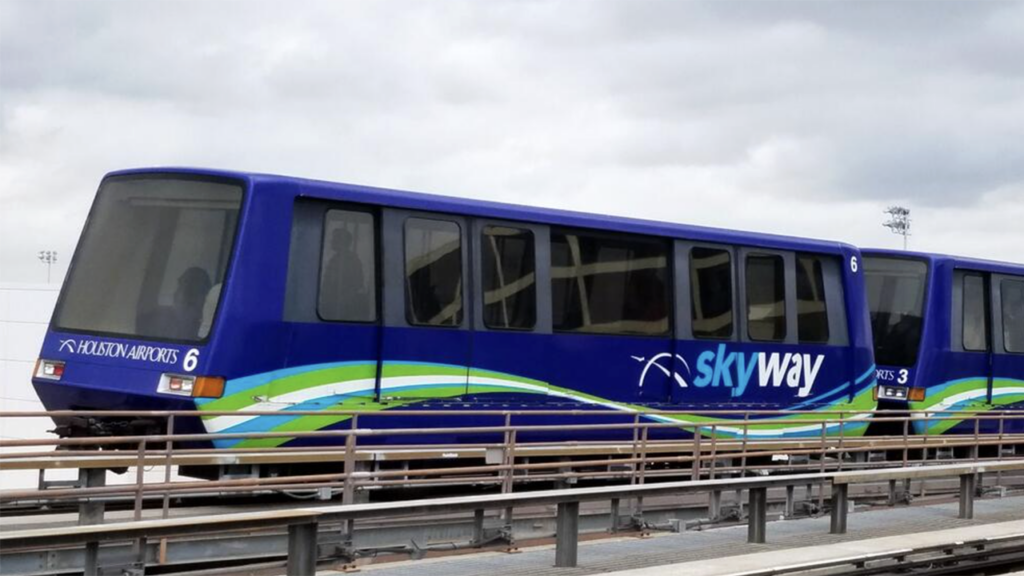
Alstom on March 24 reported being selected by George Bush Intercontinental Airport (IAH) in Houston, Texas, to replace its existing Skyway automated people mover (APM) system and provide operations and maintenance services for 15 years. The contract includes a new Operations Control Center, upgraded Automatic Train Control (Urbalis) and communications systems, 16 new Innovia APM R vehicles, modernized station doors across all terminals, and continued operations and maintenance of the system. The total contract value is approximately $437 million, Alstom said.
Alstom has been operating and maintaining the Skyway APM at Houston’s largest airport for two decades, using the original Innovia APM 100 vehicles built by Bombardier Transportation, which Alstom acquired in 2021. Alstom said it has a dedicated 48‑person operations and maintenance team onsite.
“IAH is undergoing multi‑billion‑dollar expansion to accommodate record‑breaking passenger growth, which topped 48 million passengers last year,” Alstom reported. “The renewed Skyway system will reduce service disruptions, improve passenger flow between terminals, and enhance the overall travel experience. Upgraded digital communications and monitoring systems will increase operational reliability, supporting smoother journeys during peak airport demand.”
Alstom noted that interim busing will be provided when the Skyway is out of service to minimize customer impact.
“Modernizing Houston’s Skyway system is essential to meeting the needs of one of the fastest‑growing airports in the United States,” said Michael Keroullé, President of Alstom Americas. “This next‑generation APM will deliver more reliable, seamless travel for millions of passengers every year. We are proud to continue our long partnership with IAH and to help shape the future of airport mobility together.”
Separately, in March four new Alstom APM vehicles entered service at Tampa International Airport in Florida, and last May Hartsfield-Jackson Atlanta International Airport in Georgia took delivery of the first of 29 APM vehicles from Alstom.
Further Reading:
- Toronto Commuter Operating Contract Extension Signed
- Toronto Orders New Subway Train Fleet
- IAM Alstom Members Ratify First Contract
- Mexico Awards $1B Passenger Fleet Contract
- From Expo 86 to Everyday Essential: SkyTrain Marks 40 Years
- Finch West LRT Opens
- Alstom, CTDOT Unveil Commuter Railcar Mockup
- Montreal REM Segment 2 Launches
- NJT Slates $917MM Multilevel I, II Overhaul