KC Streetcar
Kansas City’s newest streetcar, #814, from vehicle manufacturer CAF USA, Inc. arrived in Kansas City today.
This is the eighth streetcar to arrive to support operation of the Main Street and Riverfront Extensions, ultimately connecting the University of Missouri-Kansas City (UMKC) to Berkley Riverfront. The KC Streetcar vehicles are picking up the numbering where it left off with the 801-806 streetcar series. The new vehicles are numbered 807-814.
CAF, along with Silk Road Transport, delivered KC Streetcar vehicle #814 more than 1,000 miles from Elmira, N.Y. to Kansas City, Mo. Once on-site, the streetcar was offloaded onto the tracks located along 2nd Street just east of Oak Street and transported to the Kite Singleton Vehicle Maintenance Facility located at 600 East 3rd Street. KC Streetcar #814 will undergo shop testing for several weeks before it starts testing on the tracks.
The addition of eight new streetcars, the agency says, is a pivotal step in supporting the expansion of the KC Streetcar system, particularly as it grows beyond its original downtown route to include the Main Street and Riverfront Extensions. “These new vehicles are essential to accommodate the increased demand expected with the expanded service area, ensuring that frequency, reliability, and capacity are maintained even as ridership grows. With both extensions, the streetcar system will connect more neighborhoods, businesses, and cultural destinations, making efficient, sustainable public transit accessible to more Kansas Citians,” the agency noted.
The acceptance of KC Streetcar #814 is especially significant, the agency says, because it marks the culmination of this fleet expansion. As the last new streetcar to arrive in Kansas City, its arrival “symbolizes the readiness of the system to operate at full capacity for the expanded service area. This moment is momentous because it reflects years of planning, investment, and community effort to bring the vision of a larger, more connected streetcar system to fruition,” according to the agency.
“KC Streetcar #814 is not just a new vehicle but a testament to the streetcar system’s growth and a significant step forward for public transportation in Kansas City,” said KC Streetcar Authority Executive Director Tom Gerend. “It represents a moment of transition as Kansas City prepares to embrace an expanded era of modern, accessible, efficient, and fare free public transit.”
In addition to the arrival of #814, KC Streetcar #808 is undergoing “burn-in” testing on the route, a period of trial runs to ensure that all systems function properly before it’s put into passenger service. During this process, the streetcar is operated on the route without passengers, allowing the CAF and KC Streetcar team to evaluate performance, safety, and reliability. Some of the evaluations include monitoring how the streetcar handles real-world scenarios like track conditions, signaling systems, and speed limits and verifying that propulsion, braking, doors, HVAC (heating, ventilation, air conditioning), and electrical systems are working as intended. Only after the streetcar has passed these tests and any issues are resolved is it considered ready for passenger service. The burn-in process helps to identify and correct potential problems before the vehicle is relied upon to carry passengers. In November, KC Streetcar #807 started passenger service.
KC Streetcars #809 – #813 are also performing various tests in the Singleton Yard Vehicle Maintenance Facility and on the streetcar route during services hours and overnight. These tests include checks of the braking systems, interior systems such as vehicle leveling, sensors, door mechanisms, onboard digital signage and announcements, and more. As each new streetcar completes the required testing and becomes certified for service, they will be deployed on the downtown line.
MTC
MTC, the regional transportation planning, financing and coordinating agency for the nine-county San Francisco Bay Area, and Bay Area transit agencies on Dec. 12 at the El Cerrito del Norte Bay Area Rapid Transit (BART) station unveiled new test transit maps and signs “designed to help make transit journeys easier to understand for both existing and new riders by delivering information that is clear, predictable and familiar across service areas and county lines.” A new, comprehensive regional transit map, which will enable riders to discover key destinations they can reach on the Bay Area’s extensive bus, rail and ferry network, also was released.
The event kicked off the start of an evaluation period for the Regional Mapping & Wayfinding project, in which MTC and its transit partners invite Bay Area residents and visitors alike to share their thoughts about the test signs and maps now installed at the El Cerrito del Norte BART station. Several “test” prototype signs and other communication materials also will be installed at the Santa Rosa Transit Mall/Downtown Santa Rosa Sonoma-Marin Area Rail Transit (SMART) station later this month.
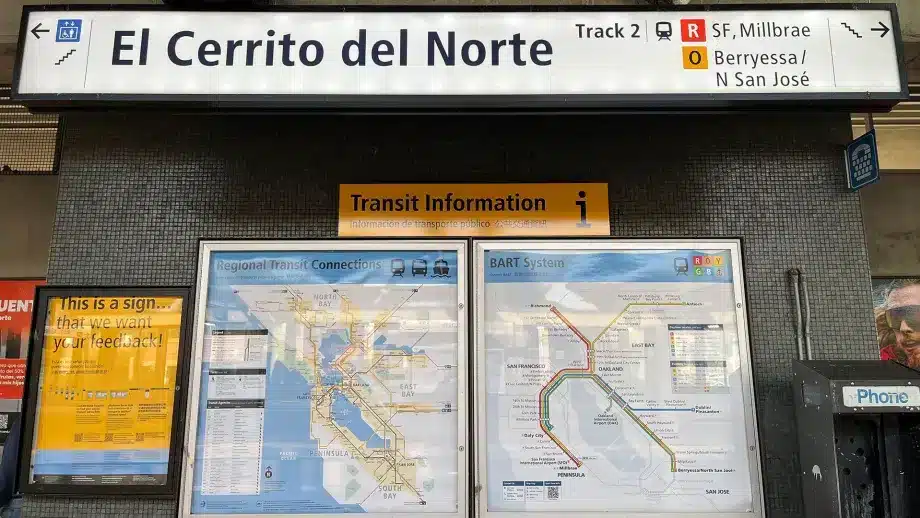
“Transit in the Bay Area and elsewhere is still suffering the effects of the pandemic,” said Sue Noack, Vice Chair of MTC’s Regional Network Management Committee and Pleasant Hill City Councilmember. “But these maps and signs are tangible examples of the work MTC and the transit agencies are doing together to make the Bay Area’s system simpler, easier to use and more affordable.”
Transit riders will be able to engage with the test materials during their journeys and share with MTC their ideas about how to make new signs and maps work better for them. This public feedback will help inform the next stage of the project, in which the new maps and wayfinding materials are expected to be installed at seven additional locations across the Bay Area in 2025 and 2026.
Members of the public who are unable to visit one of the test locations in El Cerrito or Santa Rosa are invited to take an online survey. Full details are available here.
A new, comprehensive regional transit map, which will enable riders to discover key destinations they can reach on the Bay Area’s extensive bus, rail and ferry network, also was released.
The new maps and signs are part of the larger Regional Mapping and Wayfinding initiative aimed at making it easier to ride transit in the Bay Area. Whether a rider is traveling by bus, rail, ferry or a combination, the signs, maps, screens and other communication systems will be consistent and easy to identify across all nine Bay Area counties.
The Regional Mapping and Wayfinding Project is the result of a first-of-its-kind effort—led by MTC with the partnership of transit riders, Bay Area cities and counties, and over two dozen Bay Area transit agencies—to redesign and harmonize maps and signage across all nine Bay Area counties to help people navigate transit more easily. This project, MTC says is just one piece of a broader effort, outlined by the Bay Area Transit Transformation Action Plan, focused on making Bay Area transit easier and more convenient for riders of all ages and abilities to use.
The Regional Network Management Council includes top executives from MTC, the San Francisco Municipal Transportation Agency (SFMTA), BART, AC Transit, the Santa Clara Valley Transportation Authority (VTA), Caltrain, SamTrans and the Golden Gate Bridge, Highway and Transportation District, as well as three general managers representing all other transit agencies serving Bay Area communities.
WMATA
WMATA has released its proposed budget for the next fiscal year that the agency says “optimizes service to meet ridership demand without any major funding increase.”
WMATA is calling for longer weekend hours, targeting service increases on the Red, Silver, and Yellow lines.
“This budget helps serve our customers where it is needed most,” WMATA General Manager and CEO Randy Clarke. “We are proposing several efficiencies that save us money to pay for this additional service.
“While we are able to fund the budget this year, Metro will to need a dedicated source of funding to keep the system viable in the decades to come,” Clark added.
Proposed Metrorail Changes
- Extend half of Yellow Line trains to Greenbelt: Operate the Yellow Line in two patterns at all times, with half of trains operating between Huntington and Greenbelt and half operating between Huntington and Mt Vernon Sq.
- Split Silver Line service between Downtown Largo and New Carrollton: Operate the Silver Line in two service patterns at all times, with half of trains operating between Ashburn and Downtown Largo, and half operating between Ashburn and New Carrollton.
- Silver Line additional peak service: Operate two additional Silver Line trains to provide capacity in the weekday peak hour only. Trains would operate from Wiehle-Reston East to Stadium-Armory in the morning, and from Stadium-Armory to Wiehle-Reston East in the afternoon.
- Red Line additional peak service: Operate Red Line trains up to every 4 minutes, from every 5 minutes, during the busiest portions of weekday rush periods to provide additional capacity in both directions of travel. Red Line trains would continue to operate every 5 minutes during the remainder of peak service.
- Increase Weekend Hours of Operation: Open the rail system one hour earlier on weekend mornings, opening at 6 a.m. on Saturdays and Sundays. Close the rail system one hour later during weekend late nights, closing at 2 a.m. on Fridays and Saturdays.

The FY2026 Proposed Budget includes proposed expansion of service hours on Metrorail and proposed revised Metrobus network as previously approved by the Board. To the extent that these changes increase the service hours or service area, MetroAccess services will, as required by federal law, expand to meet those requirements. Otherwise, the service area and service hours will remain fixed as per existing Board policy, the agency noted.
According to WMATA, fare prices will not change but the ways that customers can pay are expanding.
WMATA is preparing to introduce an Open Payment fare system to Metrorail, Metrobus, and parking facilities during the next calendar year. Open Payment would allow customers to have the option to use their contactless credit/debit card (e.g., Visa, Mastercard, American Express, Discover), mobile wallet, or linked smartwatch for fare payment without the need to use a SmarTrip card. WMATA is planning to implement Open Payment to make the payment experience more “seamless and incentivizing adoption.”
As proposed, Metrorail will be first to receive Open Payment—the ability to pay with a credit/debit card, mobile wallet, or linked smartwatch—in May of 2025, followed by Metrobus by summer 2025 and Metro parking facilities in late fall 2025.
Capital Program
The proposed FY2026 capital budget of $2.4 billion and six-year capital improvement program of $12.5 billion (both including revenue loss and debt service) include investment in ongoing projects, prioritized system preservation and renewal needs and investments “to provide safe and efficient service delivery informed by asset management and reliability plans,” according to WMATA.
Major capital program investments to further improve service and customer experience include:
- Railcars and Rail Facilities: Major vehicle investments include the 8000-series railcar acquisition program. Major facilities and systems investments include rail vehicle scheduled maintenance program (SMP) facility improvements and railyard state of good repair.
- Rail Systems: Major investments include Train Control Room Rehabilitation, Track Circuit Cable Testing and Replacement, Switch Machine Replacement, Rail Power System Rehabilitation, Radio Infrastructure Replacement, Fiber Installation.
- Track and Structures Rehabilitation: Major investments include track rehabilitation and maintenance; tunnel ventilation demonstration and water leak mitigation demonstration on the red line; and bridge and aerial structural rehabilitation.
- Station and Passenger Facilities: Major investments include standpipe systems and tunnel emergency egress; parking garage and surface lot rehabilitation, station entrance canopies, and elevator rehabilitations; digital signage and wayfinding, lighting, and fare payment modernization.
- Operations and Business Support: A modern training facility, computing infrastructure state of good repair; Enterprise Resource Planning (ERP) System Replacement; Asset Management System Upgrade; service vehicle replacement; and environmental compliance.
Between now and February, WMATA staff and the Board of Directors will finalize a budget proposal for the public’s input and comments. The Board of Directors will vote on the proposed budget in 2025, and service changes would go into effect in late June/early July.
Amtrak
Amtrak achieved an all-time ridership record in FY24, welcoming 32.8 million customers as demand for passenger rail service continues to grow in markets across the nation.
Amtrak also invested $4.5 billion into major infrastructure and fleet projects, “creating the largest boom in rail construction in Amtrak’s history, putting thousands of skilled Americans to work and jump-starting American manufacturing,” said Amtrak, adding that the company is “seizing the opportunity of strong customer interest and leveraging investments to improve all aspects of the travel experience.”
Watch Amtrak’s FY24 Year-End Summary video below.