


Caltrain
Caltrain on March 5 reported that its Board of Directors has voted to adopt a new Corridor Right-of-Way Safety Strategy (CROWS).
“Caltrain and its partners have implemented safety improvements at specific locations in response to known risk conditions, operational needs and available funding since the agency’s founding,” the commuter railroad said. “While these investments have delivered meaningful benefits, the corridor continues to face serious challenges including repeated trespassing incidents and vehicle incursions onto the right-of-way, events that can result in death or serious injury, trauma to employees and the public, and significant service disruptions.”
The CROWS Strategy combines education, outreach, enforcement, engineering improvements, and standards/procedure updates, organized around “data-driven risk analysis and national best practices for trespass and suicide prevention,” Caltrain said.
According to the railroad, the strategy includes:
“1. Hazard and Risk Assessments (data-driven prioritization)
- “Update a corridor-wide threat and Vulnerability Assessment (TVA) that explicitly addresses trespass, suicide risk and grade-crossing hazards, incorporating applicable Federal Railroad Administration (FRA) tools and Caltrain data.
- “Update the Grade Crossing Hazard Assessment using FRA accident prediction inputs and local collision/trespass history to support prioritization for separation, closure or improvements.
“2) Enforcement (targeted deterrence and rapid response)
- “Recurring, data-driven enforcement blitzes at high-risk crossings and trespass locations, providing opportunities to educate the public as well as citations for egregious behavior.
- “Coordinated operations with cities and local police to increase presence at peak-risk times.
- “Training and coordination with law enforcement on crisis intervention and rail-specific hazards, including appropriate 988 referral pathways.
- “Expanded data collection and analytics (including heat maps by location/time) to deploy resources effectively and measure results.
- “Potential license plate recognition pilot to deter grade-crossing violations, identify unauthorized vehicles, and support coordinated enforcement with local partners.
“3) Education and Outreach (shared responsibility and safer behavior)
- “A corridor-wide Safety Communications Strategy with consistent messaging: stay off the tracks, follow grade-crossing rules, and increase 988 Suicide & Crisis Lifeline visibility in appropriate locations and formats.
- “Targeted outreach in communities near high-risk crossings and stations (e.g., schools, senior centers, businesses, and service providers).
- “Seasonal and event-based campaigns using earned media, social media and station announcements.
- “Partnerships with organizations such as Operation Lifesaver and local jurisdictions for ongoing joint education and enforcement events.
“4) Engineering and Technology (physical and operational risk reduction)
- “A corridor-wide plan to reduce access to the tracks (barriers, fencing, channelization, and design integration for grade separations and station rebuilds).
- “Pilot and standardize treatments such as anti-trespass panels at high-risk access points.
- “CCTV Master Planning for a unified system across crossings, stations, yards, and high-risk areas, including analytics/intrusion detection and defined monitoring/response protocols.
- “Vegetation management focused on safety sightlines, fire risk, and limiting informal access paths into the ROW.
- “Copper theft mitigation measures to protect critical signal and grade-crossing infrastructure and reduce service impacts.
“5) Standards and Procedure Updates (consistency and accountability)
- “A Grade Crossing Design Standard incorporating current best practices (signage, lighting, channelization, barriers, CCTV expectations, and other treatments).
- “Updated internal controls requiring TVA and hazard assessment use in scoping capital and third-party projects.
- “Enhanced ROW access procedures and strengthened internal reporting systems to improve visibility, tracking, and corrective action.
- “Ongoing transparency through quarterly safety reporting.”
Caltrain said the CROWS Strategy is designed “to standardize and scale effective improvements, in order to accelerate deployment at identified high-risk locations, and strengthen ongoing maintenance and monitoring to ensure safety improvements remain effective over time.” Staff, it noted, are also seeking additional funding to expand “proven measures” to more locations throughout the corridor.
Caltrain said it will continue to provide regular safety reports to the Board and share similar information with employees to support a stronger safety culture and continuous improvement. Reports include both lagging indicators reported to the Federal Railroad Administration (which can reveal hazards after incidents occur), and leading indicators that help identify risk earlier and enable preventive action before incidents happen, according to Caltrain.
“Safety is Caltrain’s core value, and the need to make our right-of-way safer is reflected in everything we do,” Caltrain Executive Director Michelle Bouchard said. “After years of targeted improvements, this strategy establishes a comprehensive approach to reducing risk, strengthening accountability, and delivering the most effective treatments where they are needed most throughout the entire Caltrain corridor to keep the people and communities we serve safe.”
Further Reading:
- Success Story
- For Bay Area Transit, a $590MM ‘Fiscal Bridge’
- Caltrain: ‘Cuts to Come’ Without External Funding
- Caltrain Implementing Asset Monitoring Tech at Crossings
UTA
UTA will transition to the UTA FAREPAY Card as its recommended fare payment method beginning April 12, the transit agency reported this month. The move to more electronic forms of payment is part of the transit agency’s efforts to modernize its fares system and simplify the payment process for riders. The UTA FAREPAY Card is a reloadable card that allows riders to tap the card on the payment validator when getting on and off any UTA vehicle. FAREPAY Cards are available at UTA customer service locations, online, and at participating retailers.
The UTA FAREPAY Card tracks customer rides on UTA and automatically applies daily and weekly fare capping to ensure riders always pay the lowest possible fare, according to the transit agency. The more customers ride, the more they save with UTA fare capping. The transition to FAREPAY Cards is the latest step in UTA’s Fare Payment System Upgrades project to improve and simplify the fare payment process. This project includes the installation of new ticket vending machines, new tap on/tap off validators, and upgraded online fare payment tools. UTA’s fare system modernization program will continue throughout 2026 with the launch of debit and credit card payment capabilities later in the year, UTA said.
UTA said its Reduced Fare customers are encouraged to visit UTA customer service locations to obtain a free FAREPAY Card, while supplies lasts.
“This change is another step forward as UTA works to modernize and improve the customer experience,” said Jay Fox, UTA Executive Director. “As we standardize and streamline our fare payment system, customers see further savings and convenience through fare capping, automatic transfers, and easy ways to reload their FAREPAY Card.”
UTA in 2023 selected Scheidt & Bachmann Inc. to implement its “next generation” fare collection system.
Separately, professional services firm STV was recently selected to support UTA’s FrontRunner 2X Project.
Amtrak
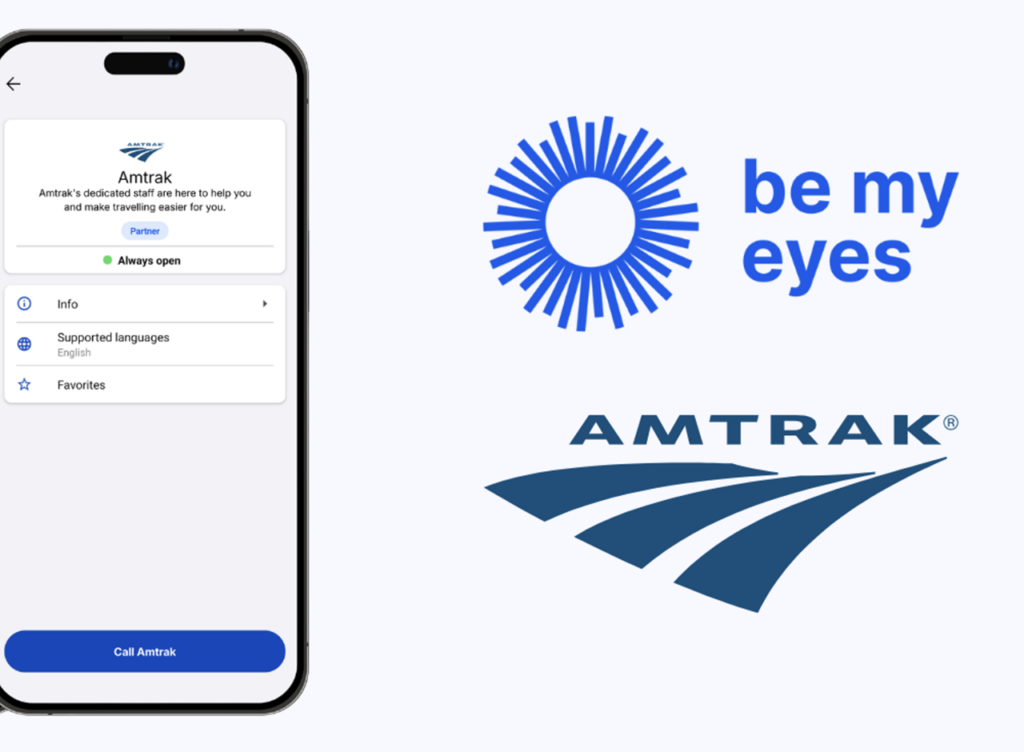
Be My Eyes and Amtrak last August launched a pilot to make it easier for blind and low vision travelers to navigate train stations in real time. According to Be My Eyes, its app allowed riders “to connect instantly with trained visual interpreters” who could help with such tasks as:
- Finding the correct track or gate.
- Reading departure boards and signage.
- Navigating large or unfamiliar stations.
Users downloaded the app from the App Store and Google Play, selected the Service Directory, navigated to Travel and Transportation, and chose the Amtrak support profile. They then connected live with an Amtrak agent for assistance “on the go,” according to Be My Eyes.
“The service helped reduce stress, supported independent travel, and proved its value in real-world journeys,” Be My Eyes reported late last month. As a result, it said, Amtrak has decided to expand the program to 50 train stations across the United States.
Live visual support is now available at stations including:
Albany-Rensselaer, NY; Alexandria, VA (ALX); Austin, TX; Bakersfield, CA; Baltimore, MD (BAL); Boston, MA – Back Bay (BBY); Boston, MA – South Station (BOS); Buffalo (Exchange Street Station), NY; BWI Marshall Airport, MD (BWI); Charlotte, NC; Chicago (Union Station), IL; Denver (Union Station), CO; Emeryville, CA; Eugene (Amtrak), OR; Fredericksburg, VA; Fresno, CA; Greensboro, NC; Harrisburg, PA; Indianapolis, IN; Kansas City (Union Station), MO; Los Angeles, CA; Martinez, CA; Metropark, NJ (MET); Milwaukee (Downtown), WI; Moynihan Train Hall + NY Penn Station (NYP); New Carrollton, MD; New Haven, CT (NHV); Newark, NJ – Penn Station (NWK); Oakland (Jack London Square), CA; Philadelphia, PA (PHL); Pittsburgh (Union Station), PA; Portland (Union Station), OR; Providence, RI (PVD); Raleigh, NC; Richmond, VA – Staples Mill Road (RVR); Rochester (Louise M. Slaughter Station), NY; Route 128, MA (RTE); Sacramento, CA; San Diego (Downtown), CA; San Jose, CA; Seattle (King Street Station), WA; Springfield, IL; Springfield, MA; St. Louis, MO; Stamford, CT (STM); Stockton (San Joaquin Street Station), CA; Trenton, NJ; Vancouver, WA; Washington, DC (WAS); Wilmington, DE (WIL).
“For blind and low vision passengers, accessibility isn’t optional—it’s essential,” said Bryan Bashin, Vice President of Be My Eyes. “Seeing this partnership grow from a pilot into a nationwide expansion shows what’s possible when accessibility is built into the travel experience.”
“Very excited to expand Amtrak’s partnership with Be My Eyes bringing this live visual interpretation service to 50 stations across the route network nationwide,” noted Anna Brophy, Program Manager for Amtrak Digital Technology-Real Estate in a LinkedIn post. “I am incredibly proud of the team’s hard work to make this happen. Part of our Beyond Compliance program, this will help blind and low vision passengers with in station navigation and real time assistance. An excellent use of adaptive technology!”




